How vintage variation impacts wine investment value
- Vintage in wine refers to the year the grapes were harvested, not the year of release.
- A vintage wine is a biological time capsule of that year’s specific weather patterns.
- For investors, vintage quality is a key driver of secondary market value and longevity.
In the world of fine wine, a vintage is much more than a date on a label; it is a record of a single growing season. Wine, in many ways, is bottled history.
For a wine to carry a vintage date, the grapes must have been harvested in that specific year, although regional regulations allow for some flexibility in the exact percentages used. Unlike non-vintage wines such as NV Champagne or Sherry, which rely on blending across multiple years to maintain a consistent house style, vintage wines embrace variation.
For the investor, this variation is what creates a market. A 1982 Château Lafite Rothschild is a fundamentally different financial and sensory asset to a 1983, despite being produced from the same vineyards, by the same team, in the same winery, only a year apart.
Beyond a great vintage
In fine wine investment, a great vintage is certainly an advantage, but it cannot be the only consideration. A 100-point “vintage of the century” may sound like a guaranteed success, yet price is often the factor that ultimately determines investment performance.
Chateau Lafite Rothschild 2013 is a textbook example of this dynamic. Produced during a challenging growing season and criticised by some commentators as “lightweight”, the wine was released at comparatively modest prices. But when the Bordeaux market began to recover in 2015, that low entry point became its greatest strength. The wine did not need to be legendary to succeed as an asset; it simply needed to be Lafite Rothschild.
While the heavily hyped and aggressively priced 2010s struggled to justify their release valuations, the 2013 quietly outperformed expectations. Between 2015 and 2018, values doubled, and by the market peak in 2022, prices had risen by around 180% on the secondary market.
For the savvy investor, this highlights that a weaker vintage bought at the right price can often prove a far better investment than a perfect vintage bought at the wrong one.
How time influences vintage quality
While it is rare for the broader consensus around an entire vintage to dramatically change over time, opinions on individual wines often do. In fine wine, time is arguably the single most important ingredient in any portfolio.
Unlike most consumer goods, which begin to depreciate the moment they are purchased, investment-grade wine is a living asset that evolves in bottle. This is one of the qualities that makes fine wine such a unique alternative asset class. With age, wines can gain complexity, harmony and character, sometimes transforming dramatically from their youthful state.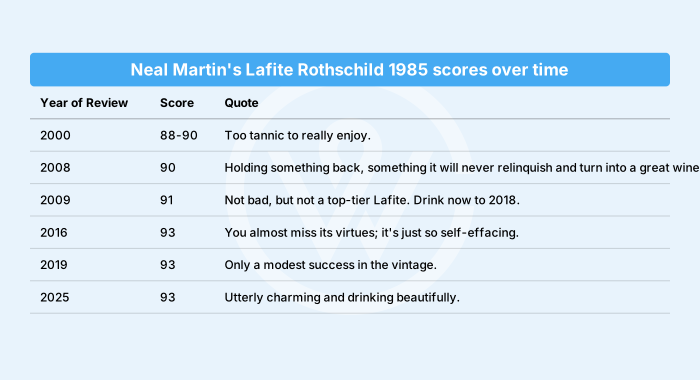
The evolution of Chateau Lafite Rothschild 1985 provides a compelling example. Neal Martin’s scores for the wine improved significantly over time, illustrating how a wine that may initially appear restrained or underwhelming can reveal extraordinary quality with sufficient bottle age.
It is entirely possible for a wine to disappoint in its youth yet become exceptional decades later. Vintage matters, but it is not everything. In fine wine, patience is often rewarded, and few assets benefit from time quite like wine does.
How regionality impacts vintage variation
Vintage quality is rarely uniform across the wine world. A “vintage of the century” in Bordeaux does not necessarily translate to Tuscany, the Mosel or Napa Valley. Each region responds differently to the conditions of a growing season, shaped by its climate, geography and grape varieties.
For investors, this regional variation creates opportunity as well as diversification. A difficult, rain-affected year in Bordeaux may coincide with an outstanding vintage in Champagne or Piedmont. Understanding these regional differences allows WineCap to build more resilient portfolios, reducing reliance on the fortunes of any single region or vintage.
Technology and vintage quality
Modern technology and greater precision in the vineyard and winery have also transformed what constitutes an “off-vintage”. Today, even challenging years can produce impressive wines thanks to significant advances in viticulture and winemaking.
Optical sorting tables, for example, allow estates to remove underripe or damaged grapes with extraordinary accuracy, ensuring only the best fruit reaches the vat. Drones and satellite mapping provide detailed insights into vineyard health and how vines are responding to the pressures of the growing season. Meanwhile, smaller and more numerous fermentation vats allow winemakers to vinify individual parcels separately, giving them far greater control when constructing the final blend. Grapes affected by heat stress or uneven ripening can therefore be handled more gently and precisely.
A talented winemaker cannot transform a poor year into a mythical 100-point vintage, but they can dramatically raise the floor of quality. As a result, modern “off-vintages” are often significantly better than their equivalents from the 1970s or 1980s. For collectors and drinkers alike, this can create compelling value, even if the long-term investment upside may be more limited.
Natural factors that shape a vintage
Despite all the advances in technology and winemaking, wine remains fundamentally an agricultural product, shaped by the whims of weather and climate. Ultimately, it is nature that determines whether a vintage will be remembered as great, average or forgettable.
Many leading critics and winemakers have attempted to define the ingredients of a great vintage. Among the clearest explanations are those offered by Antonio Galloni of Vinous and Denis Dubourdieu, the renowned Bordeaux consultant and Professor of Oenology at the University of Bordeaux. Their analysis highlights several recurring themes that consistently underpin the world’s greatest vintages:
1. Budburst and flowering
A great vintage is won or lost during the growing season, which typically lasts from April to October in the Northern Hemisphere. The process begins with budburst, where the vine wakes up from winter dormancy.
If a vintage is to be legendary, it requires:
- A steady progression without major shocks.
- No frost during budburst as this can kill potential fruit.
- Dry enough weather during flowering (the “fruit set”) as rain can cause uneven development.
- A seamless transition from flowering to veraison (when grapes change colour and soften) and finally to the harvest.
2. Sunshine and heat
Sugar accumulation in grapes requires consistent sunlight. Regions measure this through “Growing Degree Days” (GDD), a sum of the daily temperatures above a certain threshold.
A great vintage typically features a warm, but not scorching, summer. Excessive heat can cause the vines to shut down to conserve water, leading to cooked flavours and high alcohol. Conversely, a cool year may result in underripe tannins. The Goldilocks vintage provides just enough heat to ripen the fruit while maintaining elegance.
3. Diurnal range
One of the most overlooked factors in a top-tier vintage is the diurnal temperature shift, the difference between the daytime high and the nighttime low.
Warm days build sugars and fruit intensity, but cool nights are essential to preserve natural acidity. Without these cool nights, the grapes “breathe away” their acidity, losing the structure they need for long-term ageing. Legendary years are almost always defined by significant diurnal shifts.
4. Water stress
Vines actually produce higher quality grapes when they are slightly stressed. If a vine has too much water, it focuses on growing leaves rather than ripening fruit, leading to diluted flavours.
A great vintage usually features a dry late summer. This signals to the vine that it must put all its energy into the grapes to ensure the survival of its seeds.
However, extreme drought is just as unwelcome as too much rain. The best vintages are those where there is just enough moisture to keep the vine alive while forcing it to struggle.
5. Phenolic ripeness vs sugar ripeness
A good wine grape is much more than a sweet juicy sugar bomb. True quality is also determined by phenolic ripeness, the maturity of the skins, seeds, and stems that go into the vat.
In a great year, phenolic ripeness keeps pace with sugar ripeness. This ensures that the tannins are sweet and silky rather than bitter and astringent. If the weather is too hot, sugar levels can spike before the tannins are ready, leading to an unbalanced wine that feels hot from alcohol but green on the finish.
6. The harvest window
The final two weeks before harvest are the most critical in the entire year. A vintage that looks perfect in August can be ruined by a single hailstorm or a week of heavy rain in September.
Rain just before harvest causes the grapes to swell with water, diluting the flavour and potentially causing the skins to burst, leading to rot (botrytis). A “classic” vintage is often defined by an Indian summer: dry, warm weather in late autumn that allows winemakers to pick the fruit at the right moment without rushing to beat a storm.
What vintages are the best investment
From an investment standpoint, the best vintages carry a Halo Effect. A legendary year like 1982 in Bordeaux or 2010 in Piedmont creates a tide that lifts all boats; even lesser-known estates will see their prices rise because of the vintage reputation.
Investors should look for:
- A balance between quality and prices: A great vintage is likely to be more costly than a poor one, but if other historic releases are better priced then buyers should beware.
- Longevity: A great vintage provides the structural bones that allow a wine to appreciate over a longer period.
- Critical acclaim: Years that receive high aggregate scores from major critics are often beneficiaries of better liquidity as well as higher prices.
Ultimately, vintage is one of the most powerful forces in the fine wine market, but it should never be viewed in isolation. Great investing is not simply about chasing the highest-scoring years; it is about understanding the relationship between quality, price, longevity, regional dynamics and timing. A legendary vintage can create extraordinary returns, but so can an overlooked year released at the right price and given time to mature.
FAQ: Vintage variation
Does a more expensive wine always mean a better vintage?
Not necessarily. A famous estate in a poor vintage will still be expensive due to brand power, but it may have less investment upside than a rising-star estate in a legendary vintage.
Can a wine be “too ripe”?
Yes. In very hot vintages, wines can lose their varietal character and acidity, becoming heavy and lacking the finesse that collectors look for.
What is a “late harvest” vintage?
This usually refers to years where cool weather delayed ripening, often resulting in wines with higher acidity and more delicate, floral aromatics. It can also refer to a specific style of sweet wine.
How does climate change affect vintages?
It is making great vintages more frequent in historically cool regions like Burgundy and Germany, but it is also increasing the risk of extreme weather events like frost and heatwaves.
WineCap’s independent market analysis helps investors build diversified fine wine portfolios with full ownership and transparent pricing. Speak to one of our wine investment experts and start building your portfolio. Schedule your free consultation today.
Capital at risk. Past performance is not a guide to future returns. Returns are not guaranteed.