The history of Italian wine and its rise as a fine wine investment
- The history of Italian wine spans three millennia, with over 500 indigenous grape varieties, making it the world’s most diverse viticultural landscape.
- The transition from mass-produced bulk wine to world-class investment assets was driven by the Super Tuscan movement and the formalisation of the DOCG system.
- Italian fine wine has become a vital diversifier in wine investment portfolios, offering low volatility and high liquidity.
The history of Italian wine is a story of innovation, regulation and regional identity, culminating in the emergence of some of the world’s most sought-after wines.
For centuries, Italy’s viticultural landscape was defined by production volume rather than prestige, but today it stands as a cornerstone of the fine wine secondary market. From the bureaucratic foundations laid by the Roman Empire to the creation of the DOC and DOCG systems, each stage of this evolution has shaped the investment landscape that exists today. For collectors and investors, understanding this transformation provides essential context for why leading labels from Tuscany and Piedmont have become prized assets, valued for their global demand, liquidity and long-term stability.
The early Roman influence
Long before the unification of the Italian state, the peninsula was renowned for its viticultural abundance. The ancient Greeks referred to Southern Italy as Enotria, the “Land of Wine”, reflecting a culture where vines were integrated into every aspect of daily life from simple sustenance to religious ritual.
It was the Romans though who transformed winemaking from a domestic craft into a bureaucratic industry. While the Greeks provided earlier agricultural observations, the Romans were the first to produce truly extensive technical manuals. Writers such as Columella and Cato the Elder documented precise instructions on soil selection, vine density, and fermentation. These records represent the first systematic Western codification of winemaking integrating wine into the Roman state’s extensive economic machine. They documented every technical variable:
- The exact ratios of additives, such as seawater or honey, used to stabilise lower-grade wines.
- Specific yields expected from different types of trellising and pruning.
- Classifications based on quality, which directly informed military rations and imperial taxation.
This bureaucratic rigour established a legacy of regulation that eventually evolved into the modern DOC system. As well as developing vine training systems, identifying the best wine producing regions and exporting large volumes of wine across the empire, it proved that quality could be managed and tracked, turning a volatile biological product into a reliable, taxable asset for the Roman state.
From Empire to the Age of Enlightenment
Following the fall of Rome, the Church became the primary steward of Italian viticulture. Monastic orders maintained vineyards across Italy focusing on consistent production for both sacramental use and local trade and in the process preserving grape varieties, vineyards and above all knowledge of viticultural practice.
By the early 18th century wine was a major source of tax revenue across Italian principalities, not least to the ailing Medici family who had noted that Tuscany was suffering from counterfeiting and fraud with lesser producers labelling inferior wine as Chianti.
This prompted a pivotal moment in the history of wine when in 1716 Grand Duke Cosimo III de’ Medici issued a decree defining the official boundaries for four wine-producing areas in Tuscany. It was the earliest legal precedent for protecting a wine’s geographic origin and reputation.
The 1716 decree had two direct objectives
- Geographic definition: He wanted to legally define exactly where “Chianti” and other top wines could be grown. This established the four historic zones: Chianti, Pomino, Carmignano, and Val d’Arno di Sopra.
- Quality assurance: The decree was paired with the creation of a “Congregation” (a primitive regulatory body) to oversee the production and sale of these wines. The goal was to ensure that wine leaving Tuscany met a certain standard, protecting the long-term trust of foreign buyers.
The Italian bulk wine crisis
The early twentieth century was difficult for the Italian wine trade. While a wave of immigration to the United States from the late 19th century onwards was a critical part of that country’s wine story, two World Wars and the arrival of the phylloxera pest decimated the Italian wine landscape. Following the Second World War, the focus shifted toward high-yield, mass-market production and economic recovery.
This era was defined by the ubiquitous straw-covered bottles of Chianti (known ironically as Fiascos) found in every formica tabled Italian restaurant across the United Kingdom as late as the 1980s and 1990s. These wines were often of dubious quality and diluted the international reputation of Italian viticulture. Although exceptions existed, only a small portion of wine was even bottled by its producer and the vast majority of postwar Italian wine could be generously described as “rustic”. The market came to view Italy as a source of cheap, everyday table wine rather than an investment-grade prospect.
Characteristics of the bulk era:
- Priority given to quantity over quality and terroir.
- The dominance of large cooperatives that blended grapes from multiple regions.
- Lack of stringent quality controls or ageing requirements.
- A global perception of Italy as a secondary player to France.
The 1960s quality revolution
Against this background, in the 1960s, the Italian government decided to embark on a monumental task of regulating wine production, creating hundreds of defined wines under the Denominazione di Origine Controllata (DOC).
This process was inspired by France’s appellation controlee system which had done so much over the previous 50 years to improve the baseline quality and international reputation of French wine. The system was later strengthened by the introduction of the DOCG category. The “G” stands for Garantita, representing the highest tier of quality: these laws mandated strict limits on yields, specific grape percentages, and mandatory bottle ageing.
The hierarchy of Italian wine from top to bottom went as follows:
- DOCG: The pinnacle of quality with the strictest production standards.
- DOC: Regional designations focused on traditional methods and varieties.
- IGT: A flexible category that allows for creative blending outside of old rules.
- Vino da Tavola: Basic table wine with minimal regulatory oversight.
DOC and DOCG classifications were active from 1963 and performed admirably but like all bureaucracy were not without flaws. The rigidity of the rules fossilised practices both good and bad especially around overly generous yields; raising the floor for Italian wine also seemed to implement a ceiling.
It took less than a decade for the insurgency to start.
The Super Tuscan rebellion and Sassicaia
The rules brought in during the 1960s were stifling. Not only were yields overly generous but they also specified the proportion of different grape varieties that could be used, forcing Chianti producers to use at least 10% of local white grape varieties. Anyone who wanted to make a 100% Sangiovese, experiment with French grape varieties or do anything that wasn’t on the prescribed list was out of luck.
The Super Tuscan movement
A fair number of wines claim to be the first “Super Tuscan” but most would agree that Sassicaia is the originator. Intended initially for it to be for his own consumption, Marchese Mario Incisa della Rocchetta’ entirely ignored the DOCG rulebook by planting Cabernet Sauvignon at his Tenuta San Guido estate on the Italian coast in Bolgheri, southwest of Florence.
The vines for Sassicaia were first planted in the 1940s, but only five years after the DOCG rules came into force the decision was made to make commercial release. The first vintage to be sold came to market in 1971, and wore its “Vino de Tavola” designation with pride.
It is no exaggeration to describe this as “year one” for modern Italian wine. In the years that followed, dozens of winemakers broke away from the DOC/DOCG regulations, with the mission to make higher quality wine.
The success of many of these wines can be seen in revisions to the DOC rules that have brought a number of them back into the fold of Chianti or Bolgheri. In 1992, a new law was passed to restructure the system and deal with many of the unintended negative consequences of the 1963 laws. Sassicaia’s impact was such that in 1994 it was granted its own DOC, making it the only single vineyard DOC in Italy. Others such as Fontodi’s Flacianello della Pieve remain classified as IGT (Indicazione Geografica Tipica) wines to this day.
By the early 2000s, Italy’s reputation among oenophiles had improved substantially. Already in the 2001 World Atlas of Wine, Jancis Robinson declared that Italy was no longer playing second fiddle to France.
The Barolo Wars: Modernists vs. Traditionalists
While the 1980s saw a revolution reshape Tuscany, Piedmont underwent its own transformation through what became known as the Barolo Wars.
At the heart of the debate was a clash between tradition and modernity. Traditional producers favoured extended macerations and ageing in large, neutral Slavonian oak casks, producing structured, age-worthy wines that often required many years in bottle before revealing their full potential.
A new generation of winemakers, later dubbed the Barolo Boys, sought to create wines that were more approachable in their youth while retaining Nebbiolo’s distinctive character. They introduced shorter macerations, temperature-controlled fermentation, rotary fermenters, green harvesting and ageing in smaller French oak barriques. These techniques produced softer tannins, greater fruit expression and a style that quickly attracted international attention.
Many of the producers who led this movement remain among Barolo’s most celebrated names today, including:
- Elio Altare: The spiritual leader of the modernists.
- Paolo Scavino: Early adopter of rotofermenters for softer tannins.
- Luciano Sandrone: Known for the “Cannubi Boschis” bottling which earned 100 points.
- Domenico Clerico: Champion of high-quality vineyard sites in Monforte d’Alba.
While other great names such as Bartolo Mascarell, Bruno Giacosa and Giacomo Conterno remained conspicuously traditional, this conflict has eventually led to a middle ground where even the most steadfast producers employ some of the newer techniques to blend modern precision with traditional soul.
Brunello di Montalcino: The Tuscan Powerhouse
While Chianti was working to redefine its identity, the hilltop town of Montalcino was quietly establishing a reputation for producing some of Italy’s most age-worthy wines.
The region’s modern history is closely tied to Ferruccio Biondi-Santi, who is credited with identifying and championing a particular biotype of Sangiovese, known locally as Sangiovese Grosso or Brunello. The resulting wines displayed remarkable concentration, structure and longevity, setting a new benchmark for quality in Tuscany.
Brunello di Montalcino gained significant international recognition during the 1980s and 1990s, particularly in the United States, where demand for powerful, cellar-worthy wines was growing rapidly. Strict production regulations, including lengthy ageing requirements before release, reinforced its reputation as a serious collector’s wine.
Today, Brunello remains one of Italy’s most respected fine wine categories. Leading producers such as Biondi-Santi, Soldera, Case Basse and Poggio di Sotto continue to attract strong demand from collectors, while the region’s combination of prestige, scarcity and ageing potential has helped underpin its long-term appeal within the fine wine market.
The wealth of indigenous varieties
Italy’s greatest strength lies in its extraordinary viticultural diversity. While many of the world’s leading wine regions are built around a relatively small number of international grape varieties, Italy is home to more than 500 officially recognised indigenous varieties, reflecting centuries of local adaptation and winemaking tradition.
For investors and collectors, however, the fine wine market remains concentrated around a handful of regions and grapes. Nebbiolo in Piedmont and Sangiovese in Tuscany underpin many of Italy’s most sought-after wines, while international varieties such as Cabernet Sauvignon, Merlot and Cabernet Franc continue to play an important role in the Super Tuscan category.
Beyond these established names, a number of indigenous varieties are attracting growing attention. Aglianico, often referred to as the “Barolo of the South”, produces structured, long-lived wines in regions such as Campania and Basilicata. Meanwhile, Nerello Mascalese, cultivated on the slopes of Mount Etna, has emerged as one of Italy’s most exciting varieties, prized for its elegance, transparency and volcanic character. While these wines have yet to achieve the liquidity or market depth of Barolo, Brunello or the leading Super Tuscans, they represent an increasingly important part of Italy’s evolving fine wine landscape.
Key Indigenous Grapes for Collectors
- Nebbiolo – The noble grape behind Barolo and Barbaresco, renowned for its longevity and ability to express terroir.
- Sangiovese – Tuscany’s defining variety and the foundation of Brunello di Montalcino, Chianti Classico and many of the region’s finest wines.
- Corvina – The principal grape of Amarone della Valpolicella, producing rich, powerful wines with impressive ageing potential.
- Nerello Mascalese – Sicily’s flagship fine wine grape, responsible for the elegant and increasingly sought-after wines of Mount Etna.
The Prosecco explosion
Following the quality-driven revolutions in Tuscany and Piedmont, the next major chapter in Italian wine’s evolution was defined by commercial success on a global scale.
Although Prosecco’s history stretches back centuries, it was not until the late 1990s and early 2000s that exports accelerated dramatically. Offering an approachable and affordable sparkling wine style, Prosecco succeeded in reaching a broad international audience, achieving a level of mainstream recognition that few sparkling wine categories outside Champagne had previously attained.
A pivotal moment came in 2009 with the reorganisation of the region’s appellation system. The creation of the Prosecco DOC, alongside the elevation of Conegliano Valdobbiadene and Asolo to DOCG status, strengthened geographical protections for the category and formally established Glera as the grape variety’s official name. These changes helped safeguard the identity of Prosecco as demand continued to rise.
By the 2010s, Prosecco had become one of the most successful wine categories in the world, with global sales volumes surpassing Champagne. Its accessibility, consistency and versatility transformed it from a regional Italian speciality into a fixture of the international wine market.
From an investment perspective, Prosecco occupies a very different position to Italy’s leading fine wines. It lacks the scarcity, ageing potential and secondary-market demand that underpin investment-grade status. Nevertheless, its importance to the Italian wine industry cannot be overstated.
As Italy’s largest wine export category by volume, Prosecco has played a central role in expanding the country’s global reach and strengthening consumer awareness of Italian wine. For many drinkers, it serves as an introduction to Italian wine culture, creating familiarity with Italian regions, producers and appellations. While collectors may ultimately gravitate towards Barolo, Brunello or the leading Super Tuscans, Prosecco has helped ensure that Italy remains one of the most visible and influential wine-producing nations in the world.
The modern Italian wine investment market
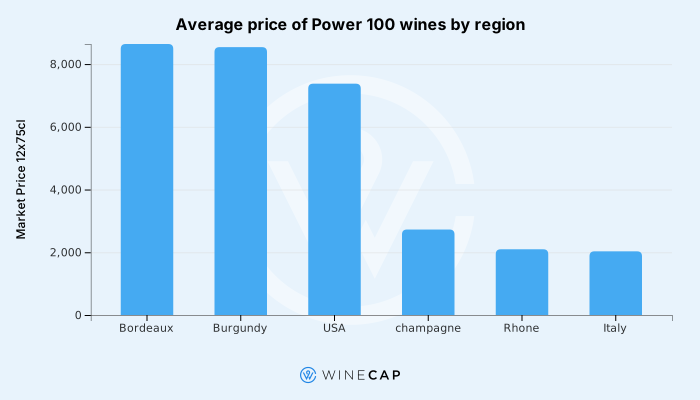
Over the past 15 years, Italy has moved from a specialist interest to a core part of the fine wine secondary market. As trade has become less concentrated around Bordeaux, Italian wines – and Tuscany in particular – have been among the clearest beneficiaries.
During periods of volatility in Bordeaux or Burgundy, Italian wines have often provided a measure of stability, supported by strong brand recognition, consistent global demand and relative value.
This has been particularly evident since the market peak in 2022. While Bordeaux, Burgundy and Champagne have all experienced price corrections, many Tuscan wines have held up comparatively well. At the same time, Italy continues to offer conspicuous value when set against other major fine wine regions, particularly Burgundy, where pricing remains elevated despite recent declines.
Reasons for Italy’s market strength:
- Lower correlation to traditional markets compared to Bordeaux.
- Excellent price-to-quality ratios for high-scoring vintages.
- Deep historical roots that provide long-term brand stability.
- Expanding global demand, particularly in the US and Asian markets.
Italy’s journey from the vineyards of the Roman Empire to today’s fine wine trading platforms has been defined by a constant tension between tradition and innovation. Whether through the regulatory foundations laid by Cosimo III, the quality revolution of the DOCG system, the rebellious spirit of the Super Tuscans, or the global success of Prosecco, each chapter has contributed to the country’s remarkable transformation.
Understanding this history explains why Italy now occupies such an important place in the fine wine market. Combining world-renowned brands, exceptional regional diversity, strong global demand and relative value, Italian wine has evolved from a source of everyday table wine into one of the most compelling categories for long-term collectors and investors.
FAQ: Italian wine history
Which Italian wines are considered investment grade?
The Italian fine wine market is dominated by a relatively small group of prestigious regions and producers. The most widely traded investment-grade wines come from Barolo and Barbaresco in Piedmont, Brunello di Montalcino in Tuscany, and the leading Super Tuscan estates of Bolgheri. Iconic names such as Sassicaia, Ornellaia, Masseto, Giacomo Conterno, Bruno Giacosa and Biondi-Santi are particularly sought after due to their global demand, limited production and strong track record on the secondary market.
What is the difference between DOC and DOCG?
DOC (Denominazione di Origine Controllata) and DOCG (Denominazione di Origine Controllata e Garantita) are Italy’s two highest wine classifications. Both establish rules governing grape varieties, production methods and geographic origin. DOCG represents the highest tier and generally imposes stricter regulations, including lower permitted yields, longer ageing requirements in some regions and additional quality controls. DOCG wines must also pass a tasting evaluation before release, helping to safeguard the reputation of Italy’s most prestigious appellations.
Why did Super Tuscans start as table wines?
The first Super Tuscans were classified as simple table wines because they did not comply with the DOC regulations of the time. Many producers chose to use international grape varieties such as Cabernet Sauvignon and Merlot, while others wanted to make 100% Sangiovese wines outside the prescribed rules. Although these wines often exceeded the quality of many classified wines, they were forced to carry the lowly Vino da Tavola designation until Italian wine laws were modernised in the 1990s.
How long can top Italian wines age?
Italy’s finest wines are among the most age-worthy in the world. Top Barolo and Brunello di Montalcino wines can often age for 30 to 50 years, while exceptional bottles from leading producers may continue to evolve for even longer. Over time, youthful fruit flavours give way to more complex aromas of dried flowers, leather, tobacco, truffle and spice. Proper storage conditions are essential to maximise a wine’s ageing potential.
Why is Prosecco cheaper than Champagne?
Prosecco is typically less expensive than Champagne because it is produced using the Charmat Method, in which secondary fermentation takes place in large pressurised stainless-steel tanks rather than individual bottles. This approach is faster and less labour-intensive than the traditional method used in Champagne. In addition, Prosecco vineyards generally have lower land costs and higher production volumes, allowing producers to offer quality sparkling wine at a more accessible price point.
WineCap’s independent market analysis helps investors build diversified fine wine portfolios with full ownership and transparent pricing. Speak to one of our wine investment experts and start building your portfolio. Schedule your free consultation today.
Capital at risk. Past performance is not a guide to future returns. Returns are not guaranteed.