Understanding the fine wine secondary market: Investing, liquidity and valuation
- While the primary market is the initial sale from the estate, the secondary market is the global trading ecosystem where wine is treated as a financial asset.
- Secondary market prices are dictated by supply/demand – as bottles are consumed, the rarity of the remaining vintage drives exponential value growth.
- Secondary market success relies heavily on professional storage and documented history to ensure investment-grade quality.
For centuries, fine wine has been seen as a treasured collectible; over the last twenty years, it has started to be recognised as a sophisticated alternative asset class too. To understand how wine functions as an investment, one must grasp the mechanics of its lifecycle – specifically the transition from the primary market to the secondary market.
This guide provides an in-depth exploration of the fine wine ecosystem, offering clarity for collectors, investors, and enthusiasts looking to navigate the complexities of global wine trading.
What is the primary market for fine wine?
Before diving into the secondary market, we must define its origin. The primary market refers to the first time a bottle of wine is sold after production. In this stage, the transaction occurs directly between the producer (the winery or estate) and the first buyer who could be an individual or a business (i.e. wine merchant).
Key characteristics of the primary market:
- Direct sourcing: The wine moves from the cellar of the estate to a distributor, importer, or La Place de Bordeaux courtier.
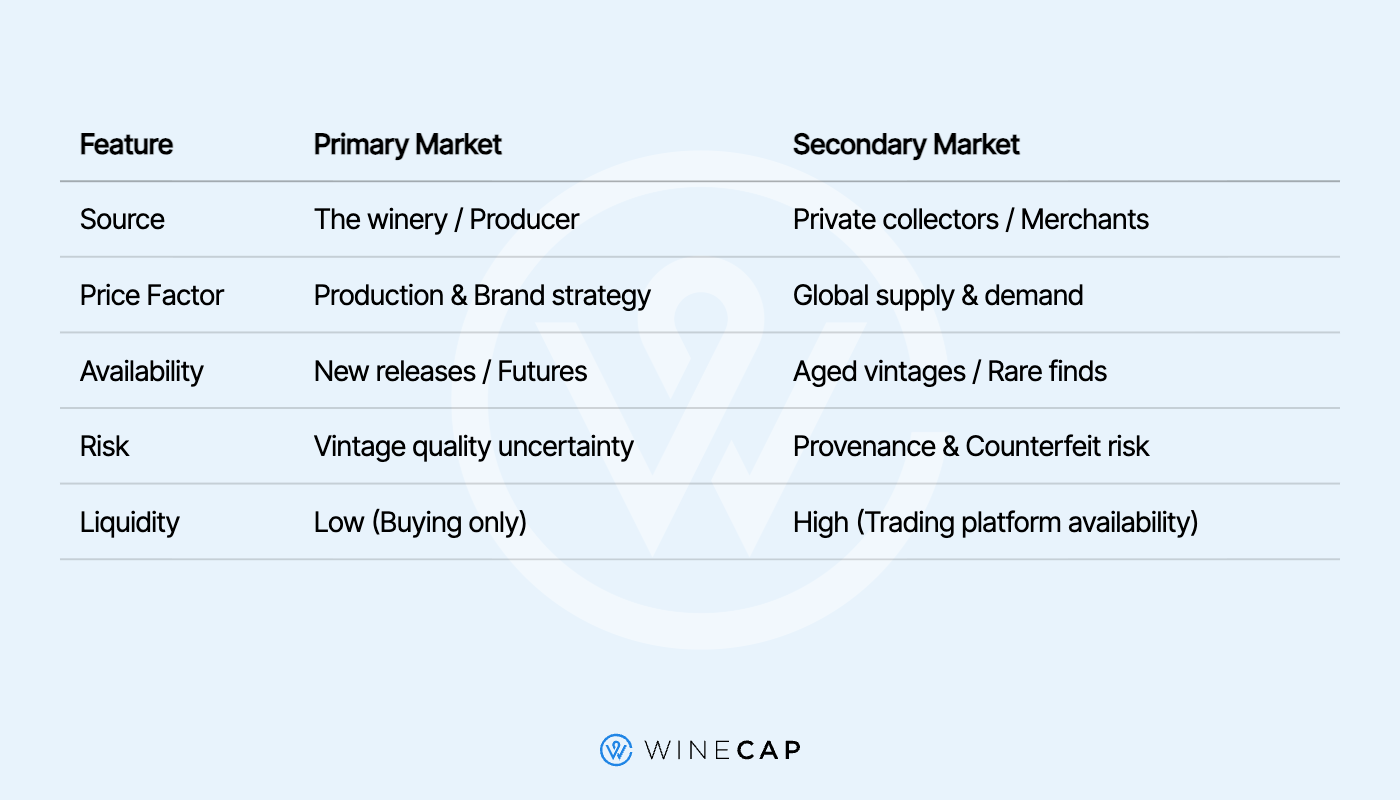
- Fixed pricing: Prices are typically set by the estate based on production costs, brand equity, and vintage quality.
- En Primeur (Wine Futures): A hallmark of the primary market, particularly in Bordeaux. Investors purchase wine while it is still aging in barrels, often 12-18 months before bottling. This offers the lowest possible entry price but carries the risk of the wine evolving differently than expected.
- Allocation systems: For “cult” wines (like Domaine de la Romanée-Conti or Screaming Eagle), primary market access is restricted to exclusive mailing lists or long-standing restaurant partners.
What is the secondary market for fine wine?
The secondary market encompasses all subsequent transactions of a wine after its initial sale in the primary market. Once a bottle leaves the original distribution chain and enters the hands of a private collector, an investment firm, or a specialised retailer, any future sale happens on the secondary market.
Unlike the primary market, where supply is controlled by the winery, the secondary market is driven by supply and demand. As bottles are consumed over time, the remaining supply of a specific vintage diminishes, often driving prices upward – a concept known as “inverse supply elasticity.”
Why the secondary market matters
The secondary market is where “wine” becomes “liquid gold.” It provides:
- Liquidity: A platform for collectors to exit their positions and convert wine into cash.
- Price discovery: Real-time valuation based on what global buyers are actually willing to pay.
- Vintage depth: Access to aged, “library” wines that are no longer available from the producer.
The core components of the secondary market
1. Wine exchanges
The London International Vintners Exchange (Liv-ex) is the “stock exchange” for wine. It provides a standardised platform for merchants to trade, offering price transparency and indices (like the Liv-ex Bordeaux 500) that track market health.
2. Auction houses
Global powerhouses like Sotheby’s, Christie’s, and Zachys dominate the high-end secondary market. Auctions are the primary venue for rare collections and “unicorn” bottles. Online auction platforms have recently democratised this space, allowing smaller collectors to participate.
3. Specialised brokers and investment platforms
Modern fintech platforms allow investors to buy managed portfolios. These entities operate almost entirely within the secondary market, sourcing back vintages with proven provenance.
4. Peer-to-peer and retail re-sales
Specialty retailers often buy back well-cellared collections from private individuals to resell them to other collectors.
Key drivers of secondary market value
What makes a bottle appreciate in the secondary market? It is not just the name on the label.
Provenance and storage
In the secondary market, provenance is everything. A bottle of 1982 Château Lafite Rothschild is worthless if it was stored in a warm kitchen. Buyers look for “ex-cellar” history or professional storage records (bonded warehouses) to ensure the wine has been kept at a constant 12-14°C (55°F) with optimal humidity.
Critic scores
Ratings from “palate-makers” like Robert Parker’s Wine Advocate, Antonio Galloni (Vinous), or Jancis Robinson act as market catalysts. A 100-point score can cause an overnight price surge on the secondary market.
Scarcity and rarity
The secondary market thrives on scarcity. If a producer only makes 500 cases of a particular cuvée, and 200 are consumed in the first five years, the remaining 300 bottles become significantly more valuable to collectors seeking a complete vertical.
Bonded warehouses and “In-Bond” trading
In the secondary market, how you store your wine is as important as the wine itself. Professional investors almost exclusively trade wine “In-Bond” (IB).
In-Bond (IB) vs. Duty Paid (DP)
- In-Bond (IB): The wine is stored in a government-approved bonded warehouse. It has not yet attracted VAT or Excise Duty. If you sell the wine while it is still “in bond,” you never have to pay these taxes. This increases the profit margin for investors and ensures the wine has never left a temperature-controlled environment.
- Duty Paid (DP): Taxes have been paid, and the wine has likely been delivered to a private home. In the secondary market, Duty Paid wine often sells at a discount because its storage history is harder to verify.
Expert tip: For maximum resale value, always keep your investment-grade wine “under bond” in a recognized facility like London City Bond.
Secondary fine wine market global trade hubs
While London remains the historical heart of the wine trade, the secondary market has shifted toward a tri-polar model:
- London: The center for technical trading and storage.
- Hong Kong: The tax-free gateway to the thirsty Asian market.
- Singapore: A growing hub for Southeast Asian high-net-worth individuals.
The “laggard” phenomenon
Fine wine is often described as a “laggard” asset. It does not react instantly to stock market crashes. Usually, there is a 6-to-12-month delay before wine prices reflect broader macroeconomic shifts. This makes it a powerful hedge against inflation and sudden equity volatility.
Secondary market trends: Beyond Bordeaux
Historically, the secondary market was 95% Bordeaux. Today, the landscape is much more diverse:
- Burgundy: Now represents a massive share of market value due to extreme scarcity and global prestige.
- Italy: The rise of “Super Tuscans” (Sassicaia, Tignanello) and Barolo has created a robust secondary niche.
- Champagne: Recently one of the top-performing sectors, as collectors realize the aging potential of prestige cuvées.
- The New World: Cult Californians (Harlan Estate) and Australian icons (Penfolds Grange) are now staples of global trading.
Risks in the secondary market
Investing in the secondary market is not without peril:
- Counterfeits: High prices attract fraud. Verification of labels, corks, and glass is essential.
- Market volatility: Like any asset, wine prices can fluctuate based on global economic conditions.
- Illiquidity: While more liquid than it used to be, selling a wine collection still typically takes longer than selling a stock.
Primary vs. Secondary Market Comparison
Frequently asked questions (FAQ)
Is fine wine a good investment?
Fine wine has historically shown low correlation with traditional stock markets, making it an excellent diversifier. It often delivers steady long-term capital appreciation, though it requires patience and proper storage.
What is a “bonded warehouse”?
A bonded warehouse is a tax-secured facility where wine is stored without the owner having to pay Duty or VAT. This is the preferred storage method for the secondary market, as it guarantees professional conditions and makes the wine easier to resell.
How do I check the secondary market price of my wine?
Platforms like Wine-Searcher provide market data. Specialised wine investment companies can provide valuations. Auction hammer prices are also a reliable indicator of current value.
Can individuals sell wine on the secondary market?
Yes, but it is regulated. Most individuals sell through auction houses or brokers who take a commission. Selling directly to another individual often requires specific licensing depending on your jurisdiction.
What is the best way to enter the secondary market?
Most investors start by using a managed platform or a specialised broker. This ensures you are buying wine with perfect provenance and professional storage already in place.
Why do prices fluctuate so much?
Secondary market prices react to critic scores, weather events affecting future crops, and shifts in global currency (the USD/GBP exchange rate is particularly influential).
Can I sell a single bottle?
While possible through online auctions, the secondary market is most liquid for full original wooden cases (OWC). Single bottles often face steeper commissions and lower demand.
WineCap’s independent market analysis helps investors build diversified fine wine portfolios with full ownership and transparent pricing. Speak to one of our wine investment experts and start building your portfolio. Schedule your free consultation today.
Capital at risk. Past performance is not a guide to future returns. Returns are not guaranteed.