White Burgundy explained: Appellations, producers and ageing
- White Burgundy is dry white wine from the Bourgogne region of France, almost exclusively Chardonnay.
- The region’s whites span four sub-regions, from Chablis in the north to the Maconnais in the south, with sharply different styles and price levels.
- Ageing potential runs from two years at regional level to over three decades at Grand Cru.
White Burgundy is the dry white wine of France’s Bourgogne region, made almost entirely from Chardonnay and named after the place it comes from rather than the grape in the bottle. It is also the region’s main business: white wine accounts for 61% of Bourgogne production by volume, against 27% for red and rose (BIVB, 2024). This guide covers the grape, the four sub-regions, the classification tiers, the producers who define the category, and how long the wines actually last.
What is white Burgundy?
White Burgundy is any dry white wine produced within the delimited Bourgogne appellations of eastern France, running roughly 230 kilometres from Chablis in the north to the Maconnais in the south. Labels carry the name of a place, not a grape, which is the single biggest source of confusion for anyone new to the category. A bottle marked Meursault, Chablis or Puligny-Montrachet is Chardonnay, but the label will not say so.
Geology defines the style as much as winemaking does. Burgundy sits on a band of Jurassic limestone and marl, and that soil, combined with a cool continental climate, gives Chardonnay higher acidity and more mineral definition than the same grape grown in warmer places.
Chardonnay is the grape, with three exceptions
Chardonnay accounts for 57% of plantings across Bourgogne, ahead of Pinot Noir at 34% (BIVB). It is behind every well-known white appellation in the region, from Petit Chablis to Le Montrachet. Three exceptions explain labels that otherwise look out of place:
- Aligote, at 6% of plantings, is Burgundy’s second white grape. It appears as Bourgogne Aligote at regional level and as Bouzeron in the Cote Chalonnaise, the only village appellation dedicated to it.
- Sauvignon Blanc is permitted in Saint-Bris, near Chablis, Burgundy’s only Sauvignon appellation.
- Cremant de Bourgogne, the region’s traditional-method sparkling wine, accounts for 12% of production (BIVB, 2024).
How Burgundy classifies its white wines
Burgundy classifies wine by vineyard rather than by producer, and the hierarchy is geographical and permanent. A plot carries its classification for good, which is why one producer can offer wines at four tiers from vineyards a few hundred metres apart.
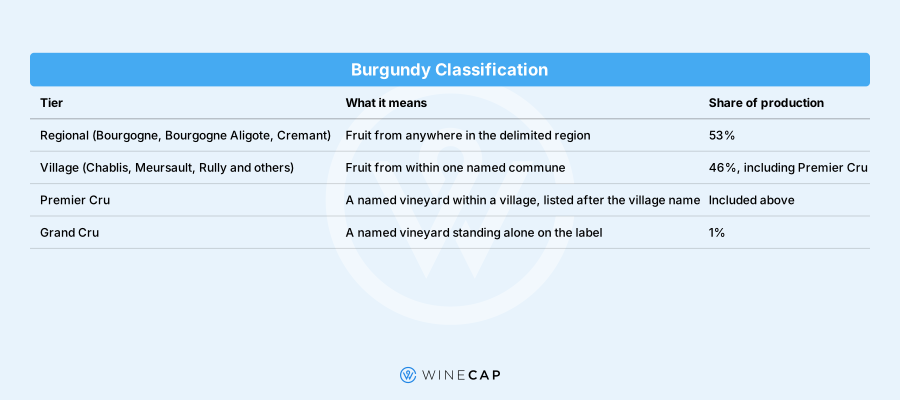
Source: BIVB, September 2024, five-year average 2019 to 2023.
The white wine regions of Burgundy, north to south
Burgundy’s whites come from four distinct areas, and the differences between them are larger than newcomers expect. Chablis sits closer to Champagne than to Beaune and makes taut, mineral wine with little oak.
The Cote de Beaune in the middle produces the richest and most expensive whites in the world.
The Cote Chalonnaise and Maconnais further south offer rounder, earlier-drinking wine at a fraction of the cost.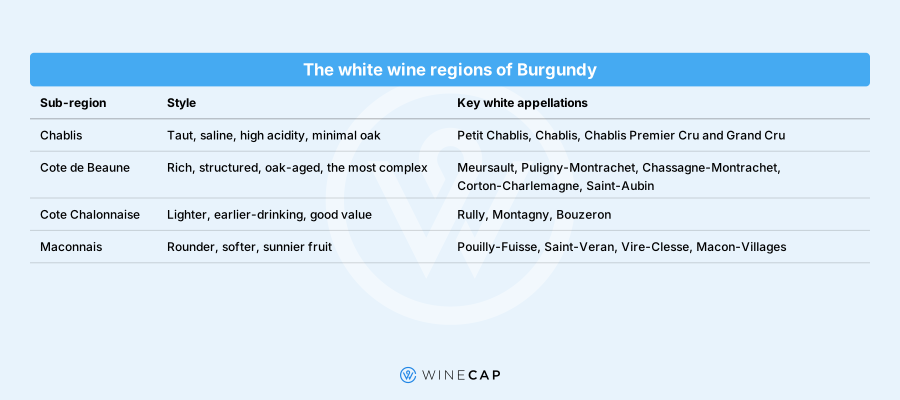
Chablis owes its character to Kimmeridgian soil, a limestone and marl formation studded with the fossilised oyster shells of Exogyra virgula. Its Premier Cru covers 40 climats across 770 hectares and 13% of Chablis production (BIVB Chablis, 2023). At the southern end, Pouilly-Fuisse gained the Maconnais’s first Premier Crus in September 2020, when INAO approved 22 climats across 194 hectares, the first new Premier Cru tier in any Burgundian appellation since 1943.
Meursault and Puligny-Montrachet compared
Meursault and Puligny-Montrachet sit side by side on the same limestone slope, and the difference between them is the most useful comparison in white Burgundy.
Meursault is broader, warmer and more forgiving, and drinks well earlier. Puligny is tighter, higher-toned and more mineral, and often needs several more years to show what it has.
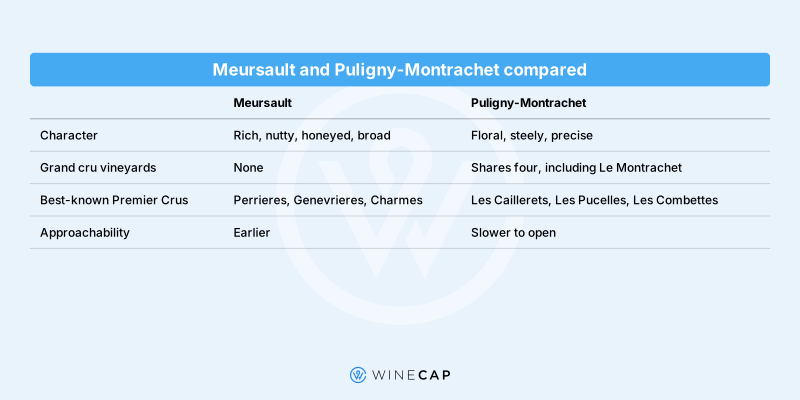
The distinction most often credited is drainage. Puligny’s higher water table restricts cellar depth in the village and contributes to the tension in its wines, while Meursault’s deeper, warmer soils give the fuller texture it is known for. Between them sits Chassagne-Montrachet, mineral and succulent with a hazelnut character, and above the slope lies Saint-Aubin, which shares the same limestone at a considerably lower price.
Which producers make the best white Burgundy?
Producer matters more than tier in Burgundy – these are the domaines most often cited as reference points in each area:
- Chablis: Domaine Francois Raveneau and Domaine Vincent Dauvissat set the benchmark, with William Fevre and Louis Michel recognised for classically styled Premier and Grand Cru wines.
- Meursault: Coche-Dury, Domaine Roulot, Domaine des Comtes Lafon and Arnaud Ente define the village at the top, alongside Pierre-Yves Colin-Morey.
- Puligny-Montrachet: Domaine Leflaive is the historical reference point, with Etienne Sauzet long established.
- Chassagne-Montrachet: Domaine Ramonet is the most cited, and the village is a reliable source of value at Premier Cru level.
- Corton-Charlemagne: Bonneau du Martray holds the largest single stake and the longest reputation on the hill.
- Maconnais and Saint-Aubin: Guffens-Heynen, J.A. Ferret and Domaine Hubert Lamy raised expectations for southern Burgundy and for Saint-Aubin respectively.
Allocation rather than availability is the constraint at the very top. Coche-Dury and Raveneau sell to long-standing customers in tiny quantities, which is why their wines surface mainly on the secondary market.
Burgundy’s white Grand Crus
Burgundy’s white Grand Crus are few and very small. Five sit in the Montrachet cluster, straddling Puligny-Montrachet and Chassagne-Montrachet: Le Montrachet itself, Chevalier-Montrachet, Batard-Montrachet, Bienvenues-Batard-Montrachet and Criots-Batard-Montrachet. Le Montrachet covers around eight hectares. Criots-Batard-Montrachet, the smallest, covers 1.57 hectares and yields roughly 8,900 bottles a year (BIVB, five-year average 2017 to 2021).
Corton-Charlemagne, around the hill of Corton to the north, is the largest white Grand Cru and spans three communes: Pernand-Vergelesses, Aloxe-Corton and Ladoix-Serrigny. Chablis has seven Grand Cru climats of its own: Blanchot, Bougros, Les Clos, Grenouilles, Preuses, Valmur and Vaudesir. Together they cover 99 hectares and 1.5% of Chablis production (BIVB Chablis, 2023).
How long does white Burgundy age?
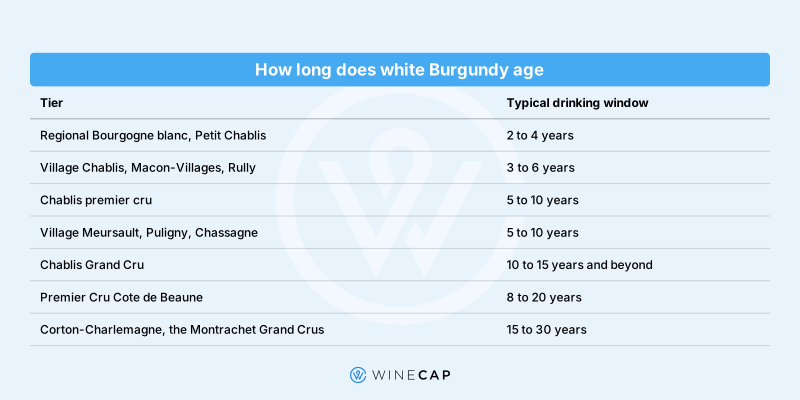
White Burgundy ages for less time than red Burgundy, and considerably less than its reputation suggests. Regional wines are made for early drinking, village wines reward a few years, and the best Cote de Beaune Premier and Grand Crus run for decades.
Premature oxidation and older bottles
Premature oxidation, known as premox, is why experienced buyers treat older white Burgundy with caution. Affected bottles turn deep gold and lose their fruit years before expected, and nothing short of opening one reveals it. The problem became widely apparent in wines from the mid-1990s onwards and dominated discussion of the category for close to two decades.
No single cause was ever established. Reduced sulphur dioxide at bottling, variable cork quality, aggressive lees stirring and changes to pressing have all been implicated. Producers responded by raising sulphur levels, adopting technical closures such as Diam and revising cellar practice, and reported incidence has fallen substantially since the early 2010s. Calling the problem solved would overstate it. For a buyer, the practical conclusion is to favour younger vintages unless a bottle’s storage history is documented.
Recent white Burgundy vintages at a glance
Recent vintages have varied more in volume than in quality, with three short harvests in five years. Whites generally fared better than reds through the harder years, notably 2024.
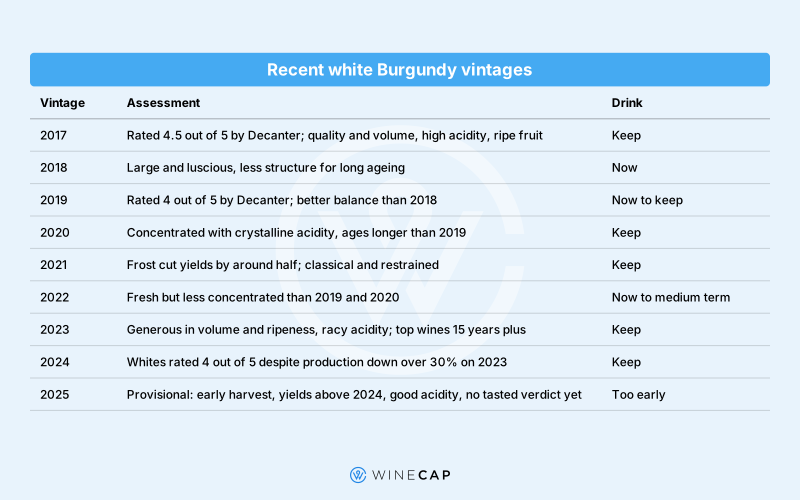
Sources: Decanter vintage guide and Burgundy 2024 En Primeur report (Charles Curtis MW, updated January 2026), Jancis Robinson vintage notes.
Serving and pairing white Burgundy
Serving temperature matters more for white Burgundy than for almost any other white wine, and most bottles are served too cold. Chablis and village wines show best at 10 to 12 degrees Celsius. Premier and Grand Cru wines need 12 to 14 degrees to open properly, closer to cellar than fridge temperature (BIVB).
Pairing follows the same north-to-south logic as the wines. Chablis and other high-acid whites suit oysters, shellfish and goat’s cheese. Richer Cote de Beaune whites work with lobster, monkfish, veal and poultry in cream and mushroom sauce (BIVB). Mature grand cru handles foie gras and caviar, which is where the region’s reputation for luxury pairings comes from.
Buying and cellaring white Burgundy
Provenance matters more here than for most wine, precisely because oxidation cannot be inspected. Buyers of older bottles study storage history, fill level and closure condition, and discount anything with an unclear past. Wine kept in a bonded warehouse retains a continuous record, which is the main reason collectors buy in bond rather than duty paid.
Burgundy’s whites also attract investor interest, and the region accounted for 69.3% of white wine traded by value on Liv-ex in 2026 to date. Fine wine values fall as well as rise, and past performance is not a guide to future returns, so anyone buying with resale in mind should treat white Burgundy as a long-term holding.
Where to start with white Burgundy
The most useful thing to know about white Burgundy is that its hierarchy of price does not map onto a hierarchy of pleasure. A village Chablis from a careful grower or a Saint-Aubin Premier Cru teaches a drinker more about the region than an expensive bottle from a weak vintage, and the gap between good and indifferent producers at the same address is wider than the gap between adjacent tiers.
That makes producer the first thing to learn and appellation the second. A handful of bottles worked north to south, from names with a track record, will build a clearer picture of the region than any single Grand Cru.
FAQ: White Burgundy
Is Chablis white Burgundy?
Yes. Chablis is the northernmost white wine district of the Bourgogne region and is made entirely from Chardonnay, which makes it white Burgundy in both legal and stylistic terms. It sits closer to Champagne than to Beaune, and its cool climate and Kimmeridgian limestone soil give it a leaner, more mineral style than the richer whites of the Cote de Beaune.
Is white Burgundy the same as Chardonnay?
Almost always. Chardonnay accounts for 57% of plantings across Bourgogne (BIVB) and is the grape behind every well-known white appellation in the region. The exceptions are Bourgogne Aligote and Bouzeron, both made from Aligote, and Saint-Bris, made from Sauvignon Blanc.
Does Meursault have a Grand Cru?
No. Meursault is the only major white wine village of the Cote de Beaune without a grand cru vineyard, despite producing some of Burgundy’s most expensive whites. Its finest sites are premier crus, principally Perrieres, Genevrieres and Charmes, and the best examples reach prices comparable with grand cru wines from neighbouring villages.
What is premox in white Burgundy?
Premox is short for premature oxidation, where a white Burgundy turns deep gold and loses its fruit years before expected. It affected wines from the mid-1990s onwards, and no single cause was established, though low sulphur levels and cork quality were both implicated. Reported incidence has fallen substantially since the early 2010s.
Why is white Burgundy so expensive?
Scarcity explains most of it. Grand Cru accounts for just 1% of Bourgogne production, vineyard boundaries are fixed by appellation law and cannot be extended, and holdings are fragmented among many small growers. Recent short harvests, including a 2024 crop down more than 30% on 2023, have tightened supply further.
WineCap’s independent market analysis helps investors build diversified fine wine portfolios with full ownership and transparent pricing. Speak to one of our wine investment experts and start building your portfolio. Schedule your free consultation today.
Capital at risk. Past performance is not a guide to future returns. Returns are not guaranteed.