Burgundy’s most expensive wines and the record vineyard prices driving them
- Burgundy vineyard prices reached new records in 2025, even as vineyard values across France fell by 6.8% on average.
- Premier Cru white vineyards in the Cote-d’Or now average £2.3 million per hectare, while Premier Cru red vineyards have climbed to almost £1 million per hectare.
- Domaine de la Romanee-Conti, Leroy and Leflaive dominate Burgundy’s luxury wine market, producing some of the region’s most valuable and sought-after bottles.
Burgundy has long occupied a unique position in the fine wine world, but new data suggests the region has moved beyond traditional measures of agricultural value altogether. According to newly released figures from France’s rural land agency, Safer, vineyard prices in Burgundy once again broke records in 2025, reinforcing the region’s status as one of the world’s most sought-after luxury assets.
A hectare of Premier Cru white wine vineyard land in the Cote-d’Or rose 6% over the past year to an average of £2.3million, while Premier Cru red wine vineyards increased by 11% to almost £1million per hectare. At these levels, Burgundy’s finest vineyard sites are increasingly being compared not to farmland, but to luxury real estate and other collectible assets prized by ultra-high-net-worth buyers.
For collectors and investors, the implications extend beyond the vineyard. The value of Burgundy’s most coveted land underpins the scarcity and prestige of the wines themselves, helping explain why the region continues to dominate the upper echelons of the fine wine market.
Burgundy’s bubble in a challenging market
What makes Burgundy’s performance particularly remarkable is the backdrop against which it is occurring.
Across France, vineyard values have come under pressure. Excluding Champagne, average vineyard prices fell by 6.8% over the past year as changing consumption habits, weaker demand for red wine and economic uncertainty weighed on the sector.
Bordeaux has been among the hardest-hit regions. Falling global demand for red wine has contributed to significant corrections in vineyard values, with average prices reportedly declining by 24%. Even some of the region’s most prestigious appellations have not escaped the downturn, with Pauillac and Margaux seeing substantial declines.
Yet Burgundy continues to move in the opposite direction.
The reason lies in a combination of extreme scarcity and global demand. Unlike many wine regions that expand their borders, Burgundy’s greatest vineyards are finite, immutable and impossible to replicate. Moreover, Grand Cru and Premier Cru sites are often fragmented into tiny holdings and fully planted. Ownership opportunities are exceptionally rare, while demand increasingly comes from a global pool of wealthy collectors, investors and luxury buyers. A stake in a Burgundy vineyard has come to represent ownership of one of the world’s most prestigious luxury goods at its source.
When land prices drive bottle prices
The relationship between vineyard values and bottle prices is not always straightforward, but in Burgundy the connection seems unusually strong. As vineyard land becomes more valuable, the scarcity narrative surrounding the wines intensifies. Tiny production volumes, growing international demand and the reputation of Burgundy’s most prized terroirs create a powerful feedback loop that supports both land and wine prices.
This has helped Burgundy’s leading wines maintain extraordinary valuations even during a period when the broader fine wine market has experienced a correction. While many regions have seen prices soften – including Burgundy as a whole – its most iconic names continue to command some of the highest prices in the secondary market despite momentary dips.
Deep dive: Ten of the most expensive Burgundy wines
Based on average case prices, Burgundy’s most costly wines reveal the extraordinary premium attached to the region’s greatest terroirs.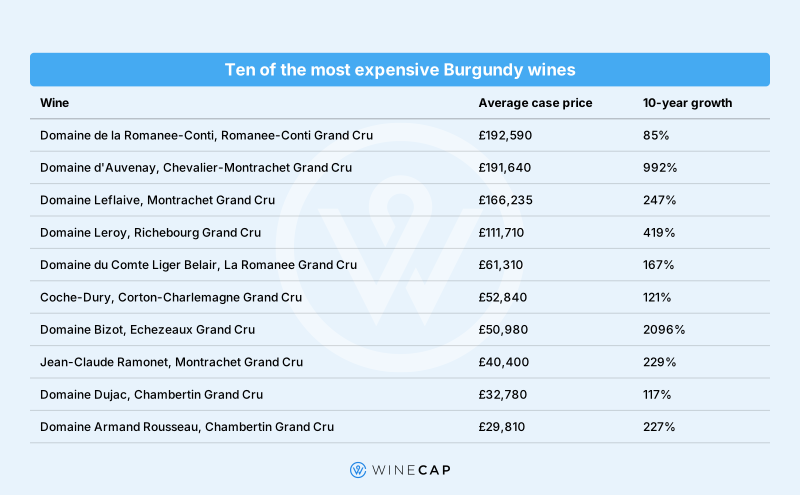
Several themes emerge from the rankings.
First is the dominance of Grand Cru terroir. Every wine on the list originates from Burgundy’s highest classification level, highlighting the premium investors place on the region’s top vineyard sites.
Second is the growing prominence of white Burgundy. Four of the ten wines are Chardonnay-based, namely Domaine d’Auvenay Chevalier-Montrachet, Domaine Leflaive Montrachet, Coche-Dury Corton-Charlemagne and Jean-Claude Ramonet Montrachet. This reflects both the surging global demand for white Burgundy and the scarcity of these wines.
Perhaps most striking is the scale of appreciation achieved by certain producers. Domaine Bizot’s Echezeaux Grand Cru leads the field with remarkable ten-year growth of 2,096%, while Domaine d’Auvenay’s Chevalier-Montrachet has gained 992% over the same period. These figures highlight the extent to which scarcity and cult status can drive long-term performance.
It is also worth noting some notable absentees. Wines such as Leroy Musigny would undoubtedly rank among Burgundy’s most expensive bottles, but limited trading volumes mean there is insufficient market data to establish reliable pricing. The same applies to the wines of Henri Jayer. While they remain among the most coveted and expensive wines in the world, the legendary winemaker’s death in 2006 and the tiny quantities currently in circulation mean transactions are too infrequent to provide robust market benchmarks.
A league of its own
The latest vineyard pricing data reinforces a reality that fine wine collectors have understood for years: Burgundy increasingly operates according to its own supply-and-demand dynamics.
While shifting consumer preferences, economic uncertainty and broader market corrections continue to affect many wine regions, Burgundy’s greatest vineyards are among the world’s most coveted luxury assets. Their scarcity is absolute, their prestige unrivalled and their appeal increasingly global.
Whether measured by the value of the land itself or by the prices achieved by the wines it produces, Burgundy continues to occupy a category almost entirely of its own. In a market searching for certainty, the region remains the closest thing fine wine has to a true blue-chip asset.
FAQ: Burgundy wine and vineyard prices
Why are Burgundy vineyard prices so high?
Burgundy’s finest vineyards are among the scarcest agricultural assets in the world. Grand Cru and Premier Cru sites are finite, fully planted and protected by strict appellation boundaries, meaning supply cannot expand to meet growing global demand.
How much is a hectare of Burgundy vineyard worth?
According to Safer’s 2025 data, a hectare of Premier Cru white vineyard land in the Cote-d’Or averages £2.3 million, while Premier Cru red vineyard land approaches £1 million per hectare. The region’s most prestigious Grand Cru sites would command substantially higher prices if they came to market.
Why is Burgundy outperforming other wine regions?
Unlike many wine regions facing declining consumption and oversupply concerns, Burgundy benefits from extremely limited production, strong global demand and a collector base willing to pay significant premiums for the region’s most prestigious wines and vineyard holdings.
What is the most expensive Burgundy wine?
Domaine de la Romanee-Conti’s Romanee-Conti Grand Cru is currently the most expensive Burgundy wine by average case price, valued at approximately just under £200k per case.
Are Burgundy wines still a good investment?
Past performance does not guarantee future returns, but Burgundy continues to demonstrate many characteristics associated with blue-chip investment assets: finite supply, global demand, strong brand equity and a long history of value appreciation among its most prestigious producers and vineyard sites.
How are vineyard prices linked to wine prices?
Higher vineyard values reinforce the scarcity and prestige of the wines produced from those sites. In Burgundy, where production volumes are often extremely limited, rising land values and rising bottle prices frequently support one another through a self-reinforcing cycle of demand and scarcity.
WineCap’s independent market analysis showcases the value of portfolio diversification and the stability offered by investing in wine. Speak to one of our wine investment experts and start building your portfolio. Schedule your free consultation today.