How investor motivations in fine wine have evolved
- Stability has overtaken sustainability as a key motivation why investors choose fine wine.
- Strong returns have never been a dominant factor for wine investors.
- Passion is less important than fine wine’s low correlation to mainstream markets.
The past four years have fundamentally reshaped investor attitudes towards risk, diversification and wealth preservation. Since 2023, mainstream markets have experienced persistent inflation, rising interest rates, geopolitical instability, recession fears and elevated volatility across both equities and fixed income markets.
Against that backdrop, WineCap Wealth Reports’ global data from surveys conducted between 2023 and 2026 shows a notable shift in how investors think about fine wine, and why they choose to include it in their portfolios. Our findings reveal that fine wine is increasingly being viewed as a strategic, portfolio-oriented asset rather than a mere passion collectible.
Stability overtakes sustainability as key wine investment driver
Four years ago, sustainability was cited by 55% of surveyed wealth managers as the primary reason why investors were allocating to fine wine. By 2026, however, stability had emerged as the dominant investment driver.
Over the past four years, the proportion of respondents citing stability as a key reason to invest in wine has risen from 54% to 70%, overtaking sustainability.
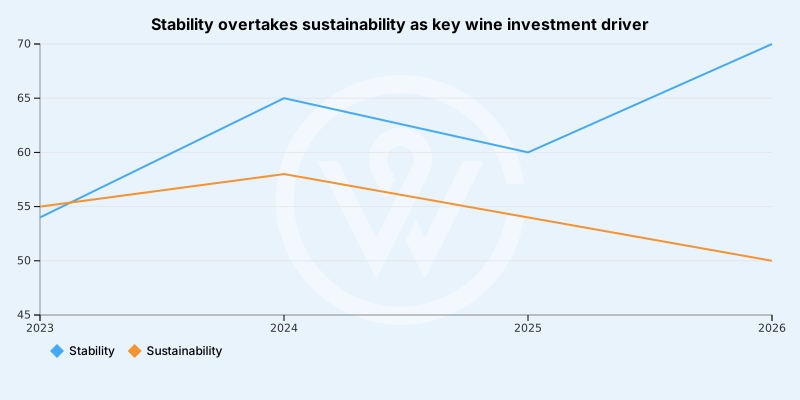
This shift reflects changing investment priorities rather than varying attitudes towards fine wine itself. In an increasingly uncertain macroeconomic environment, investors appear to be placing greater emphasis on resilience, predictability and capital preservation.
While sustainability remains important – particularly within premium wine production where environmental practices have become increasingly embedded – it no longer dominates investor thinking in the same way it did earlier. Instead, the data suggests that wine investors are becoming more pragmatic and portfolio-focused.
The timing of this shift is difficult to ignore. Since 2023, investors have navigated persistent inflation, aggressive monetary tightening, banking sector instability, geopolitical tensions and ongoing volatility. Traditional diversification strategies have also faced challenges, particularly during periods where bonds and equities moved lower simultaneously. This is why assets perceived as more stable and less reactive to short-term market movements have become increasingly attractive.
Indeed, fine wine’s appeal lies partly in its slower-moving nature. Unlike publicly traded financial assets, pricing in the secondary wine market tends to evolve gradually, supported by finite supply, long holding periods and a global collector base. That lower volatility profile increasingly appears to resonate with investors seeking resilience over aggressive growth.
Stability matters more than strong returns
The data also reveals something particularly telling about the profile of fine wine investors themselves.
Across every year surveyed, respondents consistently ranked stability above strong returns as a reason to invest in fine wine. Even as markets cycled through periods of speculative enthusiasm, wine investors remained notably defensive in their priorities.
This suggests that fine wine investors are behaving differently from more momentum-driven participants elsewhere in financial markets.
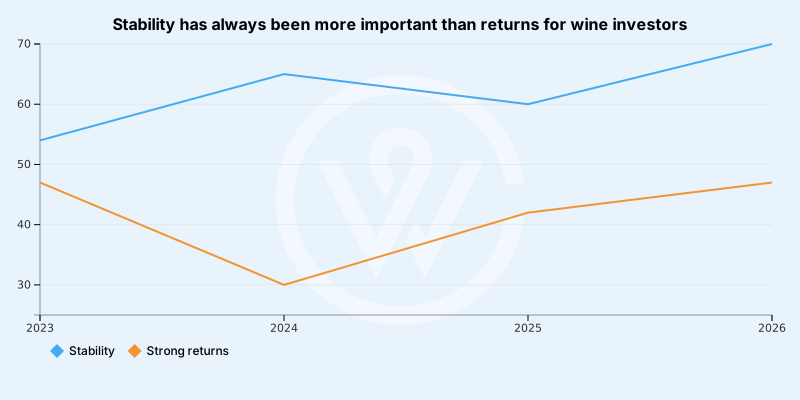
Rather than chasing short-term gains, investors increasingly appear to value predictability, wealth preservation and long-term portfolio balance. The appeal of fine wine is not necessarily that it delivers the highest returns, but that it may provide differentiated behaviour relative to traditional markets.
That aligns with broader trends across wealth management and alternative investing. In recent years, first-time investors in particular have been turning to tangible assets and alternative stores of value amid concerns around inflation, market concentration and elevated valuations in traditional financial markets.
Fine wine fits naturally within that conversation. It is a physical asset with finite supply, global demand and a market structure that historically behaves differently from mainstream financial assets. Increasingly, those characteristics appear to matter more than headline performance alone.
Fine wine is moving beyond passion
Perhaps the clearest evidence of fine wine’s evolution as an investment asset can be seen in changing attitudes towards passion and diversification.
Historically, wine investment was closely associated with collectors and enthusiasts. Emotional connection, provenance and personal enjoyment were central to participation in the market.
However, by 2025 and 2026, respondents were more likely to cite fine wine’s low correlation to mainstream assets as a motivation for investing than passion itself.
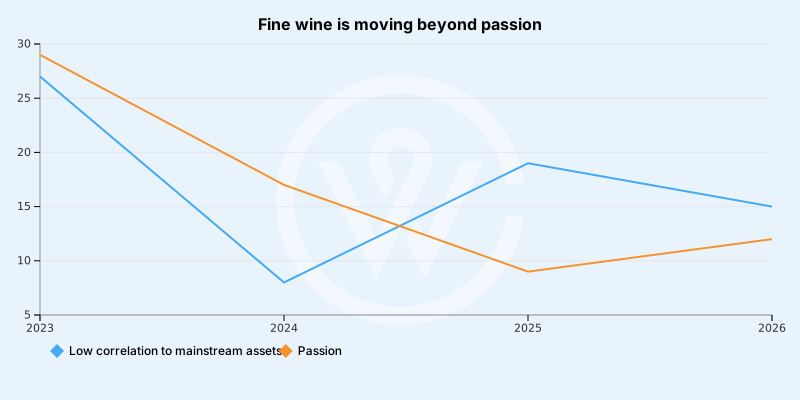
That does not suggest passion is disappearing from the category. Rather, it points to the investor base becoming broader and more financially sophisticated.
The modern wine investor increasingly resembles a diversified allocator rather than a traditional collector alone. Wealth managers, financially engaged high-net-worth individuals and portfolio-focused investors are paying closer attention to fine wine’s role within a broader investment strategy.
This reflects the continued maturation of the fine wine market itself.
Over the past decade, the market has become significantly more transparent and data-driven. Greater access to pricing data, portfolio analytics, market indices and global trading platforms has made wine more accessible as an investment proposition. Investors are increasingly able to analyse fine wine through a financial lens rather than purely through a collecting lens.
As a result, fine wine is gradually transitioning from being viewed primarily as a passion asset towards being recognised as a legitimate component of diversified portfolios.
A more mature investment landscape
Taken together, the findings from the 2023–2026 WineCap Wealth Reports point towards an increasingly mature investor mindset within the fine wine market.
Investors are becoming more measured, more strategic and more focused on resilience. Stability, diversification and portfolio construction are becoming more important drivers than emotion or speculation.
Importantly, this does not mean fine wine is losing the qualities that made it attractive in the first place. Passion, heritage and collectibility remain fundamental to the category’s identity and long-term value.
But the data suggests investors are also recognising that fine wine’s financial characteristics may be just as compelling as its cultural and emotional appeal.
In an era defined by uncertainty, that evolution may prove increasingly important.
Read our latest Wealth Reports here.
FAQ: Fine wine investment motivations
Why do investors invest in fine wine?
WineCap Wealth Report data shows investors are increasingly attracted to fine wine for its stability and diversification benefits. Other key motivations include sustainability, liquidity, tangibility, inflation protection and fine wine’s historically low correlation to mainstream financial markets.
Why is stability important in fine wine investment?
Between 2023 and 2026, stability became the leading reason investors allocated to fine wine. In periods of market volatility, inflation and economic uncertainty, investors increasingly prioritised assets perceived as resilient and less reactive to short-term market movements.
Is fine wine considered a good diversification asset?
Many investors view fine wine as a useful diversification tool because it has historically behaved differently from traditional assets such as equities and bonds. WineCap survey data shows that fine wine’s low correlation to mainstream markets has become increasingly important to investors in recent years.
Do investors buy fine wine mainly for returns?
The data suggests that strong returns are not the primary motivation for most fine wine investors. Across all survey years, stability consistently ranked above returns, indicating that investors are often more focused on capital preservation and portfolio balance than short-term performance.
Is fine wine still a passion investment?
Passion remains an important part of fine wine investment, particularly among collectors and enthusiasts. However, WineCap Wealth Report data suggests investors are increasingly viewing fine wine through a financial and portfolio-oriented lens rather than purely as a collectible asset.
Why is fine wine considered a tangible asset?
Unlike stocks or bonds, fine wine is a physical asset with finite supply and global demand. Many investors value tangible assets during periods of economic uncertainty because they can offer diversification and may behave differently from traditional financial markets.
Is fine wine used as an inflation hedge?
Some investors view fine wine as a potential inflation hedge due to its scarcity, long-term demand and tangible nature. WineCap survey data shows inflation protection remains one of the motivations behind fine wine investment allocations.
WineCap’s independent market analysis helps investors build diversified fine wine portfolios with full ownership and transparent pricing. Speak to one of our wine investment experts and start building your portfolio. Schedule your free consultation today
Capital at risk. Past performance is not a guide to future returns. Returns are not guaranteed.