Burgundy En Primeur 2023 and the current market
- The 2023 Burgundy vintage is bountiful but heterogeneous in quality.
- Careful selection of reputable domains and top producers is necessary when making purchasing decisions.
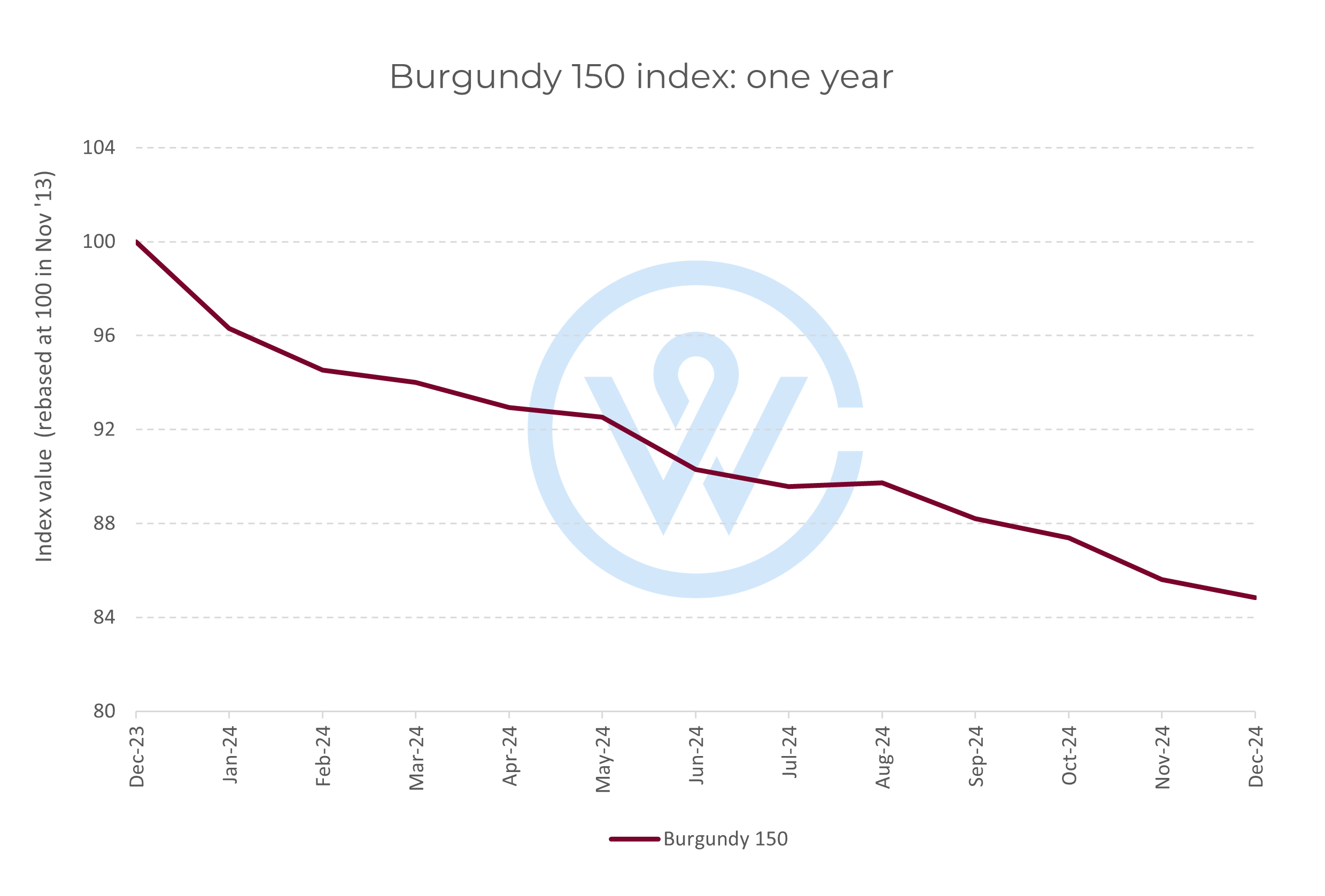
- In the secondary market, Burgundy prices have fallen 15.2% in the last year.
The Burgundy En Primeur 2023 campaign brings a vintage full of potential and expectations: potential due to the quality but mostly quantity of the vintage in a region defined by scarcity, and expectations for reduced pricing given producers’ desire to sell.
This article provides an overview of the 2023 Burgundy vintage and the market environment that surrounds its launch.
A heterogeneous but plentiful vintage
The 2023 Burgundy vintage first made news for its volume, which surpassed the region’s average production levels by 30%. Despite heat, drought and flooding challenges, the overall perception is of success – large quantities and above-average quality. Sarah Marsh MW summed it up: ‘The 2023 Burgundy was a bounteous but heterogenous vintage in which the white wines outshone the reds’.
2023 saw a late-season heat spike that concentrated the fruit. Chardonnay benefited from earlier harvests before extreme heat, while Pinot Noir avoided dilution concerns and achieved natural alcohol levels of 13 – 13.5%.
The vintage’s overall quality depended heavily on producer management, such as controlling yields for reds and maintaining freshness and acidity in whites. In comparison to the richer, more consistent 2022 vintage, the 2023s demonstrate greater precision, transparency and approachability. Growers and critics have suggested that the 2022/23 might mirror the 2015/16 or 2009/10 pairs.
The highlights include Bonnes Mares, which stood out for its opulence and structure, with the best examples from Domaine de la Vougeraie and Domaine Dujac. For whites, cooler and mineral-driven sites like Puligny Caillerets and Meursault Perrières were particularly compelling, showcasing precision and vibrancy. Producers like Comte de Vogue, Jean Chartron, and Violot-Guillemard have garnered critical praise.
Market context
The Burgundy En Primeur 2023 campaign unfolds against a backdrop of shifting market dynamics. Following a robust 2022 vintage and a successful campaign, producers are navigating a softened market. Burgundy prices have fallen 15.2% in the past year, more than any other fine wine region.
Additionally, seven Burgundies dropped from the list of the most 100 most powerful brands in the world in 2024. Still, Burgundy continues to dominate the list, cementing its place as a powerhouse in the global fine wine market. The region’s market share also remains strong, hovering around 25% and sometimes reaching 30%.
Pricing strategies
As producers seek to gather momentum with the 2023 vintage, some are keeping stable pricing levels or even lowering prices. The sizable 2023 yields stand in contrast to the tiny harvests anticipated in 2024, further amplifying the value proposition of the current release.
The 2023 vintage can thus represent a strategic opportunity. Careful selection – looking both at quality and value compared to older vintages – will be necessary, especially as the downward market trend offers a window to secure high-quality Burgundy wines at more accessible price points. More and better priced stock from older vintages has become available, creating competition for the new releases.
The current market dynamics, characterised by adjusted pricing and evolving consumer trends, create an intriguing context for the campaign. As Burgundy continues to adapt to market shifts and climatic challenges, its enduring prestige remains as compelling as ever.
WineCap’s independent market analysis helps investors build diversified fine wine portfolios with full ownership and transparent pricing. Speak to one of our wine investment experts and start building your portfolio. Schedule your free consultation today
Capital at risk. Past performance is not a guide to future returns. Returns are not guaranteed.