The WineCap guide to the best Bordeaux vintages
- The best Bordeaux vintages are shaped by exceptional growing conditions that balance ripeness, freshness and longevity.
- The highest-quality vintages do not always deliver the strongest investment returns.
- Modern viticulture has made Bordeaux more consistent, raising quality levels across almost every vintage.
Bordeaux is home to some of the most collectible wines in the world, but not all great vintages perform equally on the secondary market. While weather conditions largely determine quality in the vineyard, investment performance is influenced by a combination of critic scores, release pricing, scarcity, brand strength, and long-term market demand.
This guide explores the most important Bordeaux vintages from both a wine and investment perspective, highlighting the years that have shaped the fine wine market and continue to attract collectors worldwide.
What are the best Bordeaux vintages?
The most important Bordeaux vintages for collectors and investors are 1982, 1990, 1996, 2000, 2005, 2009, 2010, 2016, 2019, 2020 and 2022. These vintages combine exceptional growing conditions with strong critical acclaim, long-term ageing potential and sustained demand on the secondary market.
However, the best Bordeaux vintages are not always the best investments. While quality is a prerequisite for investment-grade wine, long-term performance is influenced by release pricing, scarcity, brand strength, liquidity and global demand.
Best Bordeaux Vintages
What defines a truly great Bordeaux vintage?
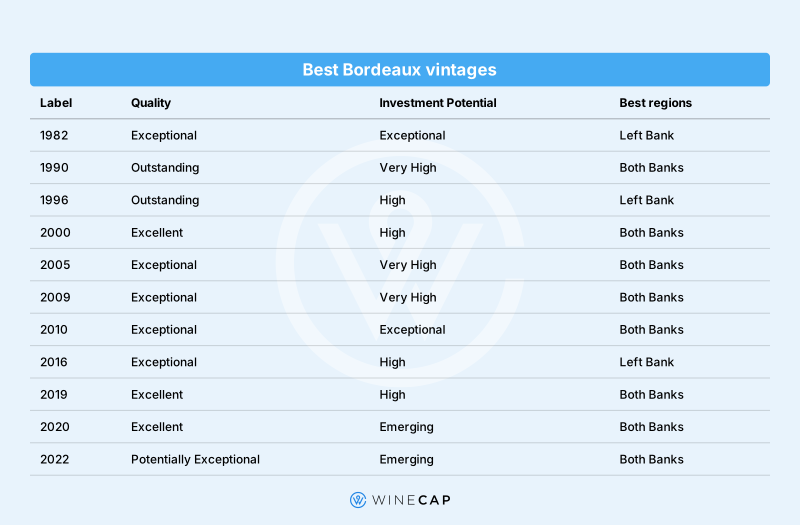
The quality of an individual Bordeaux wine depends on terroir, vineyard management and winemaking decisions. The quality of a Bordeaux vintage, however, is largely determined by weather conditions throughout the growing season.
A truly great vintage requires a rare alignment of climatic factors. Vines must progress steadily from budburst to harvest without major disruptions such as spring frost, poor flowering conditions, prolonged summer rain or harvest-time storms.
According to the late Denis Dubourdieu, the renowned Bordeaux oenologist and owner of Chateau Doisy-Daene, great vintages typically share four characteristics:
- Early and rapid flowering
- Gradual water stress during July to regulate vine growth
- Warm, dry conditions throughout August and September
- A dry harvest period that allows growers to pick at optimal ripeness
These conditions promote full phenolic ripeness while preserving acidity and freshness, creating wines capable of long-term ageing.
Great vintages are not always great investments
One of the biggest misconceptions in fine wine investment is that the highest-quality vintages automatically generate the strongest returns.
In reality, entry price is often just as important as quality.
When a vintage receives universal critical acclaim, chateau owners frequently increase release prices substantially. While these wines may be exceptional, their investment upside can be limited if expectations are already fully reflected in release pricing.
Conversely, less celebrated vintages are often released at significant discounts. Backed by the same chateau brands, vineyard sites and winemaking expertise, these wines can deliver stronger percentage returns during market recoveries. For instance, over the last decade vintages of Lafite Rothschild such as 20012, 2013 and 2014 how outperformed much more celebrated wines such as the 2005, 2009 and 2010:
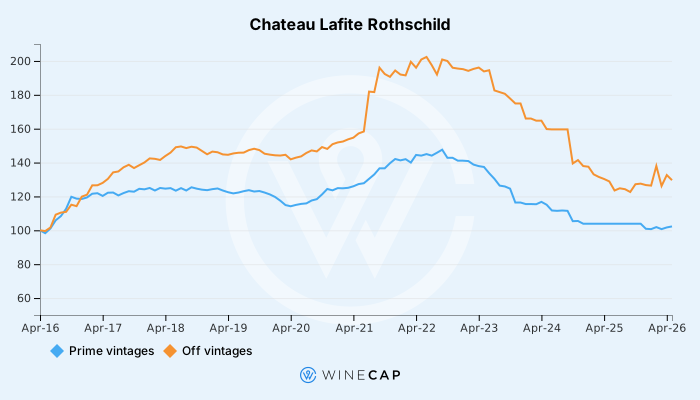
For investors, understanding value matters just as much as understanding quality.
The pre-1982 legends: 1945, 1947 and 1961
Before modern viticulture and winery technology, Bordeaux was far more vulnerable to seasonal variation. As a result, great vintages were rarer but often more distinctive.
The 1945 vintage remains one of the most celebrated in wine history. Harvested as the Second World War came to an end, it produced wines of extraordinary concentration and longevity.
The heatwave conditions of 1947 created unusually rich and opulent wines that challenged traditional Bordeaux structures.
Meanwhile, 1961 became legendary after severe spring frost dramatically reduced yields, concentrating the surviving fruit and producing some of the most profound wines ever made.
Notable wines
- Chateau Mouton Rothschild 1945: Iconic for its “V for Victory” label and immense longevity.
- Chateau Cheval Blanc 1947: Often cited as one of the greatest wines ever produced.
- Chateau Latour 1961: A powerhouse that still tastes youthful after sixty years.
- Chateau Palmer 1961: A legendary Margaux that many consider the equal of the First Growths.
These wines have become historical artefacts as much as investment assets, frequently achieving record auction prices.
1982: The dawn of the modern investment era
The 1982 vintage changed Bordeaux forever.
A warm growing season produced ripe, generous wines that contrasted sharply with the austere styles of previous decades. More importantly, it coincided with the rise of Robert Parker, whose enthusiastic endorsement of the vintage helped establish the influence of critic scores on global demand.
For many investors, 1982 marks the beginning of the modern fine wine market.
Investment snapshot
- Established the importance of critic scores in pricing
- Highly liquid on the secondary market
- Significant demand from Asian collectors during the 2000s
- Remains one of the most traded mature vintages globally
Notable wines
- Chateau Lafite Rothschild 1982: The definitive investment wine of the 1980’s and 25 years later the symbol of the emerging Chinese market.
- Chateau Mouton Rothschild 1982: Known for its exotic spice and incredible richness.
- Chateau Pichon Longueville Comtesse de Lalande 1982: A legendary Pauillac that matches the First Growths in quality.
1990: A tale of two banks
The 1990 vintage completed a trilogy of outstanding years following 1988 and 1989.
While 1989 may boast higher individual peaks, 1990 is generally considered the more consistent vintage across Bordeaux. Rich fruit, balanced structure and broad regional success make it one of the most attractive mature vintages available today.
Investment snapshot
- Strong representation across both banks
- Highly sought after by collectors seeking mature Bordeaux
- Continues to benefit from declining availability
Notable wines
- Chateau Montrose 1990: A Saint-Estephe legend that earned a perfect 100-point score from Robert Parker.
- Chateau Margaux 1990: Celebrated for its floral elegance and silky texture.
- Chateau Cheval Blanc 1990: A classic expression of Saint-Emilion’s finest gravel soils.
1996: The Left Bank triumphs
The 1996 vintage highlights how regional variation can shape Bordeaux.
Heavy rain affected parts of the Right Bank during harvest, while the Medoc enjoyed ideal conditions for Cabernet Sauvignon. The result was one of the greatest Left Bank vintages of the modern era.
Investment snapshot
- Particularly strong for Pauillac, Saint-Julien and Saint-Estephe
- Increasingly recognised as one of the best Left Bank vintages since 1982
- Offers relative value compared to 2005 and 2010
Notable wines
- Chateau Leoville Las Cases 1996: Often described as a “First Growth in all but name” in this year.
- Chateau Margaux 1996: Neal Martin has suggested this may the the Left Back highlight
- Chateau Cos d’Estournel 1996: A powerful, spicy Saint-Estephe that exemplifies the vintage.
2000: The millennium vintage
The 2000 vintage benefited from ideal weather and exceptional marketing.
Demand for the “Millennium Vintage” pushed Bordeaux into a new era of global collecting. Many estates also released special packaging and commemorative bottlings that continue to command premiums today.
In hindsight, 2000 can also be viewed as a transitional vintage that marked the beginning of Bordeaux’s adaptation to a warming climate.
Investment snapshot
- Strong global recognition
- Unique collector appeal
- Widely traded and highly liquid
Notable wines
- Chateau Mouton Rothschild 2000: Famous for its “Augsburg Ram” gold-enamelled bottle.
- Chateau Pavie 2000: A controversial and powerful wine that defined the modern Saint-Emilion style.
- Chateau Lynch-Bages 2000: A classic Pauillac that remains a collector favourite.
- Chateau La Mission Haut-Brion 2000: A Graves powerhouse with exceptional mineral depth.
2005: A vintage for the patient
Arguably the first universally acclaimed great vintage since 1982, 2005 was defined by a severe lack of rain rather than excessive heat. This led to tiny, thick-skinned grapes with massive tannins and high acidity. The wines are incredibly concentrated and have the structural profile for a very long life.
Patience is essential for this vintage. Even at twenty years of age, many of the top wines still require decanting to soften their formidable tannins. It is a vintage that rewards the long-term collector rather than the short-term drinker. The consistency across the Left and Right Banks makes it an attractive prospect for investment.
Investment snapshot
- Exceptional quality across both banks
- Strong critical support
- Long-term cellaring potential
- Consistent performance across major indices
Notable wines
- Chateau Latour 2005: A monumental wine that is only just beginning to open up.
- Chateau La Mission Haut-Brion 2005: Often considered the wine of the vintage.
- Chateau Ausone 2005: A sublime and rare Right Bank legend.
- Chateau Leoville Poyferre 2005: A Saint-Julien that punches well above its weight.
2009: The peak of opulence
The 2009 vintage was presented on release as potentially the greatest year in history. This reputation was fuelled by the unbridled enthusiasm of Robert Parker, who awarded more 100-point scores than in any previous year. It was a vintage of high alcohol, low acidity, and incredibly plush, ripe fruit.
Stylistically, 2009 represents the peak of “Parkerization”, a trend toward rich, opulent, and hedonistic wines. While some critics have raised concerns that the wines lack the bones for very long term ageing, they have proven to be remarkably successful. Unusually, this was also a great year for sweet wines in Sauternes which tends not to be at their best when Bordeaux reds are most successful.
Investment snapshot
- Numerous 100-point scores
- Strong global demand since release
- Popular among both collectors and drinkers
Notable wines
- Chateau Ducru-Beaucaillou 2009: A sensual and flamboyant Saint-Julien.
- Chateau Yquem 2009: A masterclass in botrytised sweet wine.
- Chateau Pontet-Canet 2009: A biodynamic pioneer that achieved a perfect score.
- Chateau Cos d’Estournel 2009: A powerful, modern wine that split critical opinion on release.
2010: The connoisseur’s choice
The 2010 vintage is inseparable from its predecessor. While 2009 was opulent and approachable, 2010 was more structured and intellectually demanding. Neal Martin noted that when winemakers were asked for their preference, ninety percent chose 2010. It possessed higher acidity and firmer tannins than 2009, suggesting an even longer life in the cellar.
While 2009 is often more fun to drink young, 2010 is the vintage for the serious connoisseur. It is slightly less consistent across the lower tiers of the market, but at the top end, the wines are profound and it remains one of the most sought-after years for those building a blue-chip wine portfolio.
Investment snapshot
- One of the strongest blue-chip investment vintages
- Exceptional ageing potential
- Frequently considered superior to 2009 among professionals
Notable wines
- Chateau Figeac 2010: A refined and complex Saint-Emilion that is highly prized.
- Chateau Latour 2010: Considered by many to be a perfect wine and a modern legend.
- Chateau Petrus 2010: An opulent and rare Pomerol of immense value.
- Chateau Montrose 2010: A structured powerhouse that defines the Saint-Estephe appellation.
The modern classics: 2016, 2019 and 2020
The last decade has seen a remarkable run of quality. The 2016 vintage is often cited as the modern classic, offering a perfect balance of ripeness and freshness. It is particularly strong in the northern Medoc. Notably, 2016 has the best ratings of any vintage at the annual Southwold blind tasting event.
The 2019 vintage followed, celebrated for its purity of fruit and silky textures, often compared to 2009 but with more elegance.
The 2020 vintage completed this recent trilogy. Produced under the constraints of a global pandemic, it resulted in wines of great concentration and character. These three years provide a wealth of options for the modern investor, offering high critic scores and clear regional identities.
Investment snapshot
- Strong critical support
- Significant trading on the secondary market
- Attractive long-term holding potential
Notable wines
- Chateau Les Carmes Haut-Brion 2016: A rising star that has seen significant price growth.
- Chateau Lynch-Bages 2019: A high-scoring classic that offers excellent relative value.
- Chateau Smith Haut Lafitte 2020: A Graves estate that continues to reach new heights.
- Chateau Cheval Blanc 2016: A sublime and elegant Right Bank masterpiece.
The emerging star: 2022
The 2022 vintage was born in a year of extreme heat and drought, yet the wines have surprised critics with their freshness. It is a vintage where the technical skill of winemakers was truly tested. The results are variable, but the best wines are truly spectacular. It is a vintage that highlights the resilience of Bordeaux’s greatest terroirs.
Investment snapshot
- Potentially historic quality
- Strong early critical reception
- May become a defining climate-era vintage
Notable wines
- Chateau Rauzan-Segla 2022: A Margaux estate that has seen a significant jump in reputation.
- Chateau Beau-Sejour Becot 2022: A Right Bank star with exceptional scores.
- Chateau Climens 2022: A legendary sweet wine that made a triumphant return.
- Chateau Montrose 2022: Wine Advocate’s William Kelley described it as the “quintessence of contemporary Bordeaux”.
The hidden gems: 1986, 2003 and 2018
Not every great year receives the same spotlight. The 1986 vintage has lived in the shadow of 1982 for decades, despite producing some incredibly long-lived and high quality wines. The 2003 vintage was historically hot, and while some wines have proved to be over-ripe, the best estates in the northern Medoc produced unique and powerful bottlings.
The 2018 vintage is another often overlooked year of great character. It was a warm vintage that produced dark, concentrated wines, with high alcohol but surprisingly good acidity. With modern technology, winemakers are now much better equipped to handle these hot years than they were in 2003.
Notable wines
- Chateau Margaux 1986: An exceptional wine that many prefer to the 1982.
- Chateau Montrose 2003: A Saint-Estephe that thrived in the heat.
- Chateau Calon Segur 2018: A structured and powerful wine with great longevity.
Best Bordeaux vintages for investment
While every portfolio is different, several vintages consistently stand out due to their combination of quality, liquidity and long-term market demand:
- 1982 – the original modern investment vintage
- 2005 – exceptional quality across Bordeaux
- 2010 – extraordinary structure and longevity
- 2016 – modern classic with broad critical support
- 2019 – combines critical acclaim and relative value
The strongest investment vintages are not always the highest-scoring vintages. Entry price, market sentiment and supply dynamics are equally important considerations.
FAQ: Best Bordeaux vintages
What is the best Bordeaux vintage?
There is no universal answer, but 1982, 2005, 2010 and 2016 are frequently cited among the greatest modern Bordeaux vintages.
Which Bordeaux vintages are best for investment?
1982, 2005, 2010, 2016 and 2022 are among the most compelling vintages from an investment perspective due to their quality, market demand and long-term potential.
What is the best way to buy top Bordeaux vintages?
En Primeur can provide early access and strong provenance, while purchasing mature wines reduces vintage and ageing risk. In recent years, mature wines have often offered compelling relative value.
Can I drink a great Bordeaux vintage young?
You can, but many top Bordeaux wines are built for decades of ageing. Wines from 2005 and 2010, in particular, may still be developing and can appear overly tannic when opened too early.
Are second wines worth investing in?
Yes. In strong vintages such as 2016 and 2019, second wines from leading estates can offer attractive quality and value.
How has climate change affected Bordeaux?
Climate change has resulted in earlier budbreak and earlier harvest dates, producing riper fruit and higher alcohol levels. It has also increased the frequency of extreme weather events, including frost, drought and heatwaves.
WineCap’s independent market analysis helps investors build diversified fine wine portfolios with full ownership and transparent pricing. Speak to one of our wine investment experts and start building your portfolio. Schedule your free consultation today.
Capital at risk. Past performance is not a guide to future returns. Returns are not guaranteed.