Michelin’s Wine ratings debut with a reach no critic can match, but an uncertain impact for investors
- Michelin has launched its first wine ratings under its own name, scoring Burgundy and Bordeaux producers on a one-to-three “bunch” scale rather than reviewing individual wines
- Michelin’s platforms attract roughly 12.5 million monthly website visitors, compared with 100,000 for Jamessuckling.com and 30,000 for RobertParker.com, the two largest wine review websites
- The data on Michelin’s market impact is genuinely uncertain, and it is far too early for investors to call any significant effect on prices
Michelin, the tyre company just as well known for its starred restaurant guide, has moved into wine criticism for the first time under its own name, publishing producer-level ratings for Burgundy and Bordeaux that score estates rather than individual bottles. The launch last week follows years of indirect involvement rather than a standing start: Michelin has owned Robert Parker’s Wine Advocate brand and the Robert Parker domain outright since 2019, after acquiring a 40% stake in 2017, but has kept that ownership deliberately unbranded.
This means the group now has a direct editorial voice in the market it has only influenced from behind a separate name until now. The same corporate owner now sits behind both the Wine Advocate’s individual scores and Michelin’s producer-level tiers, concentrating critical influence over pricing signals in a way the trade has not previously had to account for. Our own review of pricing data has found no evidence yet that Michelin’s ratings have moved the market: Burgundy prices actually fell in July after Michelin published its first rankings before rising again in August. It is too early to draw any conclusion for Bordeaux, rated only a week ago, and Michelin’s decision to score producers rather than individual wines will make isolating any future effect harder than it would be under a bottle-by-bottle system. A platform with Michelin’s reach going unnoticed by the market indefinitely seems implausible, all the same.
Michelin’s reach eclipses every dedicated wine critic combined
Michelin’s audience is not simply larger than any individual wine critic’s, it is larger than the entire dedicated wine-criticism sector combined, by a wide margin.
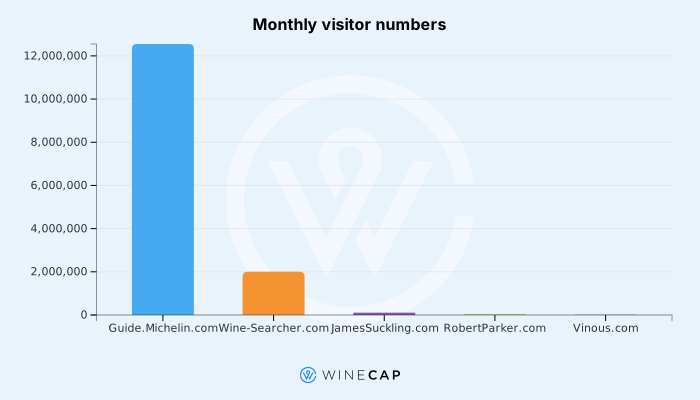
Michelin’s platform draws 12.5 million monthly organic visitors; that figure is built around restaurant and travel content rather than wine specifically, but it’s an audience that is now being exposed to new wine content, and it dwarfs any wine platform.
Among the dedicated wine-critic platforms, James Suckling leads with just over 107,000 monthly visitors, followed by Robert Parker at 32,000 and Vinous at 7,600 – even Wine-Searcher, a price-comparison tool rather than a critic, reaches around 2 million. One can argue that visitor count alone misstates the importance of certain critics.
Regardless, while it’s too soon to infer impact on values and trading history the scale of Michelin cannot be a marginal addition to how the market forms opinions about producers, whatever reservations the trade holds about the approach behind it.
Michelin ranks producers, not individual wines
Michelin’s ratings score estates rather than specific bottles or vintages, a conspicuous departure from how every established wine critic operates, and one that has unsettled parts of the wine trade.
The criticism has focused on Burgundy, where Michelin’s reviews debuted earlier in the summer. Here in particular, the small differences between producers farming adjacent rows in the same vineyard can matter enormously to specialists and have a meaningful impact on price. The argument being that a producer-level score flattens exactly the distinctions the most active and informed buyers care most about.
Behavioural evidence cuts the other way for a broader audience though: detail beyond a certain point tends to disengage casual buyers rather than draw them in, and a simpler producer-level signal is likely to travel further than a vintage-by-vintage one. The approach also reads as a deliberate fit with who already reads Michelin. Diners who use the Michelin Guide for restaurants are accustomed to spending significant sums on food and to treating price and reputation as a reasonable proxy for quality, and that same heuristic translates naturally into ranking wine producers rather than parsing individual releases. Michelin was never going to serve the specialist audience that Vinous and the Wine Advocate already own; the producer-level format targets everyone else, and that is a considerably larger pool.
The scoring system rewards consistency across five criteria
Michelin scores producers on a scale of one to three “bunches,” its equivalent of the star system it uses for restaurants, applying five standard criteria to every estate:
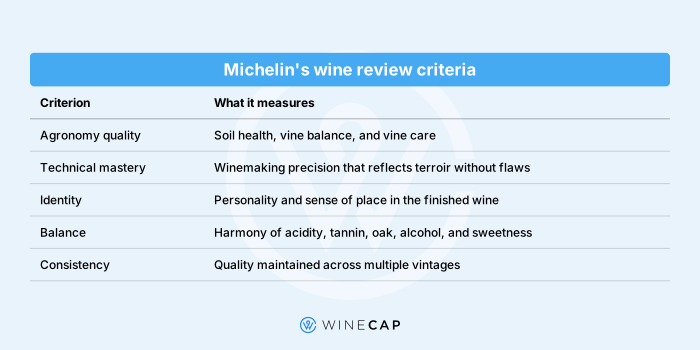
The inclusion of consistency as a standalone criterion is the clearest signal of intent, Michelin is rating a producer’s ability to repeat quality year after year, not rewarding a single outstanding vintage, which is exactly the kind of judgment long-term investors already need to make about an estate before committing capital to it.
Burgundy’s rankings confirm the obvious and surprise on the rest
The top of Michelin’s Burgundy list holds no surprises: Domaine Leroy, Domaine de la Romanee-Conti, and Domaine d’Auvenay all take the highest three-bunch tier, consistent with where the market has long placed them.
The largest surprise sits at the one-bunch level. Armand Rousseau, rated with a single bunch, is the sharpest divergence between Michelin’s score and the estate’s standing across the whole list. Armand Rousseau’s wines can approach £8,000 a bottle in the very best vintages, and prices of their Chambertin cuvees have shown no impact from their one-bunch rating.
Bordeaux’s results raise as many questions as they answer
Bordeaux’s top tier splits into two groups worth separating. Chateau Lafite Rothschild, Chateau d’Yquem, Chateau Cheval Blanc, Chateau Lafleur, and Chateau Petrus earned the top three-bunch score that their market position already assumes. Chateau Montrose and Chateau Leoville Las Cases join them in the top tier too; perhaps a surprise for investors, but not a shock, given the quality they’ve displayed in recent vintages.
Three other first growths, Chateau Mouton Rothschild, Chateau Margaux, Chateau Haut-Brion, sit in the second tier and are the first surprise. The most striking result, though, is what is missing entirely: no shows for Chateau Ducru-Beaucaillou, Chateau Leoville-Poyferre, and Chateau Pavie, eclipsed by the absence of Chateau Latour.
Neither Michelin nor Latour has said whether the estate declined to take part or whether inspectors excluded it, and that silence has left the gap open to speculation rather than explanation. Regardless of the reasons its absence is notable, and given the inclusion of another property under the same ownership (Clos de Tart) in the Burgundy ranking, quite a surprise.
Impact on wine investors
So far, there is no evidence that Michelin reviews have impacted prices for Burgundian wines, in fact, Burgundy prices fell in July, the month reviews were published. Certainly, it is too soon to make any pronouncement about an impact on Bordeaux wines, and Michelin’s decision to review at a producer level will make measuring an impact harder. However, it seems implausible that a platform with the reach of Michelin will not have some impact on the market.
WineCap will be particularly watching for an impact on the prices for wines that have not been included, and those where rankings are substantially lower than might have been expected.
Wine criticism now has a mass-market gatekeeper
Michelin has turned wine criticism into a mass-audience business for the first time, rather than a specialist one the trade debates among itself. Whatever reservations Burgundy and Bordeaux’s most exacting buyers hold about a producer-level lens, an audience the size of Michelin’s does not need the wine trade’s approval to shape how the next generation of buyers finds its way into the category. The professional argument over vineyard-level nuance will likely run for years; the audience Michelin has just brought into wine criticism will decide the more commercially important question first.
FAQ: Michelin’s wine ratings
What is Michelin’s wine scoring system?
Michelin scores producers, not individual wines, on a one-to-three “bunch” scale assessed against five criteria: agronomy quality, technical mastery, identity, balance, and consistency across vintages. A three-bunch rating is the highest distinction, akin to three stars for their restaurant guides.
Why does Michelin rate producers rather than individual wines?
The approach mirrors how Michelin’s existing food-guide audience already assesses quality in a restaurant rather than judging every dish individually. A producer-level system is also a more approachable entry point for Michelin’s much larger readership.
Is Michelin’s wine judgment independent, given it also owns Robert Parker and the Wine Advocate?
Michelin has owned the Wine Advocate outright since 2019, having built a 40% stake in 2017 after Robert Parker sold his majority holding in 2012. It kept that ownership unbranded for seven years, and its new producer ratings are the first wine product to carry the Michelin name directly. Michelin’s CEO has been clear that the new guide is not intended to replace The Wine Advocate.
Why is Chateau Latour missing from Michelin’s Bordeaux rankings?
Neither Michelin nor Latour has said whether the estate declined to participate or was excluded by inspectors, leaving the reason unexplained for now.
How does Michelin’s audience compare with existing wine critics?
Michelin’s platforms attract an estimated 12.5 million monthly organic visitors, more than 100 times James Suckling’s 100,000 and well over 400 times Robert Parker’s 30,000. Even Wine-Searcher, a price-comparison site rather than a critic, draws only around 2 million monthly visitors by comparison.
What does Michelin’s entry mean for fine wine investors?
The scale of Michelin’s audience suggests its producer tiers will shape buyer attention, and by extension pricing, for estates placed in the top tier without already commanding blue-chip prices, a dynamic worth watching most closely outside the small group of producers, such as Petrus or Domaine de la Romanee-Conti, whose position was never really in question.
WineCap’s independent market analysis helps investors build diversified fine wine portfolios with full ownership and transparent pricing. Speak to one of our wine investment experts and start building your portfolio. Schedule your free consultation today.
Capital at risk. Past performance is not a guide to future returns. Returns are not guaranteed.