Ten things about Chateau d’Yquem: Inside Sauternes’ greatest estate
- Chateau d’Yquem is the sole Premier Cru Superieur in the 1855 classification, a category it occupies alone, above all other Sauternes estates.
- WineCap’s Yquem index peaked at exactly 50% growth in early 2023, holding its gains, while wider Bordeaux declined sharply after the 2022 market correction.
- Each vine at Yquem produces roughly one glass of wine per year, making it one of the most labour-intensive fine wines produced anywhere in the world.
Chateau d’Yquem occupies a unique position in the world of fine wine. The only estate awarded Premier Cru Superieur in Bordeaux’s 1855 Classification, it has long been regarded as the benchmark for Sauternes. That exceptional status has translated into enduring collector demand, one of the strongest long-term investment records in the region, and auction prices that have set records for sweet and white wines alike. These ten facts explain what makes Château d’Yquem one of fine wine’s most distinctive investment assets.
1. The most expensive wine in the world to make
Sauternes is the most labour-intensive wine classification in France. Producing it requires botrytis cinerea (noble rot), a fungus that infects and shrivels grapes on the vine, concentrating sugar and flavour into small, wizened berries. At Yquem, that process is pursued with greater intensity than anywhere else in the world. Each vine produces roughly one glass of wine per year. Pickers make multiple passes through the vineyard, called tries, selecting only berries at the precise stage of botrytization. Three passes is now the norm, but in 1997, the harvest required seven separate tries over 32 days.
That selectivity has structural consequences for supply. Around 90 experienced pickers return to Yquem each harvest, and approximately half the fruit they deliver is rejected daily. Cellarmaster Sandrine Garbay assesses each batch at reception, sending pickers back if the fruit falls short. No other estate in Bordeaux maintains this level of selectivity.
2. Noble rot and the wine that never dies
Botrytis cinerea transforms a grape rather than simply concentrating it, and that transformation is the reason Yquem can outlive every other unfortified wine in the world. The fungus penetrates the skin of grapes, extracting water and leaving behind a richer, more complex liquid. Yquem’s microclimate makes this possible: morning mist from the Ciron, a tributary of the Garonne river, coats the vines with moisture that encourages the infection. Afternoon wind and sunshine then dry the grapes, halting the process at precisely the right moment.
The same chemistry that creates the wine also preserves it. Residual sugar, glycerol, and natural acidity produced by botrytis combine as natural preservatives, without any added spirit. Port survives centuries because grape spirit stops fermentation, leaving behind unfermented sugars; Yquem needs no such intervention and is so long lived that the 1811 and the 1847 are still discussed as living wines.
Sauternes sits within a broader family of great sweet wines, but its method is distinct.
- Port: Fortified by adding raw grape spirit, this kills the yeast and stops fermentation, which preserves sweetness and boosts alcohol.
- Trockenbeerenauslese: Germany’s most concentrated category, made from individually selected, often botrytis-affected, desiccated berries from cooler terroir. Superb longevity, but a different flavour profile.
- Ice wine: Made from grapes frozen on the vine, concentrating sugar through freezing rather than fungal dehydration. No botrytis character.
All three can age for decades.
3. What makes Chateau d’Yquem so valuable?
Yquem’s investment case rests on four foundations that few wines in the world share: singular classification status, proven secondary market depth, structural scarcity, and age-worthiness measured in centuries rather than decades. No other Sauternes holds Premier Cru Superieur status. No other Sauternes commands comparable global demand. No other Sauternes enjoys the same reputation, and no other Sauternes is subject to such strict selection standards by the producer.
WineCap’s Yquem index peaked at exactly 50% growth in early 2023, driven by collector demand during a period of sustained interest in fine wine as an asset class. Since then, there has been relatively little drop-off, particularly when compared with the broader Bordeaux market, which fell sharply after the correction that began in 2022. Some falls occurred in the 2011 to 2014 period, but the long-term trend has been consistently upward. That resilience matters to investors who have watched comparable positions in Bordeaux red wine decline.
Yquem is by some distance the leading Sauternes estate on the secondary market: the strongest long-term performer and most liquid Sauternes. Other notable producers include:
- Climens: Notable recent price rises have been driven by a series of missing vintages in the late 2010s, which reduced available stock. Strong short-term performance, but thin trading depth makes positions harder to exit reliably.
- Rieussec: Rising release prices from the estate have gradually lifted back-vintage values, creating positive momentum. Secondary market depth still lags behind Yquem.
4. The vintages that never were
Quality is not an aspiration at Yquem. It is a standard with consequences. Ten times across more than a century, the team decided the wine simply was not good enough to release. No second label absorbed the declassified fruit. No portion of the harvest reached the market. The wine sold in bulk, and the vintage disappeared from the Yquem record.
No Yquem was released in: 1910, 1915, 1930, 1951, 1952, 1964, 1972, 1974, 1992 or 2012.
Cellarmaster Sandrine Garbay commented regarding the 2012 vintage: “The 2012 season was dramatic. I really saw what gray rot is. We threw everything away.”
The counterpoint is equally revealing. Yquem produced wine in 1931, 1965, and 1977, years so difficult that most of Bordeaux wished it had not tried. The ability to extract something creditable from the worst conditions is the test of a great terroir. Every time Yquem releases in a difficult vintage, it reinforces the gap between itself and the rest of the appellation.
5. The most critically acclaimed wine ever made
The Yquem 2001 is, by consensus, the most lauded wine in the history of professional criticism. Multiple leading critics awarded it perfect scores. Cellarmaster Sandrine Garbay said: “I thought I would never see that kind of growing season again in terms of the purity and intensity of flavour.” The season delivered exactly what botrytis demands: morning mist, afternoon wind, and a pace of infection that allowed extraordinary complexity to build slowly across every parcel.
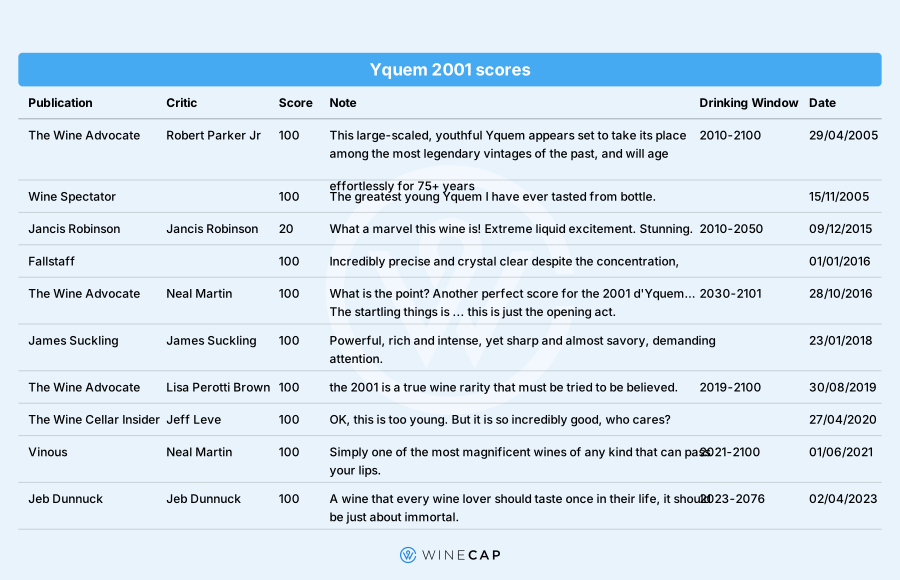
The question now occupying serious collectors is whether the Yquem 2009 will ultimately rival it. Critic Neal Martin raised this directly: “My only question pertaining to the 2001 is whether the 2009 might ultimately surpass it; time will tell.”
For investors, both vintages represent the same fundamental opportunity: a wine at the peak of its critical reputation, in finite and diminishing supply. The 2001’s excellence is better established and more complete, but the 2009 is more affordable and may in due course represent the better opportunity.
6. The comet vintage and the world’s most expensive bottle
In 1811, a great comet blazed across the European sky for 260 days, the longest recorded period of visibility until Hale-Bopp in 1997. The summer was extraordinary: warm, dry, and long, producing wines across France and Germany that bore its name for generations. Yquem 1811 became the most celebrated of the comet vintages and, on two separate occasions, the most expensive white wine ever sold. No other white wine has approached either threshold.
In July 2011, a 75cl bottle of Yquem 1811 sold at London’s Ritz Hotel, offered by rare wine specialists The Antique Wine Company, for HK$904,000 (approximately £72,000 / $116,000 at the time). The buyer was French private collector Christian Vanneque. The previous world record for the most expensive white wine sold at auction was also held by Yquem: the 1787 vintage at HK$468,000. That both world records belong to the same estate makes a point no marketing can replicate.
The 1847 Yquem is the other great 19th-century reference. That year, a 900-litre tun sold to Grand Duke Constantine, brother of the Russian Czar, for 20,000 gold francs in 1859. The sale announced Yquem’s reputation across European courts and established the template for the extraordinary prices its historic bottles still command today.
7. Y d’Yquem and the quiet revolution in Sauternes
Y d’Yquem (pronounced “ee-grek”) is the estate’s dry white wine, and its existence signals something investors should note: Yquem is actively working to broaden the appeal of Sauternes to new audiences.
Produced since 1959 but made every year only since 2004, it is limited to under 10,000 bottles annually. Estate manager Lorenzo Pasquini describes it as “dry but not completely, a nice encounter between the freshness of a great white wine and the voluptuousness of what reminds us of a Sauternes.”
Yquem is not alone in this direction. Several leading Sauternes estates now produce dry whites alongside their sweet wines:
- Guiraud, one of the appellation’s consistently high-quality First Growths.
- Clos de Lunes, made by the Lurton family, who also produce highly regarded whites at Domaine de Chevalier in Pessac-Leognan.
- Suduiraut, one of the best-value estates in the Sauternes appellation, offering an accessible price point in the dry category.
- Climens, the leading estate in Barsac (the Sauternes sub-appellation), has also committed to the category.
Climate change is a part of this as warmer vintages push sugar levels higher and compress the window for selective picking, but this is largely an issue of commercial necessity. Dry whites are both cheaper to make and easier to sell.
8. Yquem and the art of disappearing: a castle hoard and a restaurant heist
Yquem inspires a level of obsession that extends beyond the dining room, and bottles carrying dependable provenance histories command premiums that transcend vintage quality. Two stories, separated by decades, illustrate what that obsession looks like in practice.
In 1945, the aristocratic Beaufort-Spontin family fled Czechoslovakia as the war ended. Before leaving their home at Becov Castle, they hid 136 bottles of wine beneath the chapel floor alongside the Reliquary of St Maurus. Eight of those bottles were Yquem, from the 1892 and 1896 vintages. The collection lay concealed until 1985, when police discovered it following attempts by an American businessman, acting on the family’s behalf, to retrieve it.
In 2016, Yquem’s team used a Coravin device (a needle that extracts a sample through the cork without opening the bottle) to test the wine. It was alive. Cellar master Toni El Khawand led the reconditioning. Only five full original bottles survived intact. They are now on display at Becov Castle. El Khawand described the wine as “a liquid memory.”
The second story moves to October 2021 and the Michelin-starred Atrio restaurant in Caceres, western Spain. Constantin Gabriel Dumitru, a Romanian-Dutch thief, and his partner Priscila Lara Guevara checked in, completed a 14-course tasting menu, and in the small hours stole 45 bottles from the cellar. Among their haul was a bottle of Yquem 1806. That bottle had already lived several lives: bought at Christie’s London in December 2000 for £6,380, its neck broke during storage in 2001, and the estate reconditioned and re-corked it under a new label signed by Sandrine Garbay. Both thieves were caught and convicted; so far, the bottles have never been found.
9. Beyond the cheese board: Yquem and the art of food matching
Sauternes has spent decades relegated to the dessert course. Repositioning it as a versatile food wine is the estate’s most significant commercial effort and, for investors holding Yquem over the long term, the size of the future collector market depends in part on how successfully that repositioning lands. The most visible expression is the Lighthouse project that began in 2019: a curated network of restaurants worldwide that serve Yquem by the glass alongside specific dishes, reaching drinkers who would never encounter it through a traditional wine list.
The pairings that work best, traditional roast chicken and spiced dishes from India, Mexico, and South-East Asia, challenge expectations and the belief that sweet wines sit at the end of a meal. As the Lighthouse programme introduces Yquem to younger drinkers, it also builds the collector base of the future.
10. From Thomas Jefferson to LVMH: 250 years of ownership
Thomas Jefferson brought Yquem to global attention in May 1787, during his tour of French wine regions as US minister to France. In December of that year, he wrote to the estate requesting 250 bottles of the 1784 vintage and later ordered 30 dozen on behalf of President George Washington, with each president’s initials embossed on the glass. His letter, addressed to “the Lady of Yquem,” acknowledged who was actually running the estate.
That woman was Josephine de Sauvage, orphaned at 17 and widowed at 20, who oversaw Yquem’s transformation into the world’s most revered sweet wine. Arrested three times during the French Revolution, she escaped the guillotine by proving the estate had been purchased rather than granted as a feudal privilege. She pioneered the system of tries (selective passes through the vines) now mandatory for all Sauternes producers. When the 1855 classification named Yquem the sole Premier Cru Superieur, it confirmed what she had built.
The Lur-Saluces family held the estate for more than two centuries before Bernard Arnault of LVMH began acquiring shares in 1996. Alexandre de Lur Saluces fought the sale through the courts before accepting the inevitable. LVMH gained a controlling stake by 2000, and Pierre Lurton was appointed director in 2005, simultaneously overseeing Cheval Blanc. Yquem’s acquisition sat alongside Cheval Blanc and Domaine des Lambrays in LVMH’s first wave of serious fine wine investment, a statement that the world’s leading luxury group and the world’s greatest sweet wine belong in the same portfolio.
Where Yquem fits in a serious wine portfolio
Yquem belongs in a different category from every other sweet wine. Its singular classification, 250-year track record, proven secondary market depth, and resilience through the 2022 Bordeaux correction make it the only Sauternes that sits alongside Bordeaux and Burgundy in an investment portfolio without qualification.
FAQ: Chateau d’Yquem as an investment
Is Chateau d’Yquem a good wine investment?
Yquem is the most liquid Sauternes on the secondary market and the only sweet wine with the trading depth that allows investors to enter and exit positions reliably. WineCap’s index held its gains better than the wider Bordeaux market through the subsequent correction. For investors seeking exposure to Sauternes, it is the strongest and most consistent option available.
How much does Chateau d’Yquem cost?
Recent vintages trade from around £200 per bottle on the secondary market. The most sought-after releases, including the 2001 and 2009 are closer to £400. Historic bottles can be much more costly, with 20th century bottles often above £3,000 and 19th century bottles regularly trading above £20,000.
How long does Chateau d’Yquem last?
Properly stored Yquem can last centuries. The residual sugar, glycerol, and natural acidity created by botrytis cinerea act as natural preservatives without any added spirit. With correct storage conditions, modern vintages should comfortably exceed 50 years in bottle and very likely much longer.
What is the best Yquem vintage to buy?
The 2001 is the most critically acclaimed sweet wine ever produced and probably the most consistently scored wine of any description with perfect scores from multiple leading critics. The 2009 is the vintage most likely to challenge it for quality. For investors seeking a more accessible entry point younger vintages may be more attractive.
How does Yquem compare to other Sauternes as an investment?
Yquem is the strongest performer and most liquid Sauternes on the secondary market by a considerable margin. No other producer offers the same consistent quality, trading depth or performance.
WineCap’s independent market analysis helps investors build diversified fine wine portfolios with full ownership and transparent pricing. Speak to one of our wine investment experts and start building your portfolio. Schedule your free consultation today.
Capital at risk. Past performance is not a guide to future returns. Returns are not guaranteed.