- We compare the price performance of Chateau Lafite Rothschild to top wines from other regions
- Lafite’s price ratio has widened against all five wines in this comparison since October 2016
- Today, you can get 42 bottles of Lafite for the cost of a bottle of DRC, in October 2016 it was 23 bottles
- Sassicaia and Dom Perignon have gained the most, almost entirely in the past ten years
A single bottle of Domaine de la Romanee-Conti (DRC) now costs as much as 42 bottles of Chateau Lafite Rothschild. Ten years ago, it cost 23.
Lafite has become relatively less expensive than all five of the great wines in this comparison since 2016, but not for the same reason. Burgundy’s lead was already building before 2016. Champagne and Tuscany have caught up only in the past decade.
Using ten years of Wine Track data, and the average case price of each wine going back to the 2000 vintage, this article examines what has driven each gap.
How the Lafite price ratio works
How many bottles of Lafite does it take to buy one bottle of another wine? That’s the Lafite price ratio, a quick way to see how this top First Growth is moving against its peers.
Lafite is one of Bordeaux’s five First Growths, the highest tier of the Bordeaux 1855 classification. This comparison covers five iconic wines that are synonymous with their region:
- DRC Romanee-Conti from Burgundy
- Petrus from Pomerol on Bordeaux’s right bank
- Sassicaia from Tuscany
- Dom Perignon from Champagne
- Screaming Eagle from California
The figures use monthly Wine Track data from October 2016 to October 2026 and show the wines’ prices relative to each other, not an absolute return.
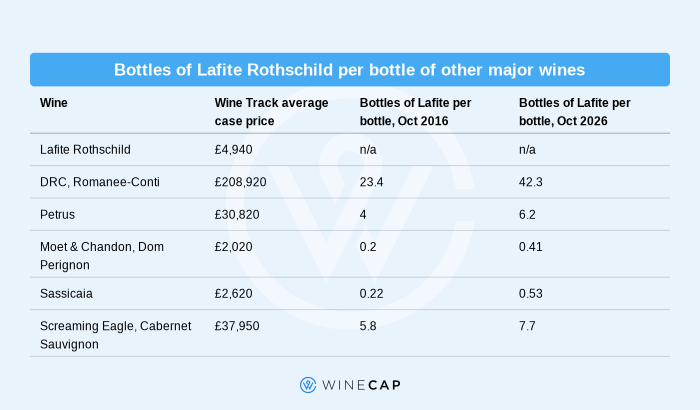 Source: Wine Track, October 2026. Capital at risk. Past performance is not a guide to future returns. Returns are not guaranteed.
Lafite Rothschild vs DRC Romanee-Conti price ratio
The DRC:Lafite price ratio is somewhat reflective of broader trends within their regions. In the last decade, Burgundy emerged as Bordeaux’s main contender. After Bordeaux peaked at the end of the China-led bull market in 2011, buyers started to seek out other corners of the fine wine world and it was Burgundy that attracted the greatest attention. The allure of rarity and quality meant that demand quickly outstripped already tight supply. Prices for Burgundy peaked, while Bordeaux ran quietly in the background.
For Bordeaux, the period between 2013 and 2015 saw contraction at the tail end of the Chinese correction. The market turned again in October 2015, and since then, Lafite Rothschild has been the second-best-performing First Growth, with some vintages doubling in value. However, it has not managed to catch up with Burgundy’s stellar rise.
DRC remains the most expensive wine in this comparison by a wide margin – one bottle now costs 42 bottles of Lafite.
- October 2016: 23 bottles of Lafite
- August 2025 peak: 44 bottles
- October 2026: 42 bottles
Price index data for Lafite and DRC provides more context to the ratio and can be found in the Wine Track section of our website. The DRC index reached its high in December 2022 and now sits 25% below it. Lafite reached its high earlier, but its fall from there has been larger, this is the dynamic that explains the change in the ratio since 2022.
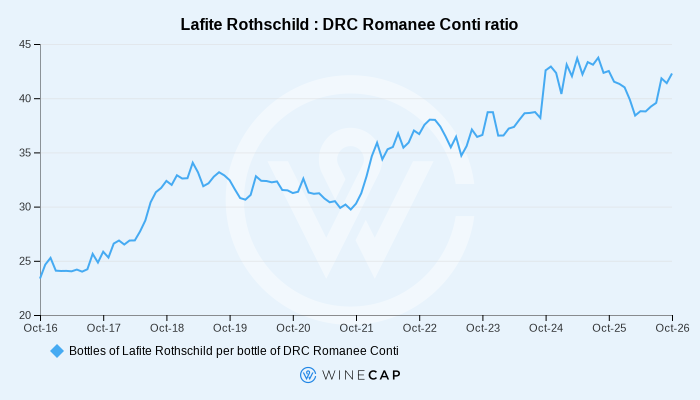
Source: Wine Track, October 2026. Capital at risk. Past performance is not a guide to future returns. Returns are not guaranteed.
Lafite Rothschild vs Petrus price ratio
Petrus from Pomerol on the right bank of Bordeaux is one of the regions rarest and most prestigious wines. Pomerol has no official classification, so its standing rests entirely on reputation and demand. A bottle of Petrus now costs 6.2 bottles of Lafite, up from 4 in October 2016. Rarity plays a key role in the gap, as Petrus produces around 3,000 cases a year, against around 25,000 cases for Lafite.
The ratio between the two reached 6.7 bottles in December 2025. The Petrus index peaked in December 2022 and now sits 28% below that high.
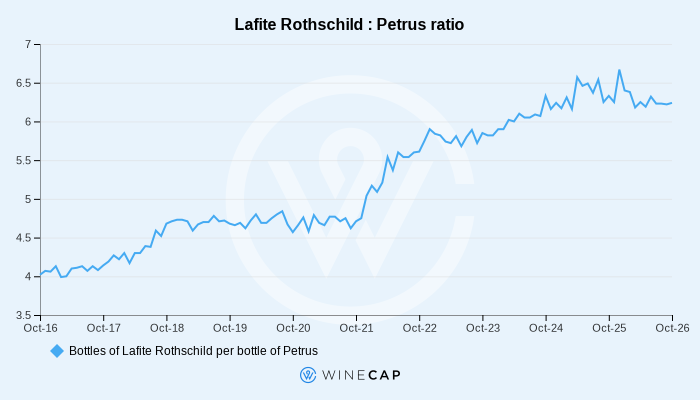
Source: Wine Track, October 2026. Capital at risk. Past performance is not a guide to future returns. Returns are not guaranteed.
Lafite Rothschild vs Dom Perignon price ratio
Dom Perignon has doubled its price relative to Lafite over the decade, in line with the wider Champagne market. A bottle now costs 41% of a bottle of Lafite. In October 2016, it cost 20%. As is the case with Lafite, Dom Perignon prices have fallen since 2022, but Dom Perignon’s contraction has been smaller. That’s why today’s ratio, 0.4 bottles of Dom Perignon to 1 bottle of Lafite, is at the highest its been in 10 years, even though prices have fallen in absolute terms.
Dom Perignon is produced in far larger quantities than Lafite, and the wine is more widely available. Its Wine Track index has risen 75% over the decade, and sits 17% below its September 2022 high.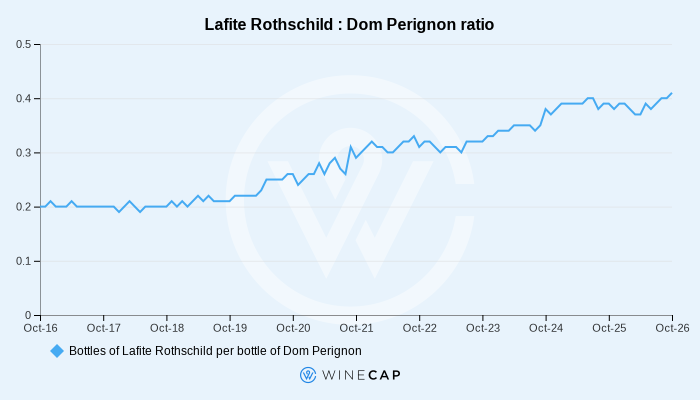
Source: Wine Track, October 2026. Capital at risk. Past performance is not a guide to future returns. Returns are not guaranteed.
Lafite Rothschild vs Sassicaia price ratio
Sassicaia has gained more on Lafite than any other wine in the comparison. A bottle now costs 53% of a bottle of Lafite, up from 22% in October 2016.
Sassicaia leads the Super Tuscans, the most liquid and heavily traded group of Italian wines. Critic scores and brand strength have helped. Trade policy has played a part too – Italian wines were left out of the 25% US tariffs placed on French wines in October 2019 – although Italian wines no longer enjoy that advantage, Tuscany’s greater presence in the large US domestic market has endured.
The ratio reached 57% in February 2025, the same month the Sassicaia index hit its high. Sassicaia’s index now sits 10% below that level.
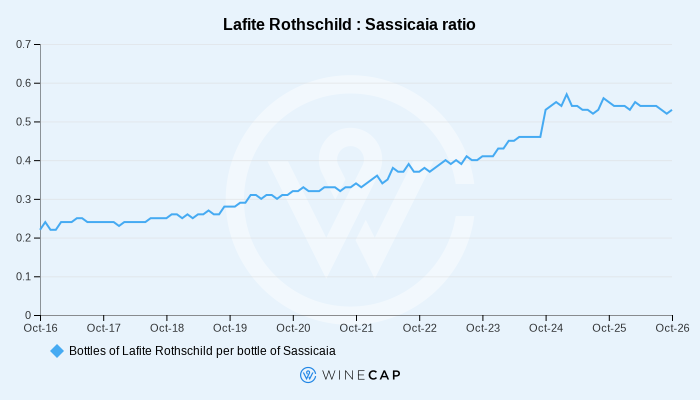
Source: Wine Track, October 2026. Capital at risk. Past performance is not a guide to future returns. Returns are not guaranteed.
Lafite Rothschild vs Screaming Eagle price ratio
Screaming Eagle has the most volatile ratio in this comparison. Its rises have been bigger and its falls sharper.
Those swings show how a Californian cult wine differs from a Bordeaux First Growth and reflect the different challenges that Napa has faced with wildfires and a difficult domestic trading climate for wine in the US. Currency adds another layer. Screaming Eagle is originally sold in US dollars, so changes in the currency pair have had some influence here.
- October 2016: 5.8 bottles of Lafite
- June 2018 low: 4.5 bottles
- October 2026 high: 7.7 bottles
The Screaming Eagle index rose 14% over the decade, roughly matching the size of Lafite’s fall. It peaked in February 2022 and now sits 21% below that high.
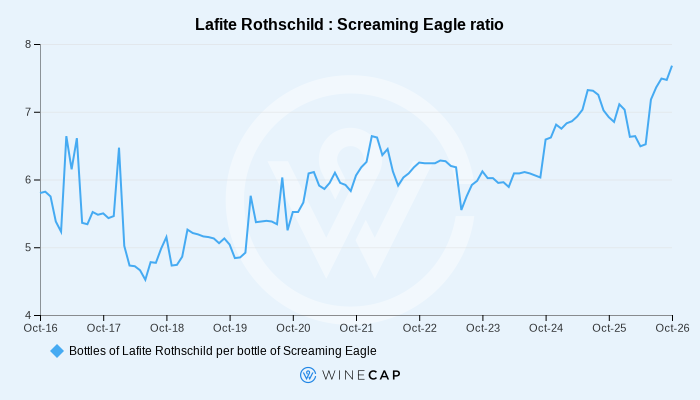
Source: Wine Track, October 2026. Capital at risk. Past performance is not a guide to future returns. Returns are not guaranteed.
How have the Lafite Rothschild price ratios changed since our 2023 analysis?
Our first price ratio analysis, published in November 2023, used data going back to 2013. Setting those starting points beside the current Wine Track figures shows two different stories.
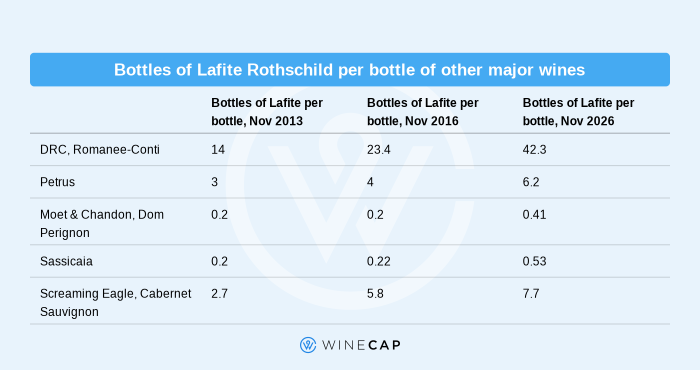
Source: Wine Track, October 2026. Capital at risk. Past performance is not a guide to future returns. Returns are not guaranteed.
The first story is about DRC, Petrus, and Screaming Eagle, which were already pulling away from Lafite before 2016. Between November 2013 and October 2016, DRC’s ratio rose from 14 to 23 bottles; the years since have extended that move, and they are not where it began.
Champagne and Tuscany tell a newer story. The ratios of Dom Perignon and Sassicaia to Lafite were static between 2013 and 2016, and their gains have happened almost entirely within the last 10 years.
A rising ratio reports the past, not the next move
Relative price ratios measure what the market has paid, not what it will pay. While the price gap against peers can persist, Lafite currently offers better relative value against each of these five wines than at any point in the last decade.
For an investor, the ratios turn a regional preference into a question of allocation. Each wine now commands a higher multiple of Lafite’s price than a decade ago, which shows where buyers have paid more, and where relative value lies.
WineCap’s independent market analysis helps investors build diversified fine wine portfolios with full ownership and transparent pricing. Speak to one of our wine investment experts and start building your portfolio. Schedule your free consultation today.
FAQ: Lafite price ratios
What does the Lafite price ratio measure?
The ratio counts how many bottles of Lafite buy one bottle of another wine, which shows relative price rather than absolute return. DRC cost 23 bottles of Lafite in October 2016 and costs 42 in October 2026.
Does a rising ratio mean Lafite is undervalued?
Not necessarily. A rising ratio could be because Lafite’s price has fallen. It could be because the other wine in the comparison has seen its prices rise, or it could be because of both. Both have happened here: Lafite’s Wine Track index fell 14% over the decade while the other five rose between 14% and 106%. Lafite’s index also sits 34% below its September 2022 high, so a lower price against peers has not meant rising prices.
Which wine has gained most against Lafite?
Sassicaia has gained the most. In October 2016, a bottle cost 22% of the price of a bottle of Lafite. By October 2026, that had risen to 53%. Dom Perignon ranks second in our study, with its ratio doubling from 20% to 41%.
Why do production volumes matter for price changes?
Supply helps shape how far a wine can rise when demand grows. Petrus produces around 3,000 cases a year against around 25,000 for Lafite, so small changes in demand can have a significant impact on price. Scarcity isn’t the whole story, though. Dom Perignon is made in larger quantities than Lafite, yet its ratio doubled.
Capital at risk. Past performance is not a guide to future returns. Returns are not guaranteed.