An Investor’s Guide to Super Tuscan Wines
- Super Tuscan wines broke Tuscany’s winemaking rules and became some of Italy’s most traded and most liquid fine wines
- The top five most searched-for Italian wines on Wine-Searcher and almost half of the 25 most searched-for Italian wines are all Super Tuscans
- Italian wines, especially Super Tuscan wines, play a useful diversification role in investors’ portfolios
Super Tuscan wines began as an act of defiance and became some of Italy’s most liquid and investable fine wines. Producers broke Tuscany’s appellation rules (the legal codes that set where a wine is made, which grapes it uses and how), accepted a humble label, and made wines that critics and collectors then rewarded. This guide explains what defines a Super Tuscan, which producers matter and why these wines can earn a place in an investment portfolio.
What is a Super Tuscan wine?
A Super Tuscan is a Tuscan wine made outside the strict wine-making rules that historically governed the region’s best known winemaking areas. The label has no legal definition, so it tells an investor nothing about quality or production methods. What links the category is the act of rule-breaking, which created some of Italy’s most recognisable investment brands.
Appellation rules exist to protect a region’s identity and set a quality floor, they dictate much of the way a wine is made. For example, Chianti rules had for decades limited the grapes producers could plant and required a small proportion of white grapes in the final blend. A producer who wanted a different wine had to leave the system, and a label that sat outside it lost the prestige of the official classification, which is how the Super Tuscan idea began.
Producers broke the rules in two main ways:
- Planting grapes the local rules did not permit, such as Cabernet Sauvignon
- Abandoning a mandatory blend, such as the white grapes once required in Chianti
In other regions, appellation rules guarantee production methods and grape types in a way that no longer applies to wines that choose the Super Tuscan identity. For instance, Champagne must undergo fermentation in its bottle, while a red Premier Cru Burgundy must be made of Pinot Noir. No such rules apply to a Super Tuscan wine.
What’s special about Sassicaia?
Sassicaia let off the starting gun on the Super Tuscan story. Inspired by the wines of Bordeaux, Marchese Mario Incisa della Rocchetta planted Cabernet Sauvignon at his Tenuta San Guido estate in Bolgheri on Tuscany’s western coast. Initially, the wine was made solely for private consumption and was never intended to become a commercial product.
The rules of the day did not permit wine made from these grapes to carry the regional brand, so Sassicaia carried the lowest label in Italy’s system, “Vino da Tavola” (table wine). The irony is that the table wine outperformed its peers in quality, and later in performance, desirability and trading in the secondary market (buying and selling between collectors and investors after the first release of a wine).
Dozens of producers followed, and eventually the rules themselves had to change. In 1992 the IGT classification was created to sit above Vino da Tavola and carry some regional specificity. The Super Tuscan’s status was cemented in 1994 with Sassicaia receiving its own appellation, becoming the only single estate appellation in Italy.
Critics confirmed the quality that was possible from these rule breakers. Sassicaia 1985 became the first Italian wine to earn 100 points from influential American critic Robert Parker in 1992. High scores for other Super Tuscan’s followed. In 2001, The World Atlas of Wine, a standard reference text could state without controversy that “Italy was no longer second to France”.
New buyers were excited by the story of defiance against Italian bureaucracy and the brand of Super Tuscan became more and more powerful. The wider following that grew supports the secondary market liquidity investors value today.
Super Tuscan producers: the rule-breakers investors should know
A handful of names account for most of the category’s secondary market trading and its core of investable wines.
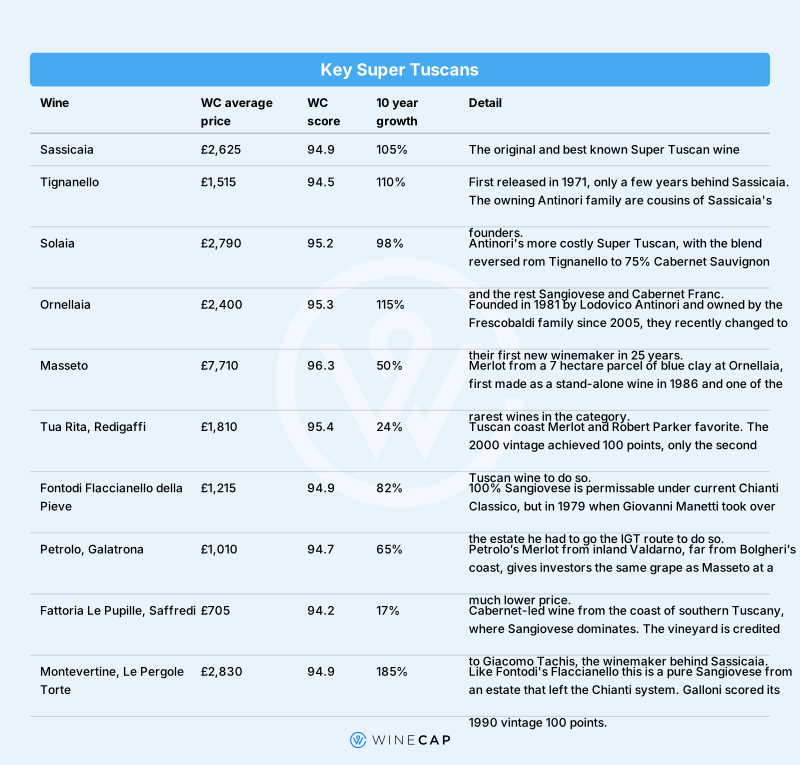
Beyond this core there are other notable Super Tuscan wines worthy of mention:
- Gaja, Ca’Marcanda: Although its core remains in Piedmont, Gaja also own a Tuscan estate, bringing a northern Italian name to Cabernet and Merlot country
- Frescobaldi Luce: In a similar vein to Mouton Rothschild’s involvement in California icon wine Opus One, Luce began as a Frescobaldi and Mondavi partnership in 1995 to make a Merlot and Sangiovese blend
- Soldera, Casse Basse: Gianfranco Soldera resigned from the Brunello consortium in 2013 after vandals destroyed six vintages of his wine, and began labelling his wines IGT thereafter
What unifies all of the Super Tuscans, isn’t performance or winemaking or even terroir. It’s the act of breaking with regulation, this makes for a very broad church.
Why Super Tuscans earn a place in investment portfolios
There are many different reasons why a Super Tuscan wine would be included in an investment portfolio, and none of them are exclusive to the category. They include:
- Profile: Popularity doesn’t equal performance, but it is nevertheless a useful measure. Super Tuscan wines make up the top five most searched-for Italian wines on WineSearcher. Liv-ex (the largest B2B wine trading platform) curates an annual Power 100 brand ranking that is another proxy for popularity; 8 of the 11 Italian wines to feature in the top 10 since 2014 have been Super Tuscan brands.
- Relative value: A key part of the appeal for Italian wines in general and Super Tuscan wines in particular. Wines like Tignanello and Sassicaia enter the market well below the highest profile Bordeaux wines such as Lafite Rothschild, but earn comparable critic scores.
- Scarcity: A factor for all investable wines but for some Super Tuscans it is a key part of their appeal. Masseto makes only around 2,500 cases per year, Casse Basse Brunello di Montalcino around half of that. With production this low, even modest changes in demand can have a significant impact on prices. Conversely fewer bottles change hands, so a seller may wait longer for the right buyer than with a more liquid brand.
- Diversification: A portfolio built only on Bordeaux depends on one region, one set of critics and one market mood. Adding Tuscan wines spreads that exposure across different grapes, styles and buyer groups, which can soften the effect of a downturn in any single area, as was the case from the peak of the market in 2022 to early 2026.
- Growing Liquidity: Italy has become one of fine wine’s biggest liquidity growth stories. Italian wine’s share of trade by value on the largest trading platform has more than tripled from 5% in 2014–2016 exceeding 16% in 2026.
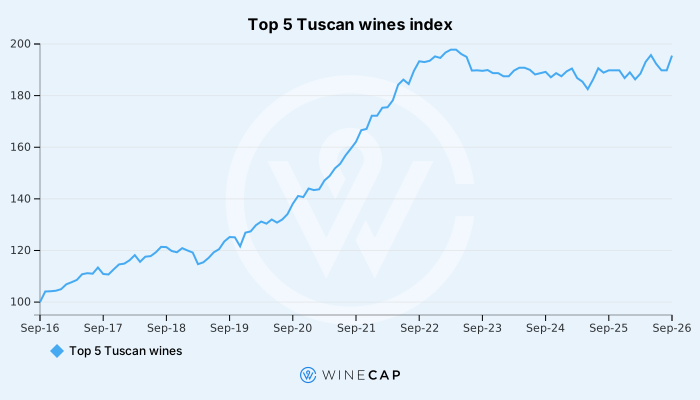
Ultimately, the prime concern for investors is performance. Our 10-year index of WineCap market prices for the five most searched for Tuscan wines (Sassicaia, Tignanello, Masseto, Ornellaia and Solaia) is currently up 95% from its starting level and despite the market correction has stayed within 10% of its high. For investors, Tuscan wines have been amongst the most resilient holdings through the recent downturn.
How Bordeaux’s distribution system widens the buyer pool for Italian wine
Distribution decides how many buyers can reach a wine, and that shapes how easily an investor can sell it. La Place de Bordeaux is the merchant network, centred on Bordeaux, that distributes top wines to buyers in London, Tokyo, Hong Kong and beyond. Its negociants (merchant houses that buy from producers and resell to the trade) give wine access to thousands of global buyers, which tends to raise liquidity and steady prices.
Access to La Place works as a quality signal as well as a sales channel. A wine on the platform has been accepted by the merchants who handle the world’s most traded bottles, and that acceptance tends to support both demand and price discovery.
Solaia joined La Place in 2009, which gave it access to a far wider group of international merchants. A broader buyer base is one reason Antinori’s Cabernet-led wine commands the prices it does.
Bibi Graetz shows that the arrangement can also unwind. Early releases from this coastal Tuscan producer had been very successful and supported significant growth, but as the market contracted so did merchant demand leading to unsold wines. 2025 was the last year Bibi Graetz released their flagship “Testamatta” through the Bordeaux network, and the estate has returned to working more closely with a smaller group of producers.
The Super Tuscan family tree supports demand
The Super Tuscan brand’s power sustains demand, and its influence extends beyond just the highest profile wines. WineCap’s guide to Sassicaia points to attention from public figures including LeBron James, Barack Obama and Rihanna. Such attention to the region’s halo wine introduces Super Tuscans beyond core wine buyers to a larger demographic interested in high profile luxury brands.
The Sassicaia’s descendants show how far the model reached. The cross pollination with Tignanello is clear, with that wine coming from Piero Antinori, nephew of Sassicaia’s founder. The influence can also be seen in other regions: In Trentino, San Leonardo became widely known as the Sassicaia of the North, and in Campania, Montevetrano as the Sassicaia of the South. These wines don’t just prove that Cabernet blends of comparable ambition could succeed far from Bolgheri, but also show the power of Sassicaia, and by extension the Super Tuscan brand.
Super Tuscan wines built their reputation on the same idea: that Italian producers could compete with Bordeaux on their own terms, and win buyers who had never considered Italy for serious cellaring. The halo power of the top wines support demand in two ways. It widens the pool of buyers who recognise the concept of a Super Tuscan wine, and it gives owners confidence that a bottle can be resold.
Michele Satta, a Bolgheri producer, put the debt simply: “We are all children of Sassicaia.“
Super Tuscans and Piedmont wines play different roles in an Italian portfolio
For investors, Piedmont overwhelmingly means Barolo and Barbaresco, the wines that attract most collector and investor interest in the region both crafted from the Nebbiolo grape.
In its structure and production Piedmont resembles Burgundy. Both regions draw fine distinctions between wines, with many small estates, individual vineyard names and sharp differences between vintages. Producers tend to make many different wines in lower quantities and from small parcels. This means that collecting is driven by site specificity as much as brand power. Bruno Giacosa makes 35 wines, Giuseppe Mascarello 29 and Aldo Conterno 27, so selection takes real expertise.
Super Tuscans are closer to the Bordeaux model. Production volumes are larger, and the producers are brand-led, with a short list of established names carrying the category. Ornellaia makes 10 wines, and Tenuta San Guido, the maker of Sassicaia, makes only 5. Sassicaia alone is produced at around 200,000 bottles a year, which makes the top names easier to follow, benchmark and trade. Global luxury recognition and a broader, more mainstream buyer base add to this, making the top names easier to sell.
In exactly the same way that investors will likely hold both Bordeaux and Burgundy, they are likely to hold Piedmont and Super Tuscans alongside each other.
Super Tuscans have earned a core place in a wine portfolio
Super Tuscans have moved from rule-breaking outsiders to an established part of the fine wine market. Italian wine’s share of trade by value has more than tripled in a decade, to over 16%, while the top five Tuscan wines are up 95% over ten years and have stayed within 10% of their high through a downturn that had a much larger impact on other regions.
That record, and a brand that now reaches well beyond wine specialists, earns Super Tuscans a place at the core of a well-considered modern portfolio alongside the core French regions in Bordeaux, Burgundy and Champagne.
FAQ: investing in Super Tuscan wines
What is a Super Tuscan wine?
A Super Tuscan is a Tuscan red made outside the appellation rules of its time, whether by using unapproved grapes, dropping a mandatory blend or choosing a looser label. The term has no legal definition. Sassicaia, first sold in 1971 as table wine, is the original example, and it now has its own DOC.
Is Sassicaia or Tignanello the better investment?
Both are viable assets for investors and they have traded closely together over long periods. Sassicaia holds higher status and has a higher search ranking, while Tignanello has a lower entry price, which has helped it prove resilient in market corrections.
Are Super Tuscans a safer investment than Bordeaux?
Not automatically. Tuscan wines held up comparatively well after the 2022 peak, but returns are never guaranteed. Some like Sassicaia trade deeply, while a higher priced but smaller production wine such as Soldera Casse Basse may take longer to sell.
How much does it cost to enter the Super Tuscan market?
Entry costs vary widely. Fontodi’s Flaccianello della Pieve offers a low cost route into top Italian wine with WineCap’s Wine Track average price at just over £1,200 a case, while Masseto sits at the other end of the scale with prices approaching £8,000 per case.
How are Super Tuscans taxed in the UK?
UK tax treatment depends on individual circumstances and HMRC rules. Fine wine is generally treated as a wasting asset (an item with a predictable life of 50 years or less), which usually means gains on sale are exempt from capital gains tax, and the same treatment is generally applied to labels such as Tignanello and Sassicaia. This is general information, not tax advice, so investors should take professional advice.
Does storage matter for Super Tuscans?
Yes. A bottle of Tenuta San Guido, Sassicaia 1985 with a documented storage history in a bonded warehouse can be sold with its provenance intact, which supports a premium. Wine kept at home without records is usually discounted by buyers, however good the producer.
WineCap’s independent market analysis helps investors build diversified fine wine portfolios with full ownership and transparent pricing. Speak to one of our wine investment experts and start building your portfolio. Schedule your free consultation today.
Capital at risk. Past performance is not a guide to future returns. Returns are not guaranteed.