How to invest £50,000 in wine
- More regions and more wines have become investable in recent years due to increasing liquidity
- Core French regions make up the largest part of our model portfolio: Bordeaux anchors liquidity, Burgundy adds scarcity, Champagne adds brand recognition
- Prices fell from early 2023 to late 2025 and have since stabilised, with early gains in older Bordeaux and Champagne
Yes, £50,000 is enough to build a wine portfolio, and it’s enough to build a diversified wine portfolio. This guide sets out a model split with the largest holding of 40% in Bordeaux, 25% in Burgundy, 15% in Champagne, and 10% each in Italy and other regions. It explains the role each region plays, from liquidity (how quickly a wine sells at a fair price) to scarcity, and covers the costs, risks and exit routes that decide what an investor keeps.
Is £50,000 enough to build a diversified wine portfolio?
£50,000 buys exposure to every major region with enough money in each to hold several of the market’s key brands.
Scale inherently changes what a portfolio can hold. Domaine de la Romanee-Conti, the Burgundy estate whose wines sit at the very top of the market, is unlikely to appear in a £25,000 portfolio when prices start at £6,000+ for a case of three bottles of their most affordable wines. At £50,000, an investor can start to include wines with that kind of profile, and can spread the money across regions, vintages and price points instead of concentrating it in a few cases.
Diversification is the practical benefit. A single case of a famous wine concentrates risk in one producer, one vintage and one group of buyers. Spreading £50,000 across regions and roles means a weak spell in any one of them has less impact on a portfolio’s overall value.
What are the major sectors for wine investors?
Wine already diversifies a wider portfolio, but there is a strong case for diversifying within wine as well. Regions and styles take turns leading the market, so an investor who holds several reduces dependence on any single cycle.
- Bordeaux provides liquidity. Its high production volumes and global recognition make it the cornerstone of the secondary market (buying and selling between collectors and investors after a wine’s first release).
- Burgundy provides scarcity. Small vineyard parcels and limited production keep supply tight, which makes its best wines the market’s most prized collectables.
- Champagne provides accessibility. High trading volumes and strong brand recognition give it a wide buyer pool, at a lower price per bottle than Burgundy. For most people, fine wine means a bottle of Champagne.
- Italy shares a number of characteristics with Champagne, in particular high trading volumes and strong brand recognition. Its presence in the market has expanded over the past decade, and a concentrated group of wines, led by the Super Tuscans (Tuscan reds made outside the region’s traditional appellation rules), is genuinely investable.
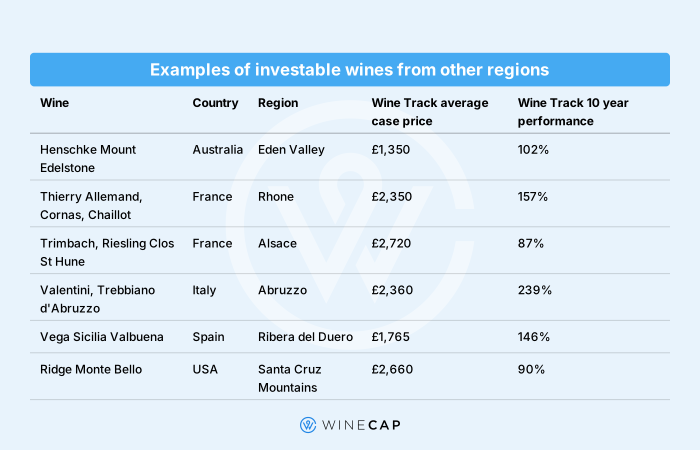
Other regions provide variety, although they have few investable wines and lower liquidity. They should form a smaller part of a portfolio and might include:
- California, led by Napa Valley
- The Rhone Valley in France
- Spain, including Rioja and Ribera del Duero
- Australia
- Alsace in France
These roles complement each other. Bordeaux and Champagne supply the wines most likely to sell quickly, Champagne and Italy supply wines where depletion through drinking has a larger and more immediate impact on values. Burgundy supplies scarcity, and other regions add variety. A portfolio built only on scarcity can struggle to sell in a quiet market, while one built only on liquidity gives up the pricing power and appreciation that rarity can bring.
How should I split £50,000 across wine regions?
The precise distribution of value in a portfolio will vary depending on prevailing market conditions, an individual investor’s personal preferences, and where good prices are available at any given time. This model should be taken as a guide only and not as a fixed proportion.
Individual investors may prefer to focus on the accessibility of Champagne or the rarity in a more costly region like Burgundy.
WineCap’s model portfolio puts about 40% of a £50,000 budget in Bordeaux, 25% in Burgundy, 15% in Champagne, 10% in Italy and 10% in other regions.
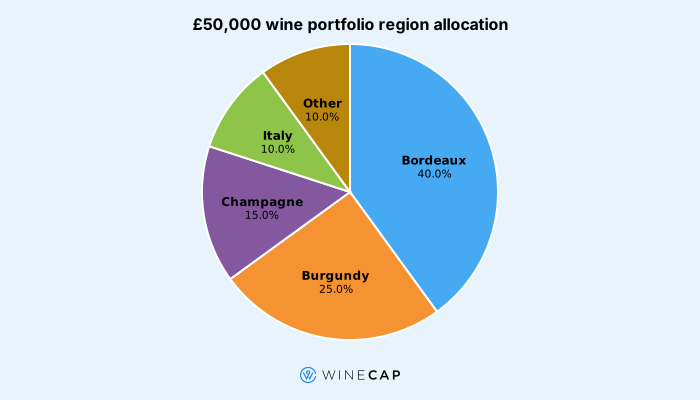
This structure has changed over time. In the early 2000s, only Bordeaux had meaningful liquidity, and that was concentrated in First Growth Bordeaux, (the five top-ranked Bordeaux chateaux in the 1855 Bordeaux classification), so those wines would have dominated any well-constructed portfolio. Liquidity has since grown sharply in other regions, alongside stronger performance that has driven greater investor interest.
Any portfolio model will vary with budget. At £25,000, five regional slices leave little room to buy meaningful volume, so fewer regions make sense. At £100,000, an investor can add more wines, higher-priced bottles and possibly a larger allocation outside the core regions.
Why put 40% of a wine portfolio in Bordeaux?
Bordeaux anchors a wine portfolio because it is the deepest and most liquid market. A deep market has many buyers and sellers, so an investor can usually sell without cutting the price sharply.
Search and trade data show how far ahead Bordeaux sits. Wine-Searcher (a price comparison site whose rankings measure search interest, not completed trades) puts Bordeaux in seven of its ten most searched-for wines, with the First Growths accounting for five of those ten.
Completed trades tell the same story. On the largest b2b exchange where merchants trade wine with each other, Bordeaux makes up five of the ten most traded wines by value.
On most technical measures of liquidity, or their proxies, Bordeaux comes out on top. The five First Growths (Lafite Rothschild, Latour, Margaux, Haut-Brion and Mouton Rothschild) are its best-known names, which is why the Bordeaux allocation builds its core around them.
A handful of individual wines may trade more often than the most traded Bordeaux. Nothing else matches the region for depth. That depth is why Bordeaux takes 40% of the model portfolio: it is the part most likely to sell quickly if an investor needs cash.
How much should I invest in Burgundy?
Burgundy offers scarcity and high prices per bottle, and it takes 25% of the model portfolio. If Bordeaux is about depth and liquidity, Burgundy is the clearest expression of collectability, where perceived quality and exclusivity make their home.
At the very top of the classic car market, buyers and sellers repeat a phrase: “try and find another one.” Burgundy is the closest thing to that for wine. Restricted supply means even small changes in demand can have an outsized effect on prices.
Scarcity also changes how Burgundian wines behave in a downturn. Thinner trading meant that price falls from 2023 to 2025 were less visible than in Bordeaux and Champagne. Price falls in less liquid wine may only show up now that trading volumes have begun to grow again. For a seller, thin trading means fewer buyers at any one time and a quoted price may not be what a seller achieves in a thin market.
High prices mean a Burgundy allocation of £10,000 to £12,500 buys fewer bottles than the same sum would in Champagne. Investors in this region therefore choose carefully, often favouring established domaines whose wines have a record of strong demand.
How much should I invest in Champagne?
Champagne costs less per bottle than Burgundy, which is why it often takes 15% to 20% of the model portfolio. Even the most expensive wines such as Krug, Clos du Mesnil (Wine Track, WineCap’s data product, shows an average case price of £16,505 across vintages) or Bollinger Vieilles Vignes Francaises (£13,775 average case price), compare favourably with the most costly Burgundy that can easily be more than £100,000 a case. A smaller allocation in Champagne can still buy meaningful volumes of the highest profile and most liquid wines.
Champagne has the broadest brand recognition in fine wine. For most people who are not wine enthusiasts, “fine wine” means a bottle of Champagne, likely from Moet & Chandon, Dom Perignon, Cristal or Veuve Clicquot. These are among the few wine brands that reach beyond wine lovers, and that recognition widens the pool of potential buyers. Trading data backs this up. On the major trading platform, Dom Perignon was the single most traded wine by volume in two of the last three years.
Consumption patterns and production levels are also different: In comparison to top wines from other regions, Champagne tends to get drunk more quickly after its release. Although this balances against larger production volumes, it does mean that depletion becomes a factor in pricing more quickly.
Those same high volumes make Champagne easier to sell, and they make price moves show up quickly. Champagne’s price falls from 2023 to 2025 were visible for that reason, and its most liquid names have led the recovery so far.
Where does Italian wine fit in a portfolio?
Italian wine earns 10% of the portfolio because its liquidity has grown strongly over the past decade, even though it lacks Bordeaux’s depth. Sassicaia (the original Super Tuscan, made by Tenuta San Guido) is heavily traded and frequently ranks among the five most traded wines on the largest exchange.
Italy’s share of the market has grown in the same way as Burgundy’s and Champagne’s, rising from 5% in 2014 to more than 16% in 2026. Italy’s recent growth has been more attractive than Bordeaux, Champagne or Burgundy, partly because of affordability and partly because of more moderate growth from 2020 to 2023. While prices did correct, falls since 2023 have been dramatically smaller than in other sectors.
Fewer Italian wines are investable, and the focus belongs on Tuscany and particularly the Super Tuscans, which WineCap’s guide covers in detail. In a £50,000 portfolio, an investor might begin to look beyond Tuscany at Piedmont wines such as Barolo and Barbaresco, and a handful of wines in Abruzzo on the Adriatic or Valpolicella in Veneto
What goes in the other 10% of a wine portfolio?
The other 10% is the flexible part of the portfolio. Pockets of liquidity exist outside the four core regions, although these wines are inherently less liquid. These regions have fewer investable wines; Investors should treat this allocation as a small supporting holding, not a core one.
At £50,000, portfolios will not be able to hold wines from every one of these additional sectors.
Which wines could a £50,000 portfolio hold?
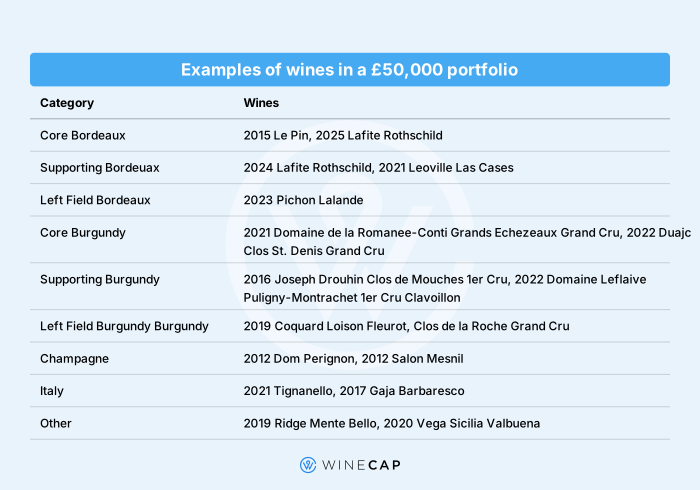
A model portfolio gives each region three types of holdings: core wines that anchor the allocation, supporting wines that add range at a lower price, and left-field wines with smaller markets. The wines below are illustrative, not a recommendation, and the mix shifts as prices and availability change.
At these budgets, core Burgundy and Champagne mean established producers at accessible price points, not the market’s rarest bottles.
What returns can I expect from wine, and what can go wrong?
Historical returns show how wide the range of outcomes can be. Some Burgundies have risen 20x over the last decade (Wine Track shows Domaine Bizot Echezeaux Grand Cru up 1960% in 10 years), but that is not the norm. Many mainstream accessible wines have seen growth of over 100% in the last decade (e.g. Dom Perignon 2005 up 130% in the last decade).
However, prices can also fall. From early 2023 to the end of 2025, prices dropped across much of the market, especially in Bordeaux En Primeur releases (the newest vintages of wine sold the year after harvest before bottling). Those released at the top of the market in 2021-2023 were particularly impacted, for example, Lafite Rothschild 2020 was at one point down 40% from its release price. Values have since stabilised and have begun to rise, led by older Bordeaux and high-liquidity wines such as Dom Perignon. In recent months those gains have begun to spread to other regions and vintages.
Averages also hide wide differences. A region’s headline index can rise while individual wines fall, and the best performers of one cycle are often not the leaders of the next. That is why spreading across regions, producers and vintages matters more than picking a single winner.
How do I sell wine when I want to exit?
The exit route depends largely on the provider. With a managed provider, the provider handles the sale. With a merchant or marketplace, the investor does more of the work.
WineCap manages the entire sale of wine stored with it for a flat 3% fee, working across different platforms to sell the wine in a timely manner. Auction platforms can sometimes achieve the best return, but costs can be high. For self-directed investors, platforms like Squelch and BidforWine charge from 5%-10%, but the seller arranges listing, photography and delivery, so the headline fee understates the effort.
Liquidity in wine differs from equities or bonds. It sits closer to property but has good substitutability, supported by in-bond storage (an HMRC-regulated facility that allows long-term storage with duty and VAT unpaid), which can make it easier to find buyers than other treasure assets such as whisky, art or antiques.
Price drives speed. An investor with a specific price target may wait until the market reaches it, while one in a hurry may price below the market. Higher-priced wines tend to be less liquid, at the very top end of the market, a wine like Domaine Leroy, Musigny at £30,000 or more per bottle simply does not have that many buyers.
WineCap’s broad guidance is to expect a full portfolio sale to take at least three months. Some wines will find new homes much faster, particularly if the seller prices aggressively.
Exit costs belong in the plan from the start, and investors should understand that wine is not suited to be a good source of short-term liquidity.
A £50,000 wine portfolio works best as a long-term allocation
A £50,000 portfolio gives an investor the scale to hold wine as an allocation and not as a bet on a single case. The harder decisions come after the purchase: how to rebalance as vintages mature and liquidity moves between regions, and when to sell. Regional leadership has changed before, from near-total Bordeaux dominance in the early 2000s to today’s broader mix, and it may change again.
Investors who build for that change, with costs understood and an exit route planned from the start, own something more durable than any single wine. The next step is to test the model split against a personal budget, risk appetite and time horizon, ideally with an adviser who sees the whole market.
FAQ: investing £50,000 in wine
How many wines should a £50,000 portfolio hold?
Our sample £50,000 portfolio holds 26 different wines, so no single bottle dominates the result, however, there may be reasons for an investor to look for greater concentration or more diversification. It would be unusual for a portfolio of this size to hold fewer than 10 different wines or more than 40.
Can I invest less than £50,000 in wine?
Yes, although smaller budgets work best with fewer regions. At £25,000, more costly wines and more niche regions may best be avoided.
How long should I hold a £50,000 wine portfolio?
Holding periods depend on the wine, and best returns can take years to arrive. WineCap generally advises a hold period of at least 5-10 years.
How is wine investment taxed in the UK?
UK tax treatment depends on individual circumstances and HMRC rules. Fine wine is generally treated as a wasting asset (an item with a predictable life of 50 years or less), which usually means gains on sale are exempt from capital gains tax. This is general information, not tax advice, so investors should seek professional advice.
Does storage matter for a wine portfolio?
Yes, very much. Buyers discount heavily when a wine lacks a documented storage record, and wine kept in bond is much easier to sell than VAT and duty-paid wine. Selling a case of Chateau Lafite Rothschild stored in bond since release is a very different proposition to one stored at home in unverifiable conditions.
WineCap’s independent market analysis helps investors build diversified fine wine portfolios with full ownership and transparent pricing. Speak to one of our wine investment experts and start building your portfolio. Schedule your free consultation today.
Capital at risk. Past performance is not a guide to future returns. Returns are not guaranteed.