Sassicaia: The Super Tuscan that changed Italian wine forever
- Sassicaia is widely regarded as the original Super Tuscan, pioneering the use of Bordeaux grape varieties in Tuscany and helping reshape modern Italian wine.
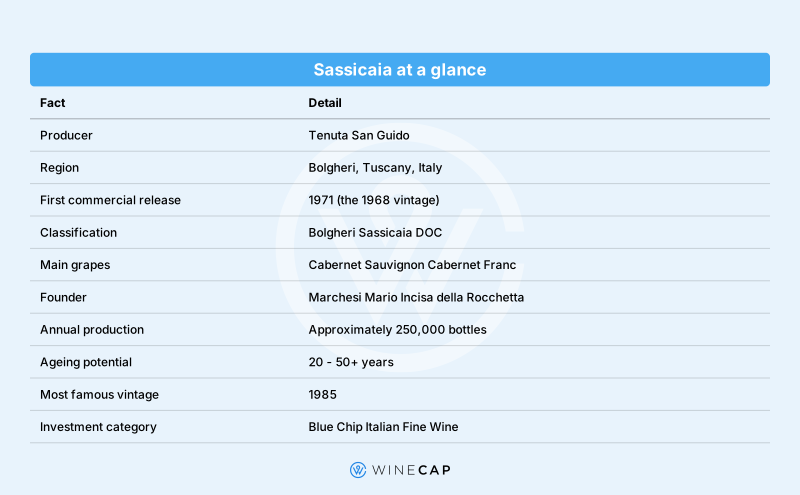
- Produced by Tenuta San Guido in Bolgheri, Sassicaia is the only Italian wine with its own dedicated appellation: Bolgheri Sassicaia DOC.
- Sassicaia is one of Italy’s most traded and collectible fine wines, combining global demand, strong liquidity, and a long track record of investment performance.
Sassicaia is the wine that transformed the global perception of Italian fine wine. Widely regarded as the original Super Tuscan, it demonstrated that the coastal vineyards of Bolgheri could produce Cabernet-based wines capable of competing with the world’s greatest Bordeaux.
Produced at Tenuta San Guido, Sassicaia has become one of the most influential and collectible wines in the world. It is the only wine in Italy with its own dedicated DOC appellation, has consistently ranked among the leading brands in the Liv-ex Power 100, and remains one of the most actively traded Italian wines on the secondary market.
For investors, Sassicaia combines global recognition, deep market liquidity, and a long history of price appreciation. Alongside Tignanello and Masseto, it sits firmly within the elite tier of Italian investment-grade wines, offering both long-term growth potential and resilience during periods of market volatility.
Sassicaia at a glance
1. The Super Tuscan rebellion
The story of Sassicaia begins with a challenge to the Italian wine establishment.
During the 1960s, Italian wine regulations were highly prescriptive. In Tuscany, many producers were required to follow blending rules that prioritised tradition over quality, including the use of white grape varieties in wines intended for ageing.
Marchese Mario Incisa della Rocchetta had different ambitions. Inspired by the great wines of Bordeaux, he planted Cabernet Sauvignon at his Tenuta San Guido estate in Bolgheri on Tuscany’s western coast. Initially, the wine was made solely for private consumption and was never intended to become a commercial product.
When Sassicaia was first commercially released in 1971 (from the 1968 vintage), it could not qualify for any recognised quality designation because it used grape varieties that fell outside the regulations. Instead, it was labelled simply as Vino da Tavola.
What began as a personal experiment ultimately sparked the Super Tuscan movement, demonstrating that world-class wines could be produced outside Italy’s traditional appellation system and helping reshape the country’s wine laws in the decades that followed.
2. Terroir of the “place of stones”
The name “Sassicaia” translates from Italian to mean a “place of stones”. This refers to the gravelly clay soils found in the 42-hectare vineyard that was originally planted in 1944. Marchese Mario Incisa della Rocchetta noted that this terrain bore a striking resemblance to the gravelly terroir of Graves in Bordeaux.
The geography of the vineyards is unique within Tuscany. Situated on the Tyrrhenian Coast, the site benefits from cooling “Libeccio” winds that lift off the sea. These winds prevent the grapes from over-ripening in the hot sun and maintain the fresh acidity required for long-term ageing.
This combination of well-drained, stony soil and a maritime climate creates a profile of structural elegance. It is a terroir that distinguishes Sassicaia from the warmer, hilly interior of Tuscany.
3. The grapes and the technical blend
Sassicaia has maintained a remarkably consistent blend throughout its history. It is typically composed of 85% Cabernet Sauvignon and 15% Cabernet Franc. The Cabernet clones were originally sourced from a friend’s estate in nearby Pisa.
The winemaking process focuses on precision rather than power. It involves:
- Short maceration periods to ensure refined tannins.
- Separate fermentation for every vineyard parcel to allow for meticulous blending.
- The total avoidance of artificial yeasts to preserve the natural character of the fruit.
- Ageing for approximately 24 months in French oak barriques.
Historically, the estate utilised Slavonian oak until the 1983 vintage, when it made the definitive switch to more costly French oak. This change added further polish and complexity to the wine’s structure. The goal remains to achieve a balance of ripe fruit and herbal sophistication.
4. The legendary 1985 vintage
If there is one vintage that defines the modern era of Italian wine, it is the 1985 Sassicaia. This bottle was the first Italian wine to receive a perfect 100-point score from the critic Robert Parker. Parker described the wine as “otherworldly,” and it became the benchmark for the entire region.
The 1985 vintage was born from a challenging year. A violent hailstorm in the spring led to very low yields, and a harsh winter frost had killed thousands of the area’s olive trees. Yet, the resulting wine showed a level of vitality and fiber that few had seen before in Italy.
For investors, this vintage transformed Sassicaia into a global blue-chip asset. It remains a mythical bottle that continues to age with a “long arch and a long plateau”. Even decades later, it shows no signs of slowing down. Although the volume of trades has fallen, prices of the 1985 are up 60% in the last five years and more than 150% over the last decade, cementing its status as one of the greatest wines of the 20th century.
5. The 21st century Golden Age
Following a somewhat lackluster period in the 1990s, often attributed to the large number of young vines from estate expansion, Sassicaia entered a new golden age. This modern era is defined by a level of purity and precision that has captivated the world’s leading critics.
Two recent vintages stand as modern titans:
- 2016: Monica Larner called this 100-point masterpiece “the wine we have all been waiting for”. It has seen significant price appreciation since its release.
- 2021: This vintage earned 100 points from Antonio Galloni, who described it as marrying “textural intensity with classic refinement”.
The 2006, 2008, and 2013 vintages are also considered modern highlights. The 2008 vintage was particularly notable as it was produced “without a winemaker” following the retirement of the legendary Giacomo Tachis in 2007. These years prove the estate’s ability to achieve excellence across varying conditions.
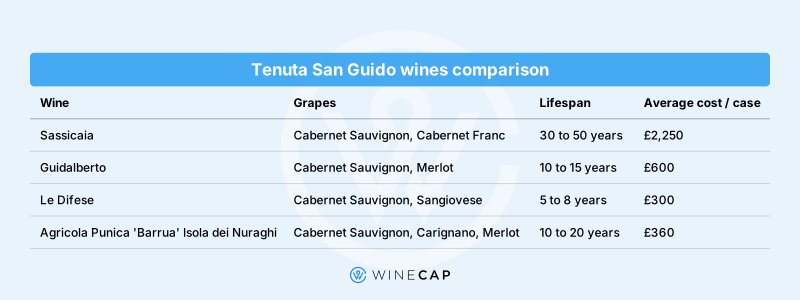
6. Beyond Sassicaia: the Tenuta San Guido portfolio
Although Sassicaia is the estate’s flagship wine, Tenuta San Guido produces a small portfolio that offers different expressions of the estate’s philosophy.
Guidalberto
Introduced in 2000, Guidalberto blends Cabernet Sauvignon and Merlot. Designed to be more approachable in its youth, it offers many of the hallmarks of Sassicaia at a more accessible price point.
Le Difese
Le Difese combines Cabernet Sauvignon with Sangiovese, creating a versatile and approachable wine intended for earlier drinking.
The family has also been involved in Agricola Punica in Sardinia, a project developed alongside the late Giacomo Tachis. The venture focuses on Carignano-based wines that showcase another side of Italian terroir.
7. Investment performance and market liquidity
Sassicaia is one of the most reliable and liquid assets in the world of fine wine. It consistently ranks in the top five of the Liv-ex Power 100, which measures the strength of brands in the secondary market.
Historically, Sassicaia has performed neck-and-neck with Tignanello for the bulk of the last 25 years. While Tignanello has shown slightly more resilience since the market peak in 2022, largely due to its lower entry price, both brands have remained more stable than major French investment-grade wines over the same period.
Most vintages of Sassicaia have seen capital gains exceeding 100% over a ten-year period. Its status is bolstered by its production volume: roughly 250,000 bottles annually.
This scale ensures there is always a deep market for buyers and sellers – a critical factor for portfolio liquidity.
8. The most searched-for Italian icon
Sassicaia occupies a unique space in the digital world of fine wine. It is consistently the most searched-for Italian wine on Wine-Searcher, a metric that reflects immense global demand. This popularity spans across North America, Asia, and Europe.
Moreover, the brand trust associated with Tenuta San Guido is unparalleled in Italy. This is partly due to its early adoption by the American market following the 1976 Judgement of Paris era. As global drinkers became more willing to look beyond Bordeaux, Sassicaia was perfectly positioned to lead the charge.
Its broader place in fine wine is secured by its own DOC. In 1994, it was granted the Bolgheri Sassicaia DOC, making it the only single-vineyard designation in Italy. This was a formal acknowledgement of its unique quality by the very bureaucracy it once rebelled against.
9. Cultural influence and celebrity fans
The fame of Sassicaia has been amplified by high-profile admirers who have shared their passion on social media. For these celebrities, Sassicaia is more than a wine: it is a symbol of sophistication and elite status.
Notable celebrity fans include:
- LeBron James: The basketball legend has frequently posted about his love for Italian wine, with Sassicaia often featuring on his table.
- Barack Obama: The former President was reported to have enjoyed Sassicaia during state visits and private dinners.
- Rihanna: The music icon has been spotted with bottles of Sassicaia, further cementing its cultural crossover appeal.
Social media discussions by these figures have introduced the brand to a younger, luxury-focused demographic. This celebrity influence helps sustain the “halo effect” of the brand, ensuring it remains relevant to new generations of wealthy collectors.
10. “We are all children of Sassicaia”
The impact of Sassicaia on the Italian wine industry is impossible to overstate; so much so that no one questions the quote of winemaker Michele Satta who once famously told critic Monica Larner: “We are all children of Sassicaia”.
Its influence has been felt in the creation of other legendary wines, including:
- Tignanello (Tuscany): Piero Antinori was the nephew of Mario Incisa della Rocchetta and was directly inspired by his uncle’s Cabernet experiment.
- San Leonardo (Trentino): Often called the “Sassicaia of the North,” this estate was developed after its owner was mentored at Tenuta San Guido.
- Montevetrano (Campania): Known as the “Sassicaia of the South”, it proved that volcanic soils could produce Cabernet blends of similar stature.
Sassicaia provided the blueprint for quality that surpassed existing DOC regulations. It proved that Italy could aim higher and achieve a level of purity and prestige with Cabernet that was previously almost the sole domain of France. Today, it remains a North Star and quality reference for winemakers across the entire peninsula.
FAQ: Sassicaia
Is Sassicaia a Bordeaux blend?
Yes, as it is primarily Cabernet Sauvignon and Cabernet Franc. However, its coastal Tuscan terroir distinguishes it from the wines of the Medoc.
Why was it originally called a “table wine”?
When first released in 1971, the use of French grapes like Cabernet Sauvignon was not permitted under the existing DOC laws of the 1970s. As a result, it had to be classified as “Vino da Tavola,” even though its quality was exceptional.
How does Sassicaia compare to Tignanello for investment?
Both are elite blue-chips. Sassicaia has a slightly higher status and its own unique DOC, while Tignanello has been more resilient during market corrections due to its wider accessibility and slightly lower price point.
What is the best way to store Sassicaia for long-term growth?
To maintain its value and provenance, it should always be stored in a professional, temperature-controlled bonded warehouse. This ensures a pristine chain of custody which is essential for achieving top prices on the secondary market.
What makes the 1985 vintage so special?
It was the first Italian wine to earn a perfect 100-point score from Robert Parker. Despite being a difficult year for growers, the wine achieved a level of complexity and longevity that changed the global perception of Italian wine forever.
WineCap’s independent market analysis helps investors build diversified fine wine portfolios with full ownership and transparent pricing. Speak to one of our wine investment experts and start building your portfolio. Schedule your free consultation today.
Capital at risk. Past performance is not a guide to future returns. Returns are not guaranteed.