Does wine expire? How long fine wine lasts and why it matters for tax
- Wine expires, and that finite lifespan is why gains on investment wines are generally exempt from UK capital gains tax
- Investment wines can last for decades, but only with good storage
- Surveys of US consumers show 90% drink their wine within two weeks of buying it.
Yes, wine expires, and the end of its life shapes both its value and its tax treatment. Every bottle has a lifespan, but the lifespan of fine wines can be measured in decades, and that plays a key role in turning a drink into an investable asset. This guide explains the short life of most wines, which wines last longest, and how storage decides condition and price. It also covers how HM Revenue and Customs (HMRC) treats wine as a wasting asset for capital gains tax (CGT), and why proof of storage matters at sale.
Why does a wine’s lifespan matter for UK tax treatment?
Every wine has a lifespan, and the end of that life is what makes wine a wasting asset in UK tax terms. For investors, that label matters because gains on wasting assets are generally exempt from CGT, the tax charged on profit when an asset is sold.
The exemption exists because an asset of this kind wears out or expires, so the tax system does not treat it like a growing capital asset. To count as a wasting asset, an item must be:
- Tangible, meaning a physical object rather than a share or fund unit
- A chattel, meaning something movable, rather than land or buildings
- Short-lived, with a predictable life of 50 years or less
The 50-year test runs from the date the investor acquires the wine, not from the vintage. HMRC guidance generally treats wines as wasting assets, although the longest-lived, such as Vintage Port and Sauternes (sweet white Bordeaux), may fall outside the 50-year test.
Tax treatment depends on individual circumstances, and this is general information, not tax advice.
What is the lifespan of most wine, and how does fine wine age?
Producers know that most wine is drunk within weeks of purchase, not decades. A survey of more than 1,000 US consumers by Sonoma State University researchers found that 20% open a bottle within 24 hours of buying it, about 51% within three days and 90% within two weeks. Only 6% said they bought wine to save it for ageing. Fundamentally, most wines lack an extended lifespan because they are not required to last, and producers are responsive to the needs of their consumers.
This isn’t to say that everyday wine can only last a few weeks. Most basic wine will last a couple of years if it’s stored in a cellar, and some will last longer than that, but wines made with age in mind are different. Acidity (the freshness that preserves a wine), tannin (the compounds from grape skins and seeds that give red wine its grip), concentrated fruit, and, in sweet wines, sugar, let a wine develop for decades.
A wine without that capacity to age does not meet the definition of fine wine, and it certainly does not meet the definition of an investment wine.
Time changes what a fine wine looks and tastes like. Investors should expect three shifts:
- Taste & smell: fresh fruit gives way to savoury, more complex and earthy flavours, and tannins soften
- Colour: reds fade towards brick and tawny, while whites deepen towards gold and amber
- Fizz: sparkling wines gradually lose their bubbles
Time supports value in two ways. Firstly, through consumption: as collectors drink bottles, fewer remain (depletion), and that shrinking supply tends to support prices as a wine matures. A lower supply also means that even small changes in demand can have a large impact on pricing.
Time also supports value through improvement in quality. Every fine wine has a drinking window, the period in which it improves, reaches a peak, plateaus and then declines. Prices tend to go up as the quality of a wine improves over time, although this isn’t always the case and market cycles can and will interrupt the process.
How do fortified wines differ from table wines?
Fortified wines last longer than table wines because added alcohol makes them more stable. Port, Madeira and Sherry all have grape spirit added during or after fermentation, which slows the changes that spoil wine. Madeira, which is heated during production, is the most resilient, and bottles more than a century old are still drunk.
For UK investors, fortified wines are more likely to exceed the 50-year test. Investors should check before assuming the wasting asset exemption applies to them.
Which fine wines last longest, and how can investors tell?
The longest-lived wines come from a small group of regions and producers. Choosing a wine whose drinking window outlasts the holding period avoids selling into decline.
Top Bordeaux, including the First Growths (the five highest-ranked chateaux in the 1855 classification), Burgundy Grand Cru, Barolo, Sauternes, Vintage Port, the best Rhone reds and vintage Champagne sit at the long-lived end. Even white wines from the best producers and best regions can have extended lifespans. A review of drinking windows is a key pillar of our selection criteria; WineCap’s analysis of critic reviews shows the following estimates measured from the vintage a wine was harvested:
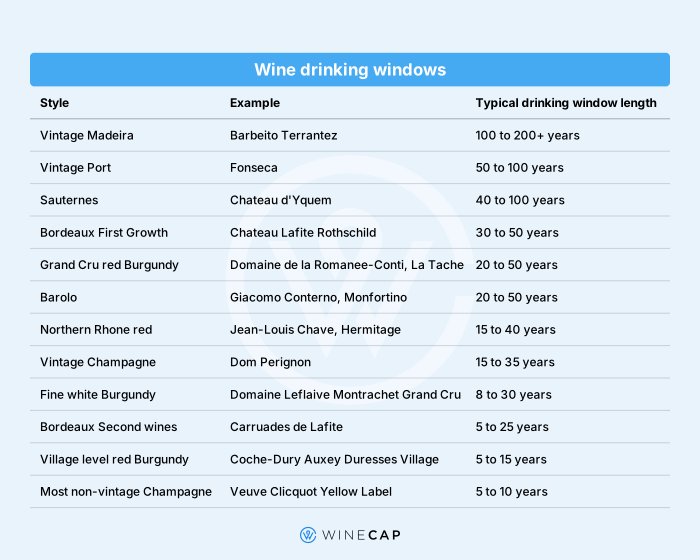
Lifespan and drinking window are similar, but are not the same. A drinking window will measure the optimum period to drink a wine, rather than its maximum lifespan. A wine doesn’t become undrinkable at the end of a drinking window, but you would expect to see demand taper as a wine moves outside its optimal drinking window.
WineCap checks the drinking windows of every wine it sells across several critics, so investors do not need their own expertise to confirm that a wine’s window fits their holding period. These windows are estimates, not guarantees, comparing multiple critics narrows any uncertainty. Investors can check drinking windows themselves through resources such as Wine-Searcher, the wine price comparison website.
How long does wine last once it is opened?
An opened bottle starts to change within hours, because oxygen begins altering the wine as soon as the cork is out. A sealed wine can last years or decades, while an opened wine lasts days or weeks, which is one reason investment bottles stay sealed.
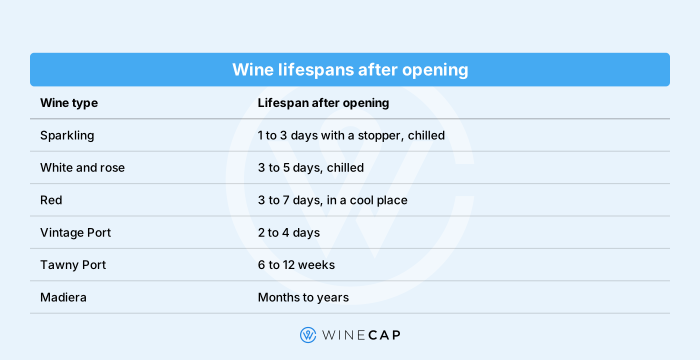
There are things that can be done to stretch out this time period, the best-known solution is to use a Coravin (a device that draws wine through the cork with a fine needle and replaces it with argon, an inert gas), which can allow an opened wine to last months. However, for investors, none of this should be a factor as bottles intended for investment and destined for the secondary market (buying and selling between collectors and investors after a wine’s first release) should never be opened.
How does storage affect a wine’s lifespan?
The lifespan of a wine is heavily influenced by storage. Poor storage can ruin a wine that should have lasted decades, and excellent storage can help an ordinary wine last longer. Investors know that condition drives price, so every threat to condition is a threat to value. The major factors are:
- Heat: speeds up ageing and can cook the wine
- Temperature swings: as damaging as heat itself, because they make the cork expand and contract, which can let air in or wine seep out
- Light: ultraviolet light damages wine, and pale bottles suffer most
- Vibration: thought to matter less, but constant movement is best avoided
The ideal storage is cool (around 12 to 13°C), stable and dark, in conditions humid enough to keep the cork sound, with bottles lying on their side. At home, a purpose-built cellar, a dual-zone wine cabinet (a fridge with two separate temperature zones) are best, although a well-chosen cool, dark space can come close. A kitchen shelf or a loft cannot.
The critical importance of storage to investors is why most will look at professional wine storage facilities for their collections.
What is professional wine storage, and why does in-bond matter?
Professional storage is an off-site, specialist service that is climate-controlled, insured, monitored and secure. Excellent home storage exists, and many WineCap clients invest in it for wines they intend to drink. The difference for investors is verification: a buyer will assume perfect conditions in a large-scale professional wine storage facility and that storage is verified by in-bond status.
In bond means stored in a bonded warehouse (a customs-supervised facility) with duty and VAT not yet paid. Wine held in the network of bonded storage facilities carries a documented record of professional storage. That record is its provenance, and it becomes invaluable at the point of sale. Critically, in-bond status can only be given to a wine once. A wine that has left bonded storage can never be in bond again.
When purchasing wines, buyers want proof of provenance and storage; wine with an unbroken in-bond record gives them that at a glance, is easier to sell, and will typically command a higher price as well.
Where does WineCap store wine?
WineCap stores wine in the Drakelow Tunnels, an underground facility owned by London City Bond that combines security with natural climate stability. For clients, that means consistent storage and a record they can prove.
The tunnels date to 1941, built by the Ministry of Aircraft Production built as a wartime factory. They cover around 3.5 miles and 26,500 m² and later functioned as a nuclear bunker up until the early 1990s before being sold. Eventually the sitre was redeveloped by London City Bond as a wine storage facility that opened in 2022, including the Drakelow Tunnels Museum.
The advantages of Drakelow start with its setting. The site sits underground, which helps keep temperature and humidity stable and helps make it more secure.
A wine’s lifespan sets the opportunity, and storage decides how much an investor keeps
A lifespan of decades is one of the traits that gives fine wine its value, it also shapes how HMRC taxes it and how investors must keep it. Investors who choose wines whose drinking windows outlast their holding period, and who document custody from the day of purchase, own an asset that is ready to sell when they are.
The practical next step is to match each wine’s drinking window against the intended holding period, and to decide where the wine will sit before buying it. Tax treatment varies with the wine and the investor, so an adviser should confirm how the wasting asset rules apply.
FAQ: wine lifespan and storage
How long does unopened fine wine last?
It depends on the wine. A Bordeaux First Growth from a strong vintage such as 1982 is still drinking well more than 40 years on, while a white wine from a lesser vintage may peak sooner. Checking the drinking window before buying avoids holding wine past its best.
Is wine a wasting asset for UK capital gains tax?
HMRC guidance generally treats most wines as wasting assets, so gains on sale are usually exempt from CGT. Very long-lived wines such as Vintage Port may fall outside the 50-year test. This is general information, not tax advice, so investors should take professional advice.
Does storing wine at home reduce its resale value?
Almost certainly. Buyers will know that even in an impeccable home cellar, a case of wine could have extended periods of sub-optimal storage. A record of in-bond storage provides assurance that this hasn’t happened. Buyers pay for the peace of mind this gives them.
What happens to duty and VAT if wine leaves bond?
Duty and VAT become payable when wine leaves a bonded warehouse. VAT is 20%, so removing a £5,000 case adds at least £1,000 before duty. Wine that has left bond is generally harder to sell on the secondary market.
How long should investors hold wine before selling?
WineCap generally advises a holding period of at least five to ten years, because the best returns can take time to arrive. A wine with a drinking window of 20 years or more at the point of purchase sits comfortably with that horizon.
WineCap’s independent market analysis helps investors build diversified fine wine portfolios with full ownership and transparent pricing. Speak to one of our wine investment experts and start building your portfolio. Schedule your free consultation today.
Capital at risk. Past performance is not a guide to future returns. Returns are not guaranteed.