What are second wines, and are they worth investing in?
- Second wines offer investors a lower cost entry point into top-end producers and vintages
- The best-known second wines, Petit Mouton Rothschild and Carruades de Lafite, rose around 80% between August 2016 and 2022
- Second wines can fall further than top wines during a correction, and have a lower trading volume
Wine producers will frequently make more than one wine from the same parcel of land. The highest-quality wine will be known as the grand vin; the second wine is the label given to the next wine in the quality hierarchy. This guide sets out what defines a genuine second wine, how their prices and liquidity compare with flagship bottlings, and how and why their investment performance differs. It also covers where the second-wine model breaks down, from Burgundy’s parcel-driven hierarchy to Champagne’s vintage tiers, so investors know when the comparison applies and when it doesn’t.
What actually is a second wine?
A second wine is a producer’s own internal declassification of fruit that does not make the grand vin (the estate’s flagship blend). Nearly every fine wine region with a quality hierarchy uses some version of this idea, but Bordeaux formalised it most clearly, and among the top tier of Bordeaux wines its adoption is almost universal. Investors benefit from understanding it because a second wine is not a lesser producer trying to copy a famous name. It is the same winemaking team, the same vineyard and the same cellar, sold at a materially lower price.
Estates arrive at a second wine in three main ways:
- Selecting out fruit that falls short of the quality bar for the grand vin in a given year
- Drawing from distinct parcels within the estate that consistently rank below the parcels used for the grand vin, or that produce fruit that is not as well suited to making a wine for significant ageing
- Using the fruit of younger vines, which typically need more years establishing themselves before they contribute to the flagship blend
The exact method varies by producer, and, in practice, the lines are often blurred. What rarely varies is the outcome: a second wine that shares a terroir and a production team with a famous name, priced for investors, collectors and consumers who want exposure to such an estate without paying grand vin prices.
Why scores and lifespans differ from the grand vin
Second wines are built to drink sooner, and their scores tend to be lower. While a grand vin is typically structured for decades of ageing, a second wine is made for an earlier drinking window, often framed as a wine for collectors to enjoy while they are still waiting for the grand vin to mature.
Some of this comes from different inputs (i.e. the grapes that the wine is made from), some from different treatments those grapes receive in the cellar.
Critic scores make the quality gap clear. Across six leading Bordeaux estates, three first growths and three super seconds, WineCap’s analysis found every grand vin has scored 100 points from Wine Advocate (one of the most closely watched critic scores in Bordeaux) in at least one vintage. Their second wines tell a different story: only two, Carruades de Lafite and Pagodes de Cos, have ever scored above 93 points, and each has done so only once.
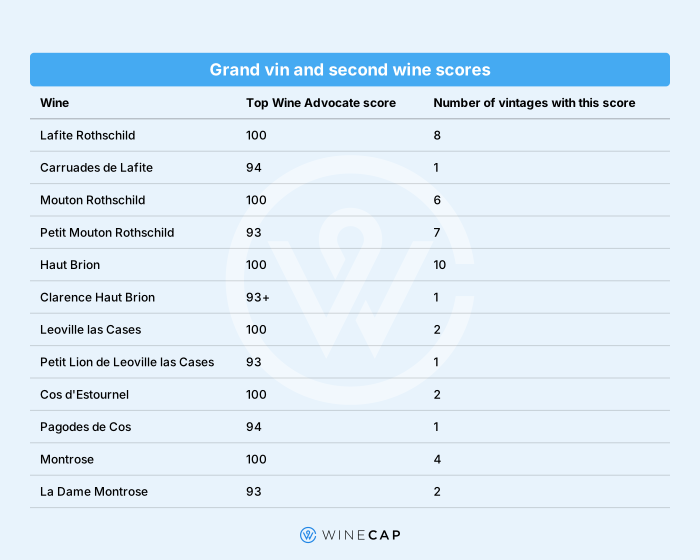
That gap does not make second wines a poor investment. It makes them a different one: a shorter-dated, higher volatility bet on the same producer’s skill, priced accordingly.
Spotting a genuine second wine
Not every wine linked to a famous name is actually its second wine. Two situations can catch out investors:
- Sibling estates under common ownership. Chateau Clerc Milon and Chateau d’Armailhac both belong to the Rothschild family behind Chateau Mouton Rothschild, but neither is Mouton’s second wine. They are separate, independently classified estates that happen to share an owner
- Similar names, unrelated producers. Chateau Carmes Haut-Brion is a distinct estate with no ownership link to Chateau Haut-Brion, despite the similar name.
Bordeaux’s 1855 classification also shows how close to universal the second wine model has become. Almost every classified growth now makes at least one second wine, and some make three or four. Chateau d’Armailhac (part of the Mouton Rothschild stable of wines) is a rare exception: despite its reputation and despite its status as a fifth growth in the 1855 classification it produces no second wine of its own.
How second wines perform against their grand vin
Second wines move further than their grand vins in both directions, Our index of first growths and their respective second wines shows this very clearly:
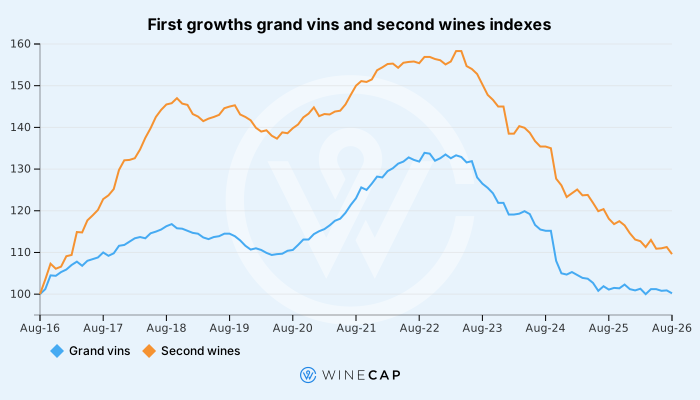
- Grand vins growth hit 33% in October 2022 before retreating, while the index of their second wines saw nearly 60% growth over the same period
- Within the second wines index, Petit Mouton Rothschild and Carruades de Lafite each rose by around 80 per cent at their peak
- Within the corresponding grand vin index, Mouton Rothschild and Lafite Rothschild rose by around 40 per cent at their peak
The same amplification worked in reverse once the market turned:
- Carruades de Lafite fell by 43% while Lafite Rothschild declined by 33%
- Petit Mouton Rothschild fell by 28% while Mouton Rothschild fell by 21%
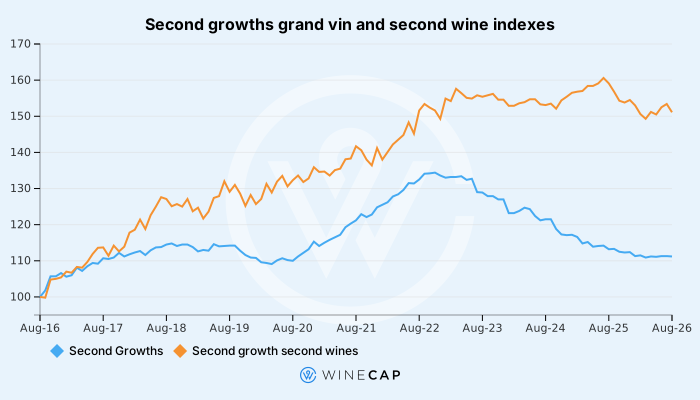
The index of Second Growths follows a broadly similar pattern to the index of First Growths. Prices rose about 30% between August 2016 and mid- to late 2022 before falling back down. Their second wines however have behaved quite differently in the current cycle. Prices stabilised in late 2022 and early 2023, around 50% above their 2016 levels, and have largely held firm since.
These modest falls reflect the fact that Second Growth’s second wines trade less often and are more likely to be drunk than resold. Their lower value has also insulated them: holders who need access to capital are able to raise more money more quickly by selling First Growths and their second wines than they were by selling the second wines of Second Growths.
Price and liquidity: what a second wine costs and how they trade
Price is where the appeal of second wines is most direct. Across a sample of eight paired first and second wines from First Growth and Second Growth estates, second wines currently trade at an average of around a third of their grand vin’s price, with most estates falling between 28% and 40% lower.
That discount buys a wine from the same terroir and winemaking team, but it comes with a liquidity cost. Our analysis across four of the most actively traded first wines in Bordeaux shows that the second wines from the same estates saw between 15% and 40% of the number of trades of the first wines on the secondary market over recent vintages.
Investors weighing a second wine purchase should treat that thinner market as part of the trade-off and be aware that exiting a position can take longer or require more flexibility on price.
Second wines beyond Bordeaux
The second wine model travels well outside Bordeaux, though not in the same form everywhere.
Napa Valley has adopted a close equivalent for many of its most sought-after producers:
- Harlan Estate makes The Maiden, sourced from younger vines and parcels not selected for the flagship blend
- Screaming Eagle makes Flight, formerly Second Flight following the same logic
- Scarecrow makes M. Etain, a second label built on the same J.J. Cohn Estate fruit. The name is French for “Mr. Tin,” a nod to the Tin Man, continuing the Wizard of Oz theme
These wines tend to echo Bordeaux’s pattern: strong demand for the flagship pulls the second label up with it during a rally, and the reverse happens in a correction. However the sample is smaller and the market thinner than in Bordeaux.
Tuscany offers a mixed picture. Ornellaia follows something close to the Bordeaux model, with Serre Nuove dell’Ornellaia as its second wine and Le Volte dell’Ornellaia as a third, more accessible tier. Sassicaia’s relationship with Guidalberto and Le Difese, made by the same producer, Tenuta San Guido, is looser. These are related wines from the same team rather than strict declassifications of Sassicaia fruit, so investors should treat them as an adjacent opportunity rather than a discounted route into Sassicaia itself.
Where the second-wine model does not apply
Burgundy and Piedmont do not follow the same model. Producers in both regions typically make many different wines from distinct, often tiny parcels, each with its own identity rather than representing a ranking below an obvious flagship. In Burgundy, investors should not consider La Tache a second wine of Domaine de la Romanee-Conti, even though it sits below Romanee-Conti itself in price. The hierarchy is more complex and involves the location and terroir of specific parcels of land, Grand cru, Premier Cru, or monopole classifications, as well as price, and is not necessarily about quality per se.
The same applies to Gaja in Piedmont. Gaja Barbaresco sits at a different price point from single-vineyard wines such as Sori San Lorenzo, but the relationship is one of terroir specificity, not a grand vin and its derivatives.
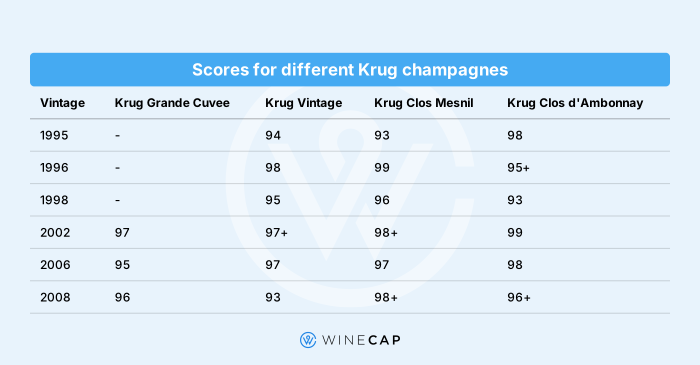
Champagne follows a third pattern entirely. Houses like Krug produce several tiers of wine, from the multi-vintage Krug Grande Cuvee through to Krug Vintage and single-parcel wines such as Krug Clos d’Ambonnay. However, the distinction is about vintage and terroir specificity, not a quality cut.
There is a clear price hierarchy between these wines, Krug Grande Cuvee is around £1600 per dozen, while Krug Clos d’Ambonnay can be £2,000-3,000 a bottle, but there is not the same structural relationship or quality divergence investors see between Chateau Lafite Rothschild and Carruades de Lafite.
Second wines reward selective buying, not blanket exposure
The investment case for a second wine is not that it is a cheaper version of its grand vin. It occupies a different position, the same producer’s skill and terroir, with its own liquidity, holding period and volatility profile. Treating a second wine as a simple discount route into a famous name misses the larger swings in both directions and the thinner market that comes with it.
For investors who understand that trade-off, second wines offer a genuine way to diversify exposure across more estates and vintages within the same budget as a smaller number of grand vins.
FAQ: buying second wines
Are second wines a good entry point for a first-time fine wine investor?
They can be. The most actively traded second wines have the liquidity and performance that merits investment; however, the number of second wines that pass the threshold of investability is lower than for first wines.
How liquid is the secondary market for second wines?
Less liquid than for the grand vin, though it varies by estate. Across a sample of four actively traded Bordeaux first wines, their second wines saw between around 15% and 40% of the number of trades over four recent vintages, so exits can take longer to execute at a target price.
Do second wines have a shorter holding period than grand vins?
Not necessarily as an investment, but they are built to drink sooner. Scores also run lower. Across a six-estate sample, only Carruades de Lafite and Pagodes de Cos have scored above 93 points from Wine Advocate, and each just once, against every grand vin in the sample hitting 100 points, most of them multiple times.
Are all classified growth second wines worth the same attention?
No. Price ratios to the grand vin range from around 28% to 40% across the sample WineCap reviewed, and trading activity varies just as widely. With this in mind, each second wine needs assessing against its own grand vin rather than as part of a single category.
Can a wine with a similar name to a famous estate be mistaken for its second wine?
Yes, and it is a common error. Chateau Carmes Haut-Brion, despite the shared name, has no ownership link to Chateau Haut-Brion. Investors should confirm the actual relationship before treating any wine as a discounted route into a bigger name.
WineCap’s independent market analysis helps investors build diversified fine wine portfolios with full ownership and transparent pricing. Speak to one of our wine investment experts and start building your portfolio. Schedule your free consultation today.
Capital at risk. Past performance is not a guide to future returns. Returns are not guaranteed.