A wine investors guide to wine critics: how their scores move fine wine prices
- Wine critic scores function like a credit rating for fine wine, shaping decisions on which producers, vintages and price levels investors are willing to pay for
- Higher and lower than expected scores can both influence wine pricing, and can do so quickly
- No single critic covers every region although many cover multiple regions
Wine critics do not just describe a wine; they help set its price. Scores and attention from a trusted voice can lift demand for an obscure appellation, wine or producer. A poor score can have the opposite effect, and different critics carry authority in different regions. This guide sets out why critic opinion matters to fine wine investors, traces how professional wine criticism developed into its modern form, and profiles the critics, magazines and platforms that carry the most weight today.
Scores work like a credit rating for wine
A critic’s score does a similar job for a wine investor that a credit rating does for a bond buyer. It condenses expert judgement and tasting experience into a signal that an investor can act on quickly.
Scores guide two separate decisions. The first is which producers and appellations deserve a place in a portfolio. The second, just as important, is which vintages and wines those producers make are worth considering. A wine investor comparing two vintages from the same estate leans on critical consensus in much the same way an equity investor might read balance sheets before choosing between two companies in the same sector.
The effect shows up directly in secondary market pricing. A strong score at release can lift demand before a wine has even left the producer’s cellar, while a score that falls short of expectation can leave a wine trading below a level its reputation alone would suggest fitting
There are many examples of high-scoring wines that have increased in value,but interpreting direct impact requires detailed data that has not been widely available until relatively recently. For example, there is little contemporary data with which to measure the impact of the 2001 rescore of 1998 Chateau Beaucastel Hommage a Jacques Perrin or the effect of Robert Parker’s 2003’s 100 point score for La Clusiere 2000. It can also be difficult to isolate the impact of a score in a market that may already be rising.
In Robert Parker’s 2015 re-score of the 2005 Bordeaux vintage, we find clear examples of how re-scores can impact on price. In summer 2015, Bordeaux wines had been stable for a year after falling from 2013’s highs, but direction was absent in the market. That June, Parker, at the end of his career and in one of his last reviews of Bordeaux wine published a 10-year-on tasting of the excellent 2005 vintage. He conferred 100 points on a number of wines that had not been at that level previously, a move that had an immediate impact on price.
- Lafleur 2005 moved from 95+ points to 100 points and prices rose from around £7,000 per case in May to more than £9,000 by the end of August
- Angelus 2005 rose from 98 points to 100 points and saw values climb nearly 30% in two months
- Larcis Ducasse 2005 merited a 2-point rise to 100 points, and values doubled to nearly £2,000 a case over the next quarter
A critic’s opinion is not just descriptive. It functions as a pricing input that investors should track as closely as any index. WineCap’s own approach to sourcing wines leans on this kind of critic consensus alongside trade price and data. In short, the score is only part of the story.
A short history of wine criticism explains today’s authority
Wine criticism has a longer pedigree than many would assume. Pliny the Elder ranked wines by quality in the first century AD, and Thomas Jefferson’s notes on Bordeaux’s leading chateaux would be recognisable as wine criticism to a modern eye, even though neither was published as such at the time.
Cheaper printing and paper, alongside rising literacy, mean the nineteenth century is really where wine criticism starts as a published genre. The best-known example today is Cocks & Feret, first published in 1846 and still in print, though its enduring fame owes as much to survivorship bias as to being the first formal wine critique.
As the baby boomer generation began engaging seriously with wine, an ecosystem of consumer-facing wine criticism grew in tandem. In Britain, wine critic Michael Broadbent and wine journalist Hugh Johnson were early proponents of this tradition: the first edition of Johnson’s The World Atlas of Wine appeared in 1971 and remains in print today. In the United States, wine aficionado Robert Finigan’s newsletter was the direct precursor to Robert Parker’s Wine Advocate, launched in 1978 as a critics newsletter, before becoming a website in 2000.
Parker’s innovation was the 50-to-100 scoring scale, and his publication was vocal about being funded entirely by subscriptions rather than advertising. His call on the 1982 Bordeaux vintage, which he rated far higher than established rivals, cemented both the scoring model and his own authority. He was, arguably, the first and last monoculture wine critic.
Scores shape a vintage’s reputation, not just a single wine
Critic consensus builds reputations at the vintage level as much as at the producer level. 2009 Bordeaux earned its standing as a modern benchmark vintage largely because so many wines across so many appellations scored well with so many critics in the same narrow window. The result was the impressive wine scores reinforced each other rather than standing alone on individual merit.
Champagne shows the same pattern. 2008 is widely treated as one of the strongest Champagne vintages of the past two decades, a reputation built on a preponderance of high scores across multiple houses rather than any single wine’s result driving the narrative.
For investors, a vintage-level reputation matters because it affects pricing across an entire category, not just one bottle. One producer’s poorer wine can still command a premium if it was made in a year the market has already decided was exceptional. The reverse holds when a vintage is judged weak, even if individual wines from it perform well against the pack.
This is why buying decisions built purely around a single wine’s score can miss the bigger picture. Two wines with an identical 95-point rating from the same critic can carry very different investment cases if one sits inside a vintage the market already treats as historic and the other in a year still waiting for its reputation to settle.
The critics who move markets today
No single critic covers the whole fine wine market, and investors benefit from knowing which voice carries weight in which region. The following are highlights rather than an exhaustive survey; wine criticism spans far more names than any one list can cover, and influence shifts as critics change roles or retire.
- Robert Parker retired from actively reviewing wine in 2017 and published his final Bordeaux reviews in 2015. His historic scores still carry weight especially in Bordeaux and Napa Valley
- Neal Martin has been Vinous’s critic for Bordeaux and Burgundy since leaving the Wine Advocate in November 2017. He is one of the most cited voices in the secondary market today, spanning the two regions’ investors trade most actively
- Antonio Galloni founded Vinous in 2013 after building his reputation reviewing Champagne and Italian wine at the Wine Advocate between 2006 and 2013; his Bordeaux assessments carry less weight than his core regions, so investors should weigh his opinion accordingly by category
- William Kelley became editor-in-chief of the Wine Advocate in 2024 and reviews Bordeaux, Burgundy and Champagne; Unusually for a critic, he is also a Burgundy producer in his own right, giving him a working understanding of the winemaking decisions he reviews
- Allen Meadows, known as Burghound, is the most encyclopaedic Burgundy-only voice in the market, with a reputation for parsimony rather than generosity when awarding scores. This makes even a modest uplift from him notable
- James Suckling runs one of the highest-traffic wine review platforms, with particular visibility at the higher-volume end of the market, including scores that appear on retail bottle stickers rather than solely in trade circles
- Jane Anson has been Bordeaux-based since 2003 and spent close to twenty years at Decanter magazine before launching her own site, Jane Anson Inside Bordeaux, in 2021, giving her a depth of regional access few critics can match
- Jancis Robinson was the first person outside the wine trade to become a Master of Wine, in 1984, and scores out of 20 rather than 100, one of the few major critics to do so. She also writes for two standard reference wine books: the Oxford Companion to Wine and the World Atlas of Wine. Her writing for the Financial Times is influential, but largely covers wine culture and reviews many wines that are not investable
- Jasper Morris, author of Inside Burgundy, retired from the wine trade in 2017 and now publishes independently. His standard reference book is of greater value to investors than his individual wine reviews and is a key text for those looking to understand the region
- Lisa Perrotti-Brown left the Wine Advocate’s top job in 2021 after eight years as editor-in-chief, launched The Wine Independent in 2022, and left that in turn in 2025 to found The Wine Palate
Beyond this core group, many other other critics command a following, but these are the most important to investors and the market.
Magazines and lifestyle titles still carry weight
Print magazines remain influential despite their decline. Decanter and Wine Spectator still publish physical editions as does Wine Enthusiast, which serves a similar consumer audience in the United States. These publications blend reviews with lifestyle and travel content rather than focusing on pure scoring.
A newer wave of titles targets a different reader, focusing less on consumer advice and more on wine as a cultural touchstone or part of a luxury lifestyle. Noble Rot built its following on an irreverent tone that deliberately avoids old-school connoisseurship, while Club Oenologique leans toward lifestyle coverage that sits wine alongside spirits, food and travel. Neither replaces a critic’s score as a pricing signal, but both shape which wines and regions capture attention among their readership.
For an investor, the practical value of magazine coverage is different from a critic’s score. It rarely moves a price on its own, but sustained magazine attention can widen demand for a region or producer over several years, contributing a slower and steadier signal.
Wine criticism beyond English language
While the English language still dominates wine criticism, there are international voices of note, particularly for producers whose core market sits outside the United Kingdom and the United States.
- In France, Gault & Millau and La Revue du Vin de France remain influential domestically. Bettane et Desseauve, founded by two Revue du Vin de France alumni who left to build their own guide, and independent Bordeaux critic Jean-Marc Quarin are also watched by the trade
- In the German-speaking market, Falstaff has covered wine since its founding in Austria in 1980. It launched an English-language international edition in 2022, extending its reach beyond German speaking countries
- In the Chinese-language market, critics include Lin Liu, the first Chinese woman to become a Master of Wine, Alexandre Ma, and Hong Kong-based Jeannie Cho Lee, the first Asian Master of Wine. They are actively building a wine criticism tradition aimed at a fast-growing base of Chinese collectors and investors, rather than simply translating Western scores for a new audience
These voices matter most where a producer’s core buying market has shifted away from the United Kingdom and the United States. A wine gaining critical traction in Chinese-language coverage before it is widely discussed in English can be an early signal worth watching.
Apps add a crowd-sourced score alongside the critics
Crowd-sourced platforms sit alongside professional critics. They don’t replace formal critique and investors should treat the two as different instruments measuring different parameters.
- CellarTracker, founded in 2003, built its authority on crowd-sourced tasting notes rather than a single reviewer’s palate, and now also carries some professional critic content by subscription
- Vivino, founded in Copenhagen in 2010, uses photo recognition to let casual drinkers rate wines instantly, and its user scores now cover 20 million wines
Neither app’s score carries market setting weight, but both shape broader sentiment toward a producer, especially at the lower end and among newer collectors. A wine with thousands of strong Vivino ratings but no professional score is a different, riskier proposition to an investor than one with both.
Michelin’s entry may be the biggest shift since Parker
The Michelin Guide launched its own wine ratings in summer 2026, starting with Burgundy and followed shortly after by Bordeaux. Michelin already owns the Wine Advocate outright, having built a 40 percent stake in 2017 before acquiring the rest by 2019, so the two operate under the same parent company rather than as rivals.
The new guide works differently from a traditional critic. It scores entire estates, not individual wines or vintages, on a one-to-three bunch scale that mirrors Michelin’s restaurant stars, judging agronomy, technical mastery, identity, balance and consistency rather than offering a single tasting note. Michelin’s own leadership has said the guide will not replace the Wine Advocate.
What makes it significant for investors is its reach. Michelin’s platform attracts around 12.5 million monthly visitors, dwarfing every established wine publication. This means its ratings could shape demand among buyers who have never read a critic’s score before.
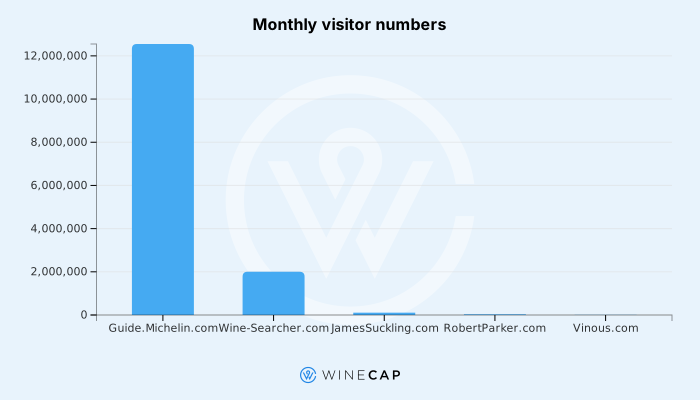
Pricing has not yet moved in response to Michelin’s scores, but investors should watch closely for effects on estates that go unrated, or that receive fewer bunches than their reputation would suggest.
WineCap’s Wine Track turns critic scores into a single benchmark
Rather than relying on any one critic, WineCap built Wine Track to combine scores from more than 100 critics across twelve international publications into a single normalised figure out of 100, called the WT Critic Score. The Wine Track platform also covers pricing, analysing more than 400,000 data points daily across over 75,000 investment-grade wines dating back to 1990, drawing price data from hundreds of merchants alongside other sources.
Critic opinion is one input, not the whole case for investment
Critic scores compress years of comparative tasting into a signal an investor can use quickly, but they work best alongside data on price, liquidity and provenance rather than in isolation. A 100-point score explains why a wine might be desirable; it does not by itself confirm that the price already reflects that desirability.
Investors who track which critic covers which region, and how that critic’s judgement has performed over time, are better placed to judge whether a new score represents an opportunity or a price already fully captured by the market. That, not any single critic’s opinion, is what separates a considered fine wine allocation from a purely speculative one.
The critics profiled here will keep changing roles, launching new publications and, occasionally, being proven wrong by time and the market. Understanding that scores are important but far from the whole story, is what lets an investor tell the difference between a genuine signal and simple noise.
FAQ: Wine critics and fine wine investment
Does a high critic score guarantee a wine will rise in value?
No. A high score can support demand, but price still depends on existing scarcity, the producer’s track record and how much of the score is already reflected in the release price. Wines scoring 100 points from multiple critics in the same vintage do not all appreciate at the same rate afterwards.
Which critic matters most for Bordeaux?
William Kelley at the Wine Advocate and Neal Martin at Vinous are the two most closely watched voices for current Bordeaux vintages, though Robert Parker’s historic scores still influence pricing.
Is Burgundy covered differently to Bordeaux?
Somewhat. Burgundy’s parcel-driven hierarchy makes region-specific expertise more important, which is why Allen Meadows (Burghound) and Jasper Morris, both Burgundy specialists rather than generalists, carry particular weight there although William Kelley and Neal Martin’s coverage also exerts an influence.
Do critic scores matter as much for Champagne and Italian wine?
Yes, though the most-cited names differ. Antonio Galloni built his early reputation on Champagne and Italian wine specifically, and vintage-level reputation, such as 2008 Champagne, can matter as much as any single wine’s score.
WineCap’s independent market analysis helps investors build diversified fine wine portfolios with full ownership and transparent pricing. Speak to one of our wine investment experts and start building your portfolio. Schedule your free consultation today.
Capital at risk. Past performance is not a guide to future returns. Returns are not guaranteed.