The 2016 vintage: what investors need to know
- If you’re thinking of investing in fine wine, there are good reasons to add 2016s to portfolios now. Critical opinion is set, and some prices are down significantly from their peaks
- 2016 produced more 100-point Bordeaux and Napa wines than any harvest since 2000, led by Mouton Rothschild’s near-perfect sweep of every major critic.
- Bordeaux, Rioja, Piedmont and Tuscany excelled in 2016, but white Burgundy, Alsace and much of Argentina and Chile fell short.
The quality of releases from a given year shapes the odds of a good investment, but it does not decide the outcome. A strong vintage lifts the quality floor, improving the odds that any single wine performs well. At ten years old, 2016 is still a young, actively traded vintage – many of its wines will have decades of life in front of them still. This guide sets out where it delivered, where it fell short, and what that means for investors now.
How good was the 2016 vintage?
A vintage gives investors a probability framework, but does not guarantee that every region or every wine from a region is a good investment.
2016 illustrates the point well. It produced some of the finest Bordeaux of the modern era, and delivered exceptional wines in Rioja, Piedmont and Tuscany too. The same year was far less kind to Chile, Argentina and Alsace, where a difficult growing season produced lesser wines across the board.
For investors, the regional headline is only the starting point. The quality of an individual wine, and more importantly the balance between that quality and a wine’s price, is much more consequential than the aggregate score of the vintage it comes from. A modestly rated 2016 bought cheaply can outperform a celebrated one bought at a premium, and a weaker region’s best producers can still reward a buyer who knows where to look.
What made 2016 a great growing season?
The late oenologist Denis Dubourdieu identified four conditions that reliably produce a great Bordeaux vintage, criteria investors can use to judge any region’s growing season, not just Bordeaux’s:
- Early and rapid flowering, producing even berry development across the crop
- Gradual water stress in July, slowing vine growth and concentrating the fruit
- Warm, dry conditions through August and September, building phenolic ripeness (the development of flavour and tannin compounds in the grape skin) without heat damage
- A dry harvest period, giving producers the flexibility to pick at optimal maturity
Bordeaux satisfied all four in 2016, and investors can see the result in the region’s pricing and scores. Flowering in early June was remarkably successful given an up-and-down spring, and it produced the region’s largest crop per hectare since 2004.
A near-total drought then set in from late June to mid-September, with many communes receiving barely a tenth of their normal rainfall, while cool nights preserved the acidity that hot, dry summers can strip away. Brief, well-timed rain in mid and late September refreshed the vines without triggering rot, and harvest proceeded through October in mostly dry conditions.
The result was fruit with concentration, freshness and near-total freedom from rot, the combination critics look for in a wine built to last decades in a cellar.
Where the growing season fell short
Not every region shares Bordeaux’s story. White Burgundy failed before the season had properly begun: severe frost in April 2016, the worst the Cote d’Or had seen since 1985, destroyed buds unevenly across the region. Chablis lost nearly its entire crop, and Grand Cru sites in Meursault and Montrachet were hit hard, while other nearby villages escaped almost untouched. The result was a small, patchy harvest rather than a uniformly weak one, which is why individual survivors can still be worth seeking out.
Argentina and Chile failed a different criterion. Both sit in the southern hemisphere, so their 2016 growing season ran from spring 2015 through harvest in early 2016, the opposite calendar to Bordeaux’s. An unusually strong El Nino brought heavy rain through the region’s flowering period and into harvest, disrupting the earliest part of the grape’s growth and forcing growers to pick earlier and in wetter conditions than they wanted. Yields fell sharply as a result. Some producers found an unexpected silver lining in fresher, lower-alcohol wines, but for investors the broader picture is a vintage that struggled against the same dry-flowering and dry-harvest conditions that made Bordeaux’s 2016 so strong.
Where 2016 scored best, region by region
The two independent critic platforms, Wine Advocate and Vinous, broadly agree on where 2016 succeeded and where it didn’t, which gives investors a reliable read on the vintage.
Wine Advocate’s regional verdicts include:
- Bordeaux: an amazing vintage overall, strong in every sub-region except a relatively weak Sauternes, the home of sweet white Bordeaux
- Burgundy: excellent in Burgundy’s red wine heartland of Cote de Nuits, merely good in the Cote de Beaune, and actively weak for white Burgundy; for Cote de Nuits reds, Wine Advocate rates 2016 slightly behind 2015, 2019 and 2005, on a par with 2020, and slightly ahead of 2010
- Champagne and the northern Rhone: good growing seasons, but a step or two behind the very best. In Champagne, 2008, 2012, 2013 and 2019 are superior, in the northern Rhone 2010, 2015, 2018 and 2019 receive greater praise
- Chateauneuf-du-Pape: an all-time great, only 1998, 2007 and 2010 boast the same strength
- Rioja and Ribera del Duero: both had all-time great vintages in 2016
- Piedmont and Tuscany: all-time greats, spanning Barolo & Barbaresco in Piedmont as well as Brunello, Chianti Classico and Bolgheri in Tuscany
- Alsace: fair only, are a number of recent vintages enjoy higher scores
- Argentina, South Australia and Chile: middling to good, but not exceptional
- North Coast California Cabernet Sauvignon: one of the two or three best vintages ever
- Willamette Valley, Oregon: very high quality
Vinous reaches a similar hierarchy independently. It rates 2016 an all-time great vintage on both banks of Bordeaux, agrees that Cote de Nuits edges out Cote de Beaune within Burgundy, concurs that 2015 is the slightly stronger Cote de Nuits vintage, and rates Barolo, Barbaresco and Tuscany as all-time greats too. The two platforms align again on Champagne, which Vinous also labels merely good rather than exceptional.
For investors, a 2016 Barolo or Napa Cabernet carries a far stronger tailwind than a 2016 white Burgundy or Alsace.
How 2016 compares with other great vintages
Wine Advocate’s own scoring history gives investors the clearest long-run comparison available, since it is the longest-established review platform with the publication’s archive stretching back over four decades of reviews. Counting 100-point scores across a sample of vintages since 2000, 2016 stands out clearly: it has 35% more 100-point wines than any other year in our sample, a gap wide enough to signal a genuinely exceptional harvest across multiple regions.
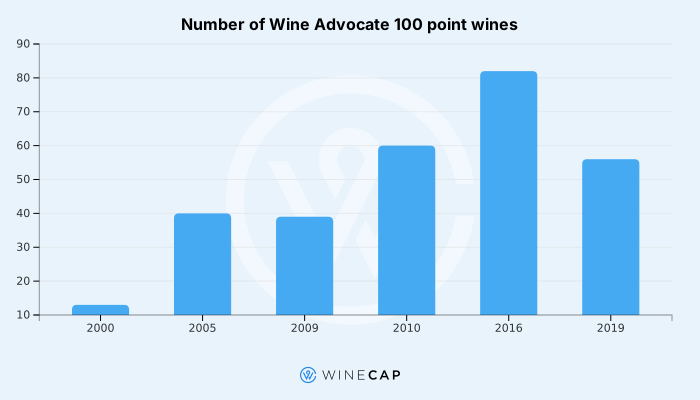
California is where the gap is starkest. 2016 produced 39 wines rated 100 points on Wine Advocate, more than double the next closest vintage, 2019, which recorded 21. The concentration of perfect scores in a single vintage is unusual even by Napa’s standards, and leaves investors with a wide variety of wines to choose from.
Bordeaux tells a slightly different story. It remains one of 2016’s strongest regions, but 2009 actually produced more 100-point wines on Wine Advocate than 2016. Regardless of the discrepancy, 2016 is exceptional in Bordeaux. A higher number of perfect scores for 2009 does not necessarily make it the better buy today.
The stand-out wines of Bordeaux 2016
There are a great many high-scoring wines from Bordeaux’s 2016 vintage:
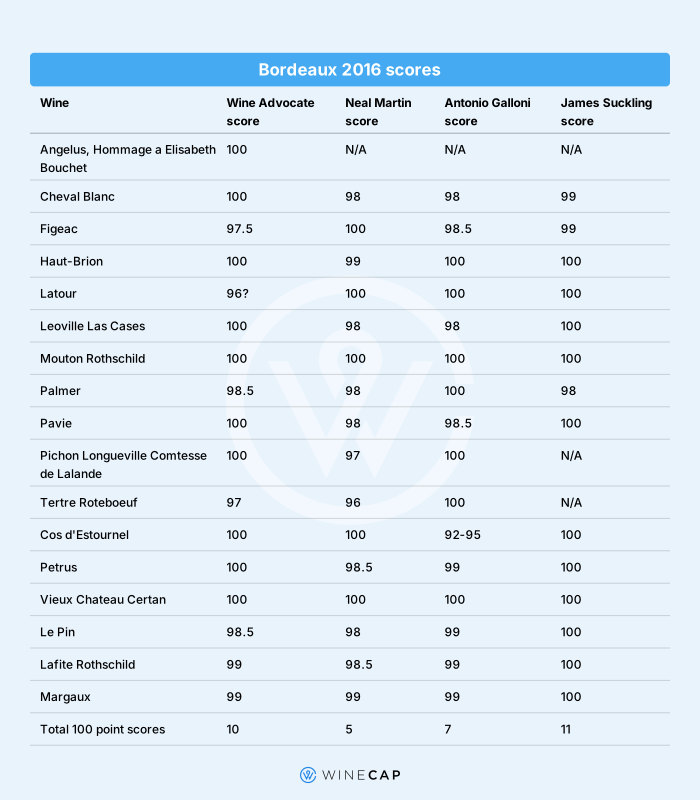
For quality four wines stand out in 2016 Bordeaux, and each shows a different shade of critical consensus:
- Chateau Mouton Rothschild 2016: arguably the highest-scoring Bordeaux of all time, with perfect 100-point scores fromWine Advocate, James Suckling, Jeff Leve, Jane Anson, Lisa Perrotti-Brown MW, Jean-Marc Quarin, Chris Kissack and La Revue du Vin de France. Vinous’s two critics were emphatic: Antonio Galloni called it “breathtaking”, and Neal Martin said it “bowled him over”
- Chateau Latour 2016: close to a clean sweep of 100-point scores elsewhere, though Wine Advocate’s own published score is 96?, with William Kelley dissenting that the wine seemed to miss the purity and precision expected of a first growth in a great vintage, explaining the question mark by suggesting its wilder, more rustic character may integrate further with more bottle age
- Chateau Haut-Brion 2016: multiple 100-point scores, including from Wine Advocate, Antonio Galloni at Vinous and James Suckling
- Vieux Chateau Certan 2016: 100 points across the board, from Wine Advocate, Neal Martin, Antonio Galloni and James Suckling, a rare right-bank wine matching the left bank’s headline scores
For investors, the spread of opinion is itself useful information. Mouton’s score is about as close to unanimous as fine wine criticism gets, which supports its position as the vintage’s benchmark. Latour’s solitary dissent is a reminder that even a wine covered in perfect scores can carry a genuine stylistic debate, one worth understanding before paying a premium for consensus that isn’t quite complete.
Why now is the moment to buy 2016
Ten years after harvest, 2016 has reached a point where patient buyers may find compelling reasons to add these wines to their portfolios. Most of these wines were released and first traded as the broader market climbed toward its 2022 and 2023 peak, and nearly all have fallen back since. Some have even fallen below their initial release price. Among the sharpest corrections are: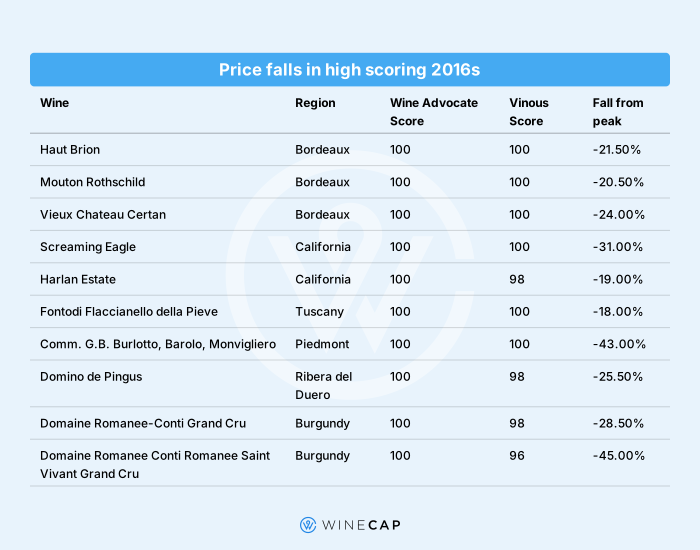
That correction is not the only reason 2016 is attractive now. These wines remain common enough to trade actively, which keeps pricing honest: a buyer is unlikely to overpay due to complex price discovery. Most 2016s are yet to enter their drinking windows, so corks are not yet being pulled at scale, and the scarcity premium that comes with a wine entering its prime has not yet built up.
Condition risk is lower than the ten-year headline suggests too. Even Bordeaux’s 2016s, some of the earliest wines from the vintage to be bottled, have typically only been in bottle and with owners since 2018 or 2019.
Ten-year-on retrospective tastings of the Bordeaux 2016s were published earlier this year, and the results were strong enough and uniform enough to ease any concerns around quality and the perception of quality. That news did little to move prices or trading activity at the time, because the broader fine wine market was still in a cautious mood. Sentiment has improved since, which makes the current window an interesting one for investors.
A vintage this strong, in this many regions, makes it easy to assume every wine carries the same tailwind, but the gap between Mouton Rothschild’s near-unanimous perfect scores and a middling Alsace or Argentine 2016 shows how wide the spread within a single year can be.
Strong vintages and high scores are not automatically good investments, and weaker vintages and modestly scored wines are not automatically poor investments, but those need real value and tend to favour the biggest, most liquid brand names.
The wines worth buying now are the ones where an exceptional vintage, a strong individual score and a price that has genuinely corrected and then stabilised all line up together, not simply the ones carrying the most famous vintage year on the label. Ten years on, with prices having fallen, drinking windows still some way off, quality widely agreed upon and hype having died down, 2016 is entering the part of its life where that alignment is easiest to find for investors willing to look past the headline.
FAQ: the 2016 vintage
Is the 2016 vintage a good investment now?
It depends on the wine, not the vintage alone. 2016 is among the strongest Bordeaux, Piedmont and Napa vintages of the past two decades, and some of its best-scoring wines are trading 24% to 45% below their 2022 to 2023 peak.
Why did white Burgundy perform so poorly in 2016?
A severe frost in April 2016 (the worst the Cote d’Or had seen since 1985), destroyed vine buds before flowering had even begun. Impact was uneven; some regions suffered near-total losses, others were able to harvest a crop, but often of lesser quality. A small number of survivors may be worth seeking out individually.
How liquid is the secondary market for 2016s?
Ten years on, 2016s remain actively traded, which is one of their attractions for buyers today. That liquidity, combined with prices well off their 2022 to 2023 peak, gives investors a genuine entry point rather than a chase for scarce stock.
Are 2016s ready to drink, and does that affect their investment case?
Most 2016s, particularly from Bordeaux, are not yet in their drinking windows, so corks are not being pulled at scale. That matters for investors because a wine entering its drinking window typically builds a premium as bottles get consumed and supply tightens. With that premium still ahead of most 2016s, current prices reflect trading value rather than drink-up demand.
How does 2016 compare with other strong vintages like 2009 or 2010?
It depends on the region and the metric used. Wine Advocate recorded more 100-point Bordeaux wines in 2009 than in 2016, even though 2016 has around 35% more 100-point wines overall than any other vintage sampled since 2000. For Cote de Nuits reds specifically, Wine Advocate rates 2016 slightly behind 2015, 2019 and 2005, but on a par with 2020 and slightly ahead of 2010. Comparisons need to be made vintage by vintage and region by region, not as a single global ranking.
WineCap’s independent market analysis helps investors build diversified fine wine portfolios with full ownership and transparent pricing. Speak to one of our wine investment experts and start building your portfolio. Schedule your free consultation today.
Capital at risk. Past performance is not a guide to future returns. Returns are not guaranteed.