The Rhone Valley wine investment guide: Northern vs Southern Rhone
- Rhone investment is concentrated in a handful of producers, led by Guigal’s La La wines in the Northern Rhône and Chateau Rayas in Chateauneuf-du-Pape.
- The Rhone represents around 5% of brands in the Liv-ex Power 100, making it a useful diversification play rather than a core portfolio allocation.
- While the region produces some of the world’s most sought-after wines, investment opportunities are more limited than in Bordeaux or Burgundy due to a narrower secondary market.
The Rhone Valley is one of France’s most prestigious wine regions, producing some of the world’s finest Syrah and Grenache. Yet from an investment perspective, it occupies a different position to Bordeaux, Burgundy and Champagne. Rather than offering broad market depth, Rhône investment is concentrated in a relatively small number of producers with established secondary market demand.
Understanding the distinction between the Northern Rhone and Southern Rhone is essential. The two regions differ in grape varieties, styles, production volumes and investment potential, with estates such as E. Guigal and Chateau Rayas dominating collector interest. This guide explains how the Rhône fine wine market works, which producers matter most, and where the region fits within a diversified investment portfolio.
The Rhone Valley: France’s fourth great wine region
Stretching from Lyon to the Mediterranean, the Rhone Valley is one of France’s largest and most diverse wine regions. Following the course of the Rhone River, it encompasses dozens of appellations with dramatically different climates, soils and grape varieties, from the steep, granite slopes of the Northern Rhone to the warm, rolling vineyards of the south.
The southern Rhone is among France’s most climate-sensitive wine regions, and 2026 has brought that into sharp focus. France endured three major heatwaves in the first half of the year, with temperatures of 40 degrees Celsius across the south for days at a time and daytime highs running 10 to 15 degrees above historical norms. Growers across the Rhone are managing significant water stress, and expectations for the 2026 vintage are already cautious. The frequency and severity of these heat events is increasing, and the southern Rhone’s position on the front line of that trend might impact the region’s investment case over the coming decades.
A region of extraordinary diversity
Although grouped under a single regional name, the Northern and Southern Rhône are separated by a 25-mile stretch around Montélimar and differ markedly in geography, climate and wine style.
The Northern Rhône is small and steep, with granite slopes overlooking the Rhône River. It has a cooler continental climate and is dominated by Syrah, alongside small plantings of Viognier, which produces some of the world’s finest white wines.
The Southern Rhône is larger, warmer and more varied. Its vineyards are planted on limestone, clay and the region’s distinctive galets roulés—large rounded stones that absorb heat during the day and release it at night. Here, Grenache forms the backbone of most blends, supported by varieties such as Syrah, Mourvèdre and Cinsault.
From an investment perspective, however, the market is far more concentrated than the region itself. Most secondary market demand centres on just three appellations: Côte-Rôtie, Hermitage and Châteauneuf-du-Pape. While excellent wines are produced elsewhere in the Rhône, these appellations account for the majority of investment-grade bottles and trading activity, making them the region’s principal focus for collectors.
The northern Rhone: Small in volume, significant in quality
The northern Rhone accounts for roughly 10% of the region’s total production. It produces the lion’s share of the Rhone’s finest wines. The appellations that matter most to investors are Cote Rotie, Hermitage, and, at the margins, Cornas. Condrieu, while producing genuinely great white wine, sits in a different category.
Cote Rotie
The northernmost and today arguably the most celebrated appellation in the Rhone, built on steep south-facing granite slopes above the town of Ampuis. Wines are made primarily from Syrah, though appellation rules permit up to 20% of the white grape Viognier in the blend. Production is small and the finest wines, led by Guigal’s La-Las, command prices that rival First Growth Bordeaux.
Condrieu
A nine-mile stretch of steep, terraced slopes growing only Viognier, producing outstanding white wines. Condrieu came close to extinction in the 1960s and 1970s, when the appellation had shrunk to just a handful of hectares and Viognier as a variety was barely known outside the region. It has since recovered to nearly 200 hectares. The wines are unquestionably fine, but Condrieu is not an investable category in its own right: secondary market depth is essentially absent. The highest-profile wines are Guigal’s La Doriane and Domaine Georges Vernay’s Coteau de Vernon. Chateau-Grillet, carries its own separate AOC designation distinct from the Condrieu AOC, despite sitting within the same geographic zone, and is planted entirely to Viognier. This monopole of Artemis Domaines (owned by the Pinault family, who also own Chateau Latour in Bordeaux) is one of a literal handful of wines from the Condrieu zone with a viable, if thin, secondary market.
Hermitage
A single south-facing hillside approximately two kilometres long and 500 metres deep, producing both red and white wine in roughly a three-to-one ratio. The vineyard is divided into a dozen or so named parcels and ownership concentrates among four producers: Paul Jaboulet Aine, Chapoutier, Jean-Louis Chave, and Delas Freres. Hermitage avoided the decades of critical and viticultural neglect that afflicted Cote Rotie and has maintained a consistent reputation for producing some of France’s most age-worthy red and white wines.
Cornas
Worthy of mention for quality, and at the top end prices are high enough to suggest investable potential, but secondary market liquidity is currently too limited for Cornas to form a reliable part of a fine wine portfolio.
Guigal and the La-Las: How three wines shaped a region
For much of the 20th century, the northern Rhone operated in relative obscurity. Its renaissance owes more to one producer than to any other: E. Guigal, whose three flagship single-vineyard Cote Roties, La Mouline, La Landonne and La Turque, are known collectively as the La-Las. In 1997, critic Robert Parker gave 100-point scores for all three wines from the 1985 vintage, one of the most significant critical events in the Rhone’s modern history.
Since the 1985 vintage 1988, 1999, 2003, 2005, 2009, and 2010 have all received triple 100 point scores, a record of excellence that any producer would be proud of. In 2003 and 2009, Guigal, Hermitage Ex-Voto Rouge also achieved 100 points and in 2010, Parker awarded 100 points to Ex-Voto and La Doriane (the estate’s flagship Condrieu), a remarkable sweep across appellations in a single vintage.
There have been no triple-100 vintages since 2010.
The secondary market places significant value on the 1985 LaLa’s as a result, with La Landonne and La Turque regularly exceeding £15,000 per case and La Mouline reaching in excess of £20,000 per case.
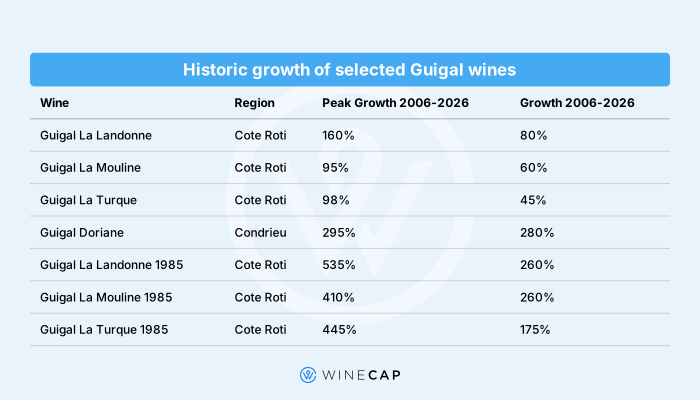
Guigal is another example where less costly cuvees see superior growth to higher priced flagships (Doriane averages £1,000 per case, while the LaLas are closer to £3,000). However, the performance advantage of true icons like the 1985’s are notable: although extreme rarity and advancing years means that prices are more volatile, more dependent on condition and also that trade volume is diminished the performance of each 1985 is markedly superior to any of our all vintage indexes.
Southern Rhone and Chateauneuf-du-Pape
Tavel’s position as one of the first appellations to receive AOC status in France earns it a historical note and Gigondas and Vacqueyras certainly produce genuinely fine wines. However, for investors examining the southern Rhone, none of these appellations offers the secondary market depth required. Chateauneuf-du-Pape is the only southern Rhone appellation with a credible investment case.
It also holds a special place in French wine history. In 1936, it became one of the first appellations to receive AOC (Appellation d’Origine Controlee) status, following the efforts of Baron Pierre Le Roy, whose work to protect the region’s identity from fraud and adulteration formed the foundation of the French appellation system still used today. The appellation permits 18 grape varieties and is best known for its Grenache-led blends, supported by Syrah and Mourvedre, grown on soils that include the famous galets roules. The Mistral wind, a powerful northerly that sweeps through the valley, limits humidity and supports the widespread organic viticulture for which the region is known.
The key producers for investors are:
- Chateau Rayas: The most sought-after name in the appellation, producing Grenache-dominant wines that regularly command the highest prices in the southern Rhone.
- Clos des Papes: Benchmark producer from the Avril family, making a single red and white cuvee that consistently ranks among the appellation’s finest.
- Chateau de Beaucastel: Famous for using all permitted grape varieties and for a Mourvedre-led style that produces wines of exceptional ageing potential, including one of the appellation’s most celebrated whites.
- Domaine du Vieux Telegraphe: Vineyards on the La Crau plateau produce wines with a strong secondary market following.
- Domaine du Pegau: Traditional, unfiltered wines with a devoted collector following and consistent secondary market presence.
The appellation’s strongest vintages for investors include 2016 (widely considered the finest modern vintage, balancing concentration with remarkable freshness), 2019, 2010, 2007, 1998, and the twin reference points of 1990 and 1989.
Comparing prices: a region that punches above its recognition
The thesis on Rhone pricing is straightforward: entry prices for the finest northern Rhone and Chateauneuf-du-Pape wines are broadly comparable to Bordeaux classified growths and, in some cases, to mid-tier Burgundy Grand Cru, while the volume of investable wines is significantly smaller. For investors, that means higher concentration of capital in fewer labels and thinner secondary market trading.
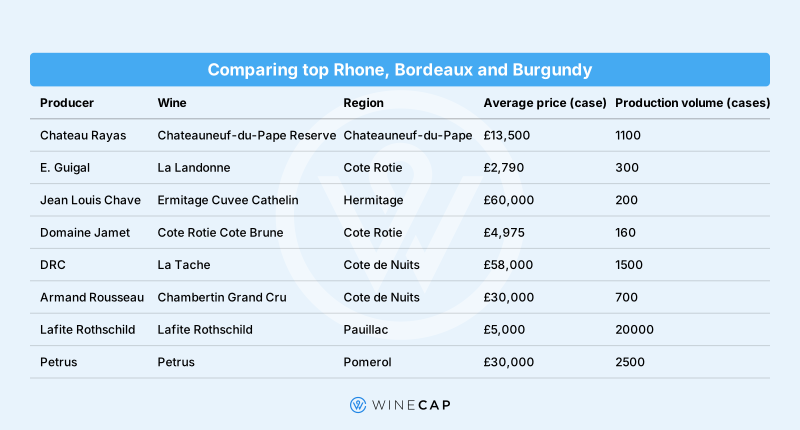
The Rhone as a diversification region
Bordeaux, Burgundy, Champagne, and the finest Italian expressions should form the core of most fine wine investment portfolios, for reasons of liquidity, market depth, and the breadth of investable producers within each region.
The Rhone makes a compelling case for diversification. The wines that justify inclusion are specific and limited: Guigal’s La-Las from the northern Rhone, a handful of wines from Hermitage and the leading Chateauneuf-du-Pape estates, and Chateau-Grillet for investors with appetite for very thin market positions.
Outside these names, the Rhone produces a significant number of wines with exceptional quality that has not yet translated into the secondary market depth investors need to enter and exit positions reliably. The wines are worth knowing, worth buying and worth drinking, but investor allocations should reflect where the market actually is, not where the quality suggests it could or should be.
FAQ: Rhone Valley wine investment
Is the Rhone Valley a good region for wine investment?
The Rhone is a viable region for diversification within a broader fine wine portfolio, but it is not a primary investment destination in the way Bordeaux or Burgundy are. The secondary market is concentrated around a very small number of producers: Guigal’s La-Las and the leading Chateauneuf-du-Pape estates account for the majority of meaningful trading activity. Outside those names, liquidity is limited and exit timing can be unpredictable.
How expensive are the top Rhone Valley wines?
The La-Las sit among the most expensive wines produced outside Burgundy and Bordeaux. Guigal, La Mouline has exceeded £20,000 per case at auction; La Landonne and La Turque regularly exceed £15,000. Chateau Rayas commands the highest prices in Chateauneuf-du-Pape, with top vintages trading well into four figures per bottle.
What is the difference between northern and southern Rhone wines?
The northern Rhone produces primarily Syrah-based reds and Viognier-based whites from steep granite hillsides in a continental climate. The southern Rhone is broader and warmer, producing Grenache-led blends. For investors, the northern Rhone’s finest producers and Chateauneuf-du-Pape in the south are the only appellations with meaningful secondary market activity.
What are the best Rhone Valley vintages for investment?
The highest quality vintages are often not the best performers, but they do tend to exhibit greater liquidity and will have a longer lifespan. The consistency of warm, dry conditions especially in the south means strong vintages occur more frequently than in Burgundy or Champagne, which tends to moderate the urgency premium on individual years.
How does Rhone Valley pricing compare to Bordeaux and Burgundy?
Entry prices for the finest Rhone wines are broadly comparable to Bordeaux classified growths and competitive with mid-tier Burgundy Grand Cru, but the number of investable labels is significantly smaller. This concentration means less portfolio flexibility, even the most established names have lower liquidity than Bordeaux and Burgundy mainstays.
WineCap’s independent market analysis helps investors build diversified fine wine portfolios with full ownership and transparent pricing. Speak to one of our wine investment experts and start building your portfolio. Schedule your free consultation today.
Capital at risk. Past performance is not a guide to future returns. Returns are not guaranteed.