Tax-efficient investing in the UK: your options
- Tax-efficient investments in the UK reach well beyond ISAs: venture schemes, pensions, forestry and CGT-exempt assets such as wine each shelter returns in different ways
- UK adults hold 8% of their wealth outside pensions in equities and mutual funds, the lowest share in the G7, against 33% in the US
- Tax relief tends to come with constraints: high risk of loss in venture schemes, low liquidity in forestry and casks, and uncertain returns in Premium Bonds
An asset’s tax treatment shapes returns as much as the asset itself. HMRC say “we would normally contend that wine is a wasting asset (an asset with a predictable life of 50 years or less) if it appears to be fine wine”, so its gains escape capital gains tax (CGT). Wine is not the only investment with a tax edge. This guide sets out how ISAs, SEIS, EIS, VCTs, pensions, Premium Bonds, gilts, forestry, whisky casks, classic cars and gold coins work, and what each one costs in risk and liquidity.
Why tax-efficient investing matters for UK savers
Tax-efficient savings and investments are available to everyone, but those tax wrappers only help the people who use them, and UK households invest less than their counterparts in many other nations. For many UK savers, a workplace pension is the closest they come to investing.
Auto-enrolment (the rule that requires employers to enrol eligible staff into a workplace pension) puts millions of employees into funds that invest on their behalf. Many therefore hold investments without ever choosing one, which leaves the wider menu of tax-efficient options unfamiliar.
- UK adults hold 8% of their wealth outside pensions in equities and mutual funds, the lowest share among the G7 nations, against 33% in the US (Aberdeen, January 2025)
- Property (50%) and cash (15%) dominate UK wealth outside pensions (Aberdeen, January 2025)
- Only 23% of UK adults have invested in the stock market outside a workplace pension, against nearly two-thirds in the US (Manchester Metropolitan University, July 2025, citing a Hargreaves Lansdown survey)
Research by Manchester Metropolitan University points to comfort with risk, a habit of holding savings in cash and Premium Bonds, and media coverage that dwells on market falls. Those habits leave money in the places where tax relief is thinnest and growth harder to find.
Some of the taxes that can be levied on investments include:
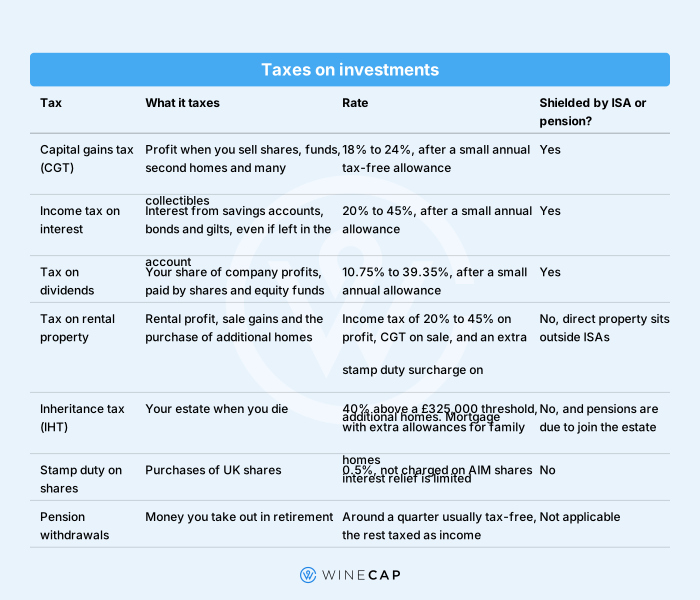
A tax-efficient wrapper doesn’t change the asset, but it can have a meaningful impact on its effective performance. Imagine two savers who earn 4% before tax, one pays 45% income tax on the interest, and the other holds the cash in a Cash ISA. If they were both to save £20,000 a year over a little more than 20 years, the advantages of a Cash ISA over a simple savings account could run into £100,000 or more.
The benefits of tax-efficient investment can be very significant.
Pensions and SIPPs: tax relief and no CGT inside the wrapper
According to the FCA, 75% of adults in the UK have some sort of private pension; these combine income tax relief on contributions with no CGT on gains inside the wrapper. A workplace pension usually invests in a default fund chosen by the provider, while a Self Invested Personal Pension (SIPP) gives the holder a wider menu, from individual shares to funds and allows them to manage their pension themselves.
Crucially, a SIPP allows the holder to make trades within the tax wrapper without attracting CGT. Savers can also take up to 25% as a capped tax-free lump sum, with the rest counting as taxable income, although they can’t access the money until 55.
Until recently, unused pension funds were also exempt from inheritance tax, although that is now changing.
ISAs as a tax wrapper, not an investment
Like a pension, an ISA (Individual Savings Account) is a tax wrapper, not an investment in itself. The wrapper sits around another investment as a shield and shelters it from tax. After pensions, ISAs are among the most commonly used wrappers. Currently, the overall allowance is £20,000 per adult per tax year across every ISA type.
Inside a Stocks and Shares ISA, dividends and interest escape income tax, gains escape CGT, and nothing needs reporting on a tax return. Just like a pension, an ISA is only as good as what sits inside it. A Stocks and Shares ISA holding a poor fund still loses money. A Cash ISA paying a low rate still earns little.
Currently there are five types of ISA open to new savers, each serving a different purpose.
- Cash ISA: allows interest on cash savings to be tax-free; from April 2027 the limit falls to £12,000 for under-65s, while savers aged 65 and over keep £20,000
- Stocks and Shares ISA: allows investment in funds, shares and bonds with no income tax, dividend tax or CGT
- Innovative Finance ISA: holds peer-to-peer loans and crowdfunding-style bonds
- Lifetime ISA: up to £4,000 a year to which the government contributes an extra £1,000, but with extra penalties and restrictions on withdrawals
- Junior ISA: up to £9,000 a year for under-18s, separate from the adult allowance
SEIS, EIS and VCT schemes, income tax relief for backing start-ups and small companies
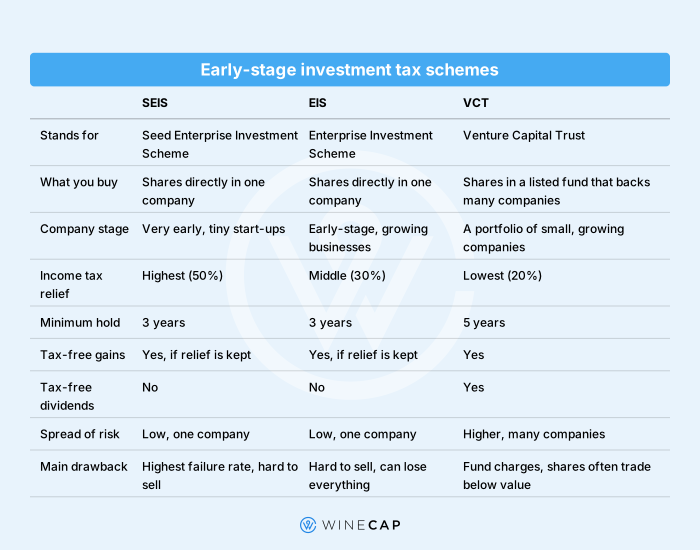
UK investors have access to three different types of schemes that grant significant tax reliefs for backing startups and smaller businesses:
- SEISs: Seed Enterprise Investment Scheme
- EISs: Enterprise Investment Scheme
- VCTs. Venture Capital Trust
Each has different limits, different holding periods and different eligibility rules, and each provides exemption from capital gains tax, but it’s the income tax relief that’s particularly interesting.
Of the three, income tax relief is most generous for the SEIS, which pays 50% income tax relief on up to £200,000 of investment. The relief reduces the investor’s tax bill rather than their taxable income, so it cannot exceed the income tax the investor owes that year. These schemes tend to suit investors with a large income tax bill, a long horizon and a higher risk appetite. SEISs target earlier stage companies than EISs, while VCTs give an easier way to invest across multiple small companies through a listed entity, at the cost of lower income tax relief and a longer minimum holding period.
Premium Bonds: tax-free prizes instead of interest
Premium Bonds are where tax-free investments begin to become a little more idiosyncratic, although they remain one of the most popular savings products in the UK according to their administrator NS&I (National Savings and Investments). They work like a tax-free savings account crossed with a lottery. Instead of a fixed interest rate, there is a prize fund that you can win prizes from. NS&I set the prize fund rate at 4.35% tax-free from the September 2026 draw, a rate describing a holder with average luck.
Each £1 bond has a 1 in 21,000 chance of a prize each month and holders can cash in at any time at face value, so the price never moves. The table below shows where the prize money goes. Research shows that the average winner holds a little under £24,000 worth of Premium Bonds. The average non-winner owns £175 worth of Premium Bonds. Depending on the total value held, a holder’s realistic outcome is therefore a handful of small prizes, not a windfall, and most holders have never won a prize. The minimum purchase is £25, and the maximum holding is £50,000.
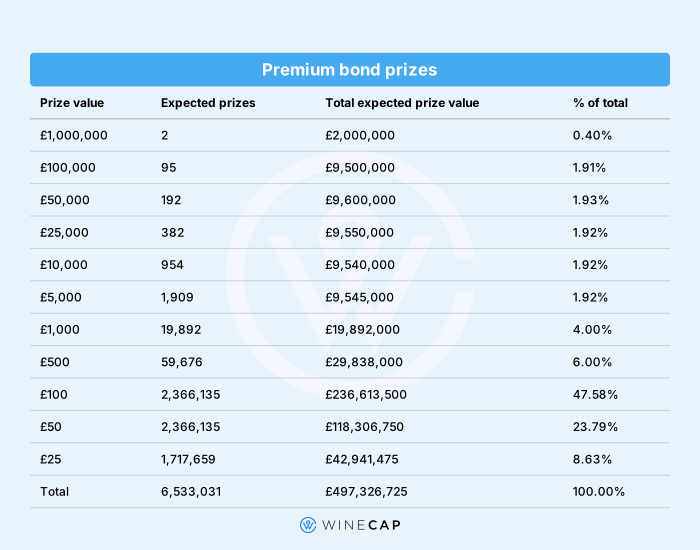
Expected Premium Bond prizes, September 2026 draw. Source: NS&I, 18 August 2026; percentage column calculated from NS&I figures.
Gilts: tax-free price gains from UK government bonds
Gilts are the main way the UK government borrows money. They are government bonds that pay fixed interest and repay a fixed sum on a fixed date. Price gains on a gilt are exempt from CGT, although the interest counts as income and is taxable. Where gilts differ from premium bonds is that they trade on the market and their price can rise and fall, so a gilt with a face value of £100 could cost you £90 or £110 to buy in practice. Held to maturity, both would repay £100.
The remaining lifespan on a gilt changes its risk profile. Longer gilts generally react more strongly to interest rate moves than shorter ones, so a 30-year gilt swings in price more than a three-year gilt. If a gilt pays a lower interest rate than the market, its value will tend to fall. If it pays a higher interest rate than the market, its value will tend to rise.
The lifespan of gilts can be quite long. The longest gilts that the UK government has ever raised lasted for nearly 300 years and were consolidated from debt accrued in the aftermath of the South Sea bubble of the 1720s – they were finally redeemed in 2015. Currently, the longest gilts available won’t mature until the 2070s.
Forestry and woodland: income tax, CGT and inheritance tax relief
Forestry offers income tax, CGT and inheritance tax advantages in one asset, but it rewards patience rather than speed. Direct ownership can cost millions, while forestry funds are available they also typically suit sophisticated or high-net-worth investors.
Returns come from timber sales, land value and sometimes carbon credits (payments linked to the carbon that growing trees store). Liquidity is very low, and holding periods of decades are common.
Inheritance tax relief carries conditions. Business Property Relief (an inheritance tax relief that applies to business assets) applies only if the investor still holds the woodland at death and has held it for at least two years. The £2.5 million cap, which applies from April 2026, passes between spouses, so a couple can shelter up to £5 million of qualifying assets.
- Income tax: profits from selling timber from commercial woodland are exempt, but losses cannot offset other income
- CGT: a sale of land with its crop attracts CGT on the land element only, often the smaller part of the value
- Inheritance tax: commercial woodland generally qualifies for 100% Business Property Relief (a relief on qualifying business assets) after two years and Woodlands Relief can defer inheritance tax on the timber’s value until felling
- Cap: business and agricultural relief share a £2.5 million limit per person, and value above it gets 50% relief, an effective 20% charge
Investors who buy through a fund should check how the fund holds the woodland, because the reliefs depend on the trade and the ownership structure rather than on the label. Forestry also suits only part of a portfolio, because it ties up money for years.
Whisky casks: a wasting asset with thin trading data
Whisky casks qualify as wasting assets because evaporation, known as the angels’ share, costs about 2% of the volume each year, which gives whisky stored in a government bonded warehouse outside of VAT and duty a predictable life under 50 years. Gains on a wasting asset are exempt from CGT, although losses earn no relief.
Liquidity, not tax, is the weak point. No regulated market exists for mature or maturing casks and the market that does exist lacks transparency and activity.
Independent bottlers (companies that buy whisky from a distillery in cask and bottle it themselves under their own label) account for a significant share of cask exits and sellers must regauge (measure) the remaining liquid before a sale. Fractional ownership exists but further limits liquidity and makes establishing ownership difficult.
Evidence on cask returns is thin. Published return figures come mostly from sellers and brokers, so investors should treat them with caution and ask how a seller calculated any quoted gain. No single reliable source of transaction data exists for whisky casks, and while there is some data for trading in bottles, they still suffer poor liquidity and advisors generally treat bottled whisky as liable to capital gains tax above the standard thresholds.
Classic cars and gold coins: CGT-exempt tangible assets
Classic cars and UK currency (including gold coins) both escape any CGT. Investors still need to check which vehicles and coins qualify, because both exemptions have clear edges.
A coin counts as currency only if it is legal tender when the investor buys it or sells it; this means that foreign currency (e.g. South African Krugerrands or Canadian Maple Leaves) and pre-decimalisation currency do not have this CGT benefit. Gold sovereigns are still legal tender with a face value of £1, whatever their year, so they do benefit from this exemption.
For cars, the legislation states that no chargeable gain or allowable loss arises on disposal, so a loss cannot offset gains elsewhere. As with wine, whisky and coins, regular dealing can also change the picture, because HMRC taxes trading profits as income.
Where fine wine sits among UK tax-efficient investments
Tax relief never arrives alone. Each option attaches a constraint that will affect how suitable the investment is for prospective investors.
Fine wine offers a different mix. Buyers get no income tax relief up front, but wine that counts as a wasting asset carries no CGT on gains, with no annual cap and no minimum holding period. HMRC’s view excludes port and other fortified wines, and inheritance tax still applies.
Many investors start with their ISA and pension allowances, then weigh the remaining options by liquidity, risk and cost rather than by tax alone. Tax rules change, and a qualified adviser can confirm what applies in a given case.
FAQ: tax-efficient investing in the UK
How much tax relief does a £200,000 SEIS investment earn?
SEIS pays 50% income tax relief, so £200,000 cuts the investor’s bill by up to £100,000. The relief cannot exceed the income tax owed that year, and the investor can apply it to the previous tax year if that year’s limit is unused.
Is a Premium Bond better than a Cash ISA?
For most savers, no. NS&I set its prize fund rate at 4.35% from the September 2026 draw, against 4.56% on the best easy-access Cash ISA in August 2026, according to MoneySavingExpert. A higher-rate taxpayer who has used the ISA allowance may still prefer Premium Bonds, because prizes are tax-free.
Are all gold coins free of capital gains tax?
No. Foreign coins such as Krugerrands are chargeable.
How easy is it to sell forestry or a whisky cask?
Both are illiquid. Forestry typically needs a holding period of ten years or more, and whisky casks lack the volume of secondary market activity enjoyed by wine.
Is wine exempt from capital gains tax?
HMRC’s own language says “we would normally contend that wine is a wasting asset (an asset with a predictable life of 50 years or less) if it appears to be fine wine” which confirms its CGT exempt status.
Do any of these investments avoid inheritance tax?
Some reduce it. Commercial woodland generally qualifies for 100% Business Property Relief after two years, up to a £2.5 million cap per person. Wasting-asset status gives no inheritance tax relief on casks, cars or wine, and unused pension funds are due to enter the inheritance tax net from 2027.
WineCap’s independent market analysis helps investors build diversified fine wine portfolios with full ownership and transparent pricing. Speak to one of our wine investment experts and start building your portfolio. Schedule your free consultation today.
Capital at risk. Past performance is not a guide to future returns. Returns are not guaranteed.