Why fine wine is a long-term investment
- Fine wine is a long-term asset because its two primary value drivers, improving quality and increasing scarcity, both require time to play out.
- The average equity holding period has fallen below six months; fine wine investment operates on a fundamentally different timescale.
- A minimum five-year hold is needed to capture the quality appreciation and supply contraction that make fine wine a distinctive investment category.
“Long term” is used freely in investment but rarely defined. For most asset classes, it has shortened considerably over the past three decades. Fine wine is fundamentally different, as the qualities that drive its value – improving with age and diminishing in supply as bottles are consumed – are inherently time-dependent. Understanding what that means in practice matters before committing capital. This article explains why wine’s long-term nature is structural rather than circumstantial, and what that demands of investors who want to benefit from it.
What long-term means across asset classes
Investment holding periods have changed dramatically over the past sixty years, and not in the same direction across all asset classes. Average holding periods for equities on the New York Stock Exchange fell from approximately eight years in the 1960s to under six months by 2020. This has been distorted by a substantial share of total equity volume taken by high-frequency trading but even adjusted for this effect, the typical retail or institutional investor holds equities for one to two years. Even that is short by the standards of most other asset classes.
Typical investment holding periods by asset class:
- Equities (adjusted for high-frequency trading): 1–2 years for retail and institutional investors
- Government bonds: often commonly held to maturity, ranging from 5 to 30 years depending on issuance
- UK residential property: approximately 9 years before resale, based on Land Registry transaction data
- Classic cars: typically 5–15 years for serious collectors; aggregate market data is limited
- Private equity: 5–7 years, determined by fund structure and investment mandate
- Fine wine: a minimum of 5 years is recommended; the strongest investment cases typically play out over 10 years or longer
The clear direction of travel in most purely investment markets has been toward shorter, not longer, holding periods. Fine wine sits firmly at the other end of the spectrum, and for reasons intrinsic to the asset rather than incidental to its market structure.
Fine wine’s value is built over time
Fine wine is one of the very few assets in which the quality of the underlying holding improves after purchase. Pinot Noir from a fine Burgundy vintage, Cabernet Sauvignon from a great Bordeaux year, Vintage Champagne from a leading house: all of these wines develop complexity over years and decades in the bottle. That improvement is not marginal. A wine rated 90 points at fifteen years can become a profoundly different wine at thirty-five, and the drinking window for the finest bottles can open a decade or more after that.
Neal Martin’s assessments of Château Lafite Rothschild 1985 trace that arc clearly and precisely:
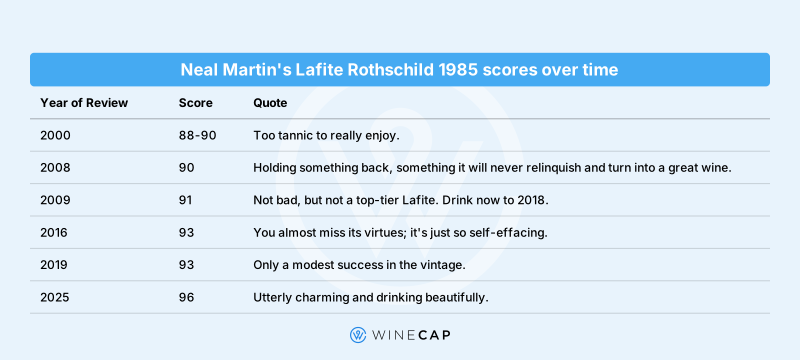
Critical reassessment of this kind drives secondary market pricing. A wine that earns a significantly higher score from a trusted critic thirty years after its vintage attracts renewed collector interest and stronger market demand. None of that benefit reaches the investor who sold at year five.
Scarcity reinforces the quality argument. As wine ages, the global stock of any given vintage contracts continuously: bottles are opened at dinner tables, cases are lost in transit, and collections are gradually consumed. Supply falls without any corresponding reduction in quality for the wine that remains. For the most sought-after producers and vintages, that contraction is irreversible. It accelerates as the drinking window opens and bottles are pulled with increasing frequency.
How wine market cycles shape returns
Fine wine’s secondary market moves in longer cycles than mainstream equity markets. Lower liquidity is driven by the fact that most buyers are collectors, not investors. That structural characteristic moderates volatility in both directions. It does not prevent contractions, but it lengthens and moderates them.
The cadence of wine criticism amplifies this long-cycle effect. A young wine receives barrel scores before release and early bottle scores in the years immediately following. The definitive assessments that attract serious collector activity often arrive ten to twenty years later, as wines with genuine ageing potential begin to show their true character. The Lafite 1985 trajectory is a clear instance of this dynamic: a wine that attracted sceptical early commentary took decades to receive scores that reflect its quality.
Three meaningful contractions have occurred in the fine wine market over the past twenty-five years: during the 2008–09 global financial crisis, during the 2011–12 Bordeaux correction (when en primeur release prices were perceived as unsustainably high following the celebrated 2010 vintage), and during the 2022–23 period of post-pandemic retracement. Contractions give way to recovery. Investors who hold through did not crystallise losses. Those who sold into them did.
Wine also carries a resistance to financialisation that most other asset classes cannot claim. Its market reflects the actual buying and selling decisions of collectors and investors rather than the amplified positions of leveraged traders. That simplicity explains why wine’s downturns tend to be recoverable rather than systemic.
The frictional costs that enforce a long-term view
Fine wine carries transaction costs that make short-term trading economically unattractive. Buyers and sellers typically face combined commissions, insurance, and handling costs that represent a larger proportion of the value than is the case with bonds or equities where fees are fractions of a single percent. A wine that has appreciated modestly over two years will return investors less net of those costs. The longer the hold, the lower the proportional drag on the final return.
Annual storage adds a predictable carrying cost of approximately £15 per case of twelve bottles at a professional bonded warehouse. On a £2,000 case, this represents 0.75% annually, a modest figure by the standards of most alternative assets. Over a ten-year hold, storage totals £150 per case: a manageable sum set against meaningful capital appreciation. The calculation becomes materially less favourable for investors who trade frequently or hold short term positions.
The combined friction of storage and transaction costs means wine investment is genuinely unsuitable for investors who expect returns over months rather than years, or who may need to liquidate at short notice. That is not a flaw in the asset class. It filters the investor base toward patient capital and reduces the speculative short-term activity that would otherwise amplify volatility.
Building a wine portfolio with a long-term horizon
Investors who enter fine wine with a clear understanding of its timescale are better placed to hold through the short-term noise that occasionally affects the market. Each of the three contractions of the past twenty-five years created buying opportunities for investors who recognised that the underlying value drivers had not changed. Those who approached the 2022–23 period of retracement with a long-term view have been able to acquire investment-grade wine at prices that will prove to be good value, just as they did after the 2011 contraction.
The Lafite 1985 case is instructive not because the wine is exceptional, but because the arc it traces is representative. Most serious Bordeaux and Burgundy vintages follow some version of it: initial release prices reflect the promise of a wine rather than its fully realised quality; secondary market pricing subsequently tracks critical reassessment; and the investment case plays out over decades rather than years. An investor who bought Lafite 1985 in 2000 based on an 88–90 score, and held with the understanding that the wine had more to give, has arrived at a 96-point wine that the market values accordingly.
A minimum five-year hold gives a wine time to begin that arc. A decade captures more of it. Investors who build collections with long horizons in mind, selecting wines from producers and vintages with genuine ageing potential, consistently achieve better outcomes than those who treat fine wine as a short-term trading category.
The long-term case is structural, not sentimental
Fine wine’s status as a long-term asset is not a marketing claim: it is a function of the way wine works. Quality builds over decades, supply contracts with every cork pulled, critical reassessment arrives on a timeline measured in years, and transaction costs make frequent trading economically irrational. As Charlie Munger said “The big money is not in the buying and the selling but in the waiting.”
Investors who understand these mechanics before they commit capital are able to hold with conviction when markets move against them, and to recognise the difference between a temporary contraction and a structural shift. That distinction, more than any individual vintage or producer decision, is what separates successful wine investors from those who exit too early.
FAQ: Wine as a long-term asset
How long should fine wine be held as an investment?
A minimum of five years is recommended to give any significant quality appreciation and supply contraction. The strongest investment cases in fine wine, from Bordeaux First Growths to top Burgundy Grand Crus, typically play out over ten years or more. Investors who hold for shorter periods are unlikely to capture the full value.
What are the storage costs for a fine wine investment?
Bonded warehouse storage costs approximately £15 per case of twelve bottles per year. Storage costs are a predictable and manageable element of the return calculation. Investors should always consider the proportion of their collection’s value being paid in storage.
Is fine wine suitable for investors with a short time horizon?
Fine wine is not well-suited to investors who need capital back within one to three years, or who cannot tolerate periods of flat or modestly declining prices. The quality and scarcity dynamics that drive returns take years to play out. Investors who require near-term liquidity should consider carefully whether fine wine is the right allocation for their portfolio.
Do wine market downturns pose a significant risk to long-term holders?
Three meaningful contractions have occurred in the fine wine market over the past twenty-five years: in 2008–09, 2011–12, and 2022–23. Each gave way to recovery. For investors who entered at reasonable prices and held with patience, the greater risk in each case was exiting during the contraction rather than holding through it.
What is the relationship between critic scores and wine investment returns?
Critic scores influence secondary market pricing significantly, particularly reassessments that arrive years after a vintage. Barrel scores and early bottle scores are useful for identifying potential, but the definitive assessments that drive sustained market appreciation tend to arrive on the same long timeline as the investment itself.
WineCap’s independent market analysis helps investors build diversified fine wine portfolios with full ownership and transparent pricing. Speak to one of our wine investment experts and start building your portfolio. Schedule your free consultation today.
Capital at risk. Past performance is not a guide to future returns. Returns are not guaranteed.