Q2 2026 Fine Wine Report
The second quarter of 2026 marked a turning point for investors. While global markets were driven by AI optimism and higher interest rates, the fine wine market increasingly rewarded disciplined buying. This report analyses the quarter’s defining events, the investment lessons from Bordeaux 2025 En Primeur, the strongest-performing wines of H1, and the industry developments shaping the outlook for the remainder of the year.
Key findings
- Global equities reached new highs as the SpaceX IPO and continued AI optimism fuelled a retail-led rally before a quarter-end correction.
- Gold posted its worst quarter in over a decade as surging global stock markets and a strengthening US dollar pulled capital away from traditional safe-haven assets.
- Easing trade and geopolitical tensions reopened key demand corridors across Asia and the Gulf, supporting the long-term outlook for luxury assets, including fine wine.
- Bordeaux 2025 delivered outstanding quality at the lowest release prices among recent prime vintages, but buyers consistently favoured 2019 where new releases failed to offer a meaningful pricing advantage.
- Back-vintage Bordeaux dominated H1 returns, accounting for nine of the ten best-performing wines, reinforcing the market’s growing preference for proven quality and relative value.
Executive summary
The second quarter of 2026 was defined by a tension between market exuberance and the quiet tightening of financial conditions beneath it. Despite renewed geopolitical tensions, persistent inflation concerns and expectations of further interest rate rises, global equities continued to push higher, driven by investor enthusiasm for artificial intelligence and one of the largest public listings in history. SpaceX’s market debut became the key financial event of the quarter, fuelling a retail-led rally before a sharp correction reminded investors that even the strongest narratives remain subject to valuation discipline.
Meanwhile, gold posted its worst quarter in over a decade. After reaching record highs earlier this year, the precious metal experienced a sharp correction, as higher Treasury yields and a stronger US dollar introduced fresh headwinds. While gold remains one of the world’s most established stores of value, its price swings highlighted an important trend among wealth managers and investors: a growing willingness to look beyond conventional safe-havens and towards alternative assets that can offer diversification benefits.
Against this backdrop, the fine wine market continued to move on its own fundamentals. Demand remained concentrated in wines where quality, scarcity and pricing aligned, reinforcing fine wine’s position as a long-term tangible asset largely independent of public market sentiment.
As anticipated, the Bordeaux 2025 En Primeur campaign stole the spotlight in Q2. While the vintage received widespread critical acclaim and entered the market at the lowest average release price among recent prime vintages, the campaign also confirmed a fundamental shift in buying behaviour. Investors prioritised estates that offered compelling value relative to the back vintages, while releases priced too close to higher-scoring vintages such as 2019 struggled to gain traction.
That same discipline was reflected across the secondary market. Nine of the ten best-performing wines in the first half of the year were Bordeaux, led by strong gains in mature vintages from Barsac, Sauternes and the exceptional 2016 vintage. Rather than chasing momentum, buyers increasingly allocated capital towards established brands where prices had yet to fully reflect quality and reputation.
Looking ahead to the second half of 2026, attention will shift to the autumn La Place campaign, where the industry’s willingness to apply the pricing lessons of Bordeaux En Primeur will face its next test. After the traditional summer lull, we expect the fine wine market to continue exhibiting the characteristics that have emerged throughout the first half of the year: disciplined buyers, selective demand and broadly stable prices. In a world where capital increasingly moves at the pace of headlines, that consistency is becoming an investment strength in its own right.
Bordeaux En Primeur 2025: Q2’s defining event
The Bordeaux 2025 En Primeur campaign – the defining event of the second quarter – arrived with both an exceptional vintage and heightened expectations around pricing. After several years of declining trade participation and increasing competition from the secondary market, the campaign became a test of whether Bordeaux could realign new-release pricing with buyer expectations. The outcome was clear: where estates offered compelling relative value, demand followed. Where they did not, buyers looked to back vintages instead.
Where does the 2025 vintage stand among Bordeaux’s greatest?
Our analysis of average release prices against critic scores across six leading Bordeaux vintages from the past decade reveals a striking conclusion.
The quality gap between these vintages is remarkably narrow. The highest-ranked vintage, 2016, achieved an average critic score of 98.08 points, while 2025 averaged 96.8 – a difference of just 1.3 points. The intervening vintages – 2019, 2022, 2018 and 2020 – all fall within this point range. By any measure, these are exceptional wines, suggesting that collectors need not focus exclusively on the highest-scoring years to access world-class quality.
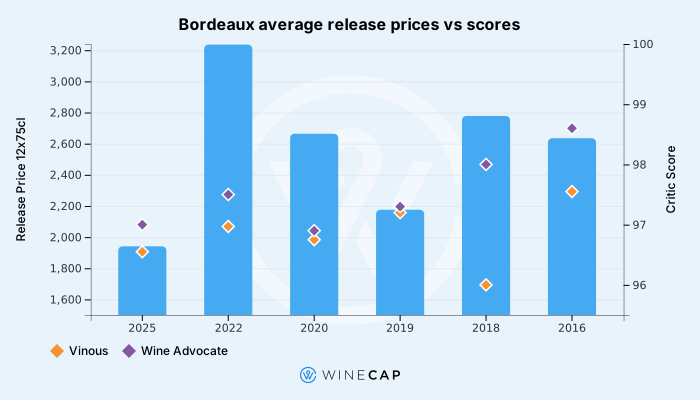
Where the vintages diverge is on price. The 2022 campaign – fuelled by speculative excitement and post-lockdown demand – produced the highest release prices of the group, well above vintages of comparable or superior quality. The 2025, by contrast, entered the market as the most attractively priced vintage of the six, despite yielding wines of outstanding quality. For an investor comparing price-to-score efficiency across these campaigns, the 2025 presents one of the strongest entry points of the decade.
The vintage ranking also provides a clear investment framework. With quality ordered 2016, 2019, 2022, 2018, 2020, and 2025, the lattersits at the foot of the score table – outstanding in absolute terms, but the least compelling on quality grounds relative to its peers. That has a direct implication for pricing: any 2025 release priced above its 2019 equivalent struggles to make the investment case. The 2019 scores higher, is already bottled, and available for immediate delivery. Unless a 2025 release offers a meaningful discount to the 2019, or a scarcity argument that stands independently – as Cheval Blanc’s 15hl/ha yield does – the back catalogue remains the more rational allocation.
The investment takeaway
The 2025 En Primeur campaign will be remembered not for any individual headline release but for what it confirmed about today’s fine wine buyer. Demand has not disappeared – but it has become more considered, more analytical, and less susceptible to prestige alone.
For the market, this represents a positive development. Greater pricing discipline encourages participation, strengthens confidence and supports long-term liquidity. Estates that recognised this dynamic – notably Cheval Blanc, alongside Lafite Rothschild and Mouton Rothschild – were rewarded with stronger buyer engagement, demonstrating that trust remains one of Bordeaux’s most valuable assets.
The 2025 vintage also reinforces that selective En Primeur buying continues to make investment sense. While it entered the market at the most attractive average release prices of recent prime vintages, buyers consistently favoured established back vintages whenever the pricing advantage narrowed. The lesson from this campaign is therefore not simply that lower prices drive demand, but that relative value has become the defining principle of today’s fine wine market.
The best-performing wines of H1 2026
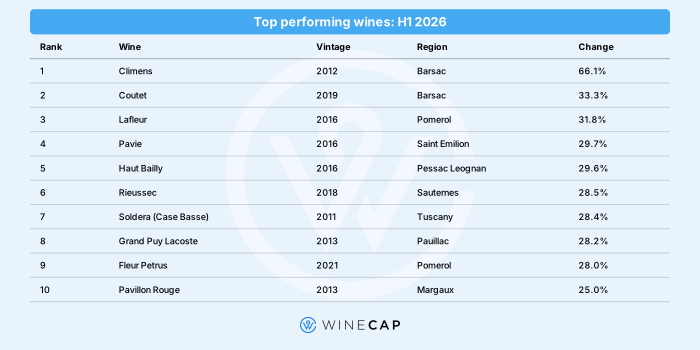
The first half of 2026 delivered a clear message from the fine wine market: back-vintage Bordeaux is where capital found the strongest returns. Nine of the ten best-performing wines came from Bordeaux, spanning five appellations and six vintages. Rather than a single producer or region outperforming, the results point to a broader reassessment of the secondary market, where buyers are increasingly rewarding established wines offering compelling relative value. While the En Primeur campaign dominated headlines, it was the back vintages that delivered the strongest performance.
Barsac leads the field again
For the second consecutive quarter, Barsac produced the market’s strongest performer. Château Climens 2012 rose 66.1% during the first half of the year, extending the momentum established in Q1. Château Coutet 2019 followed with a 33.3% gain, while neighbouring Château Rieussec 2018 ranked sixth, up 28.5%.
The consistency of this performance suggests more than a short-term trading opportunity. Buyers are increasingly recognising the value offered by top sweet wines, a category that has long traded below its critical standing and ageing potential. Climens 2012 also benefits from exceptional scarcity: with no Grand Vin produced between 2013 and 2017, it represents the estate’s final widely available vintage before a six-year production gap. That combination of rarity, quality and relative value has made it one of the defining performers of the current market cycle.
The 2016 vintage comes into focus
Three of the ten strongest performers came from the 2016 vintage: Lafleur (+31.8%), Pavie (+29.7%) and Haut Bailly (+29.6%). As shown in our vintage analysis, 2016 remains the highest-scoring Bordeaux vintage across the major critics we track.
The market is increasingly reflecting that quality. For investors, 2016 continues to offer a compelling combination of exceptional critical pedigree, mature secondary market pricing and significant ageing potential.
Lafleur’s performance is particularly noteworthy. One of Pomerol’s smallest and most sought-after estates, its 31.8% gain demonstrates that even the market’s most established blue-chip wines continue to offer meaningful upside when pricing remains attractive relative to intrinsic quality.
Back-vintage opportunities extend beyond the great years
Two of the top ten performers came from the often-overlooked 2013 vintage: Grand Puy Lacoste (+28.2%) and Pavillon Rouge du Chateau Margaux (+25.0%). Their performance reflects another emerging characteristic of today’s market: buyers are looking beyond vintage reputation in search of relative value.
Although 2013 received a mixed reception at release, the best estates produced wines that have aged more successfully than early perceptions suggested. Investors willing to reassess these wines on their individual merits, rather than the reputation of the vintage as a whole, have begun to see that conviction reflected in prices.
Beyond Bordeaux
The only non-Bordeaux wine to feature in the top ten was Soldera Case Basse 2011, which gained 28.4%. With tiny production, no second wine and one of Italy’s strongest collector followings, Soldera exemplifies the type of rare fine wine asset that continues to attract capital during periods of market uncertainty.
What H1 performance tells us
The first half of 2026 highlights a fine wine market becoming increasingly disciplined. The strongest returns were generated by established wines whose prices had yet to fully reflect their long-term quality, scarcity and investment credentials.
Just as revealing is what failed to appear among the top performers: recently released vintages, momentum-driven trades and wines supported primarily by reputation rather than value. The same discipline that shaped the Bordeaux 2025 En Primeur campaign is evident across the secondary market, where buyers continue to prioritise relative value over novelty. As the second half unfolds, the key question is not whether demand will remain, but whether this increasingly selective approach will continue to define where capital is allocated.
Fine wine news round-up: Q2 2026
Record heat returns to Europe’s vineyards
As the second quarter drew to a close, Europe’s leading wine regions once again found themselves confronting extreme heat. A late-June heatwave pushed temperatures above 40°C across large parts of France, with Bordeaux exceeding 42°C and the country recording its hottest day since records began. Similar conditions affected Spain, Italy and other major wine-producing regions, prompting widespread heat alerts across Western Europe.
Following an unusually warm spring that accelerated vine development, many vineyards entered flowering and early fruit set ahead of the long-term average. Extreme heat during these stages can influence yields, berry development and ultimately wine style, although the full impact will not become clear until later in the growing season. After the 2025 Bordeaux vintage was shaped by one of the hottest Junes on record, the opening months of the 2026 season suggest that climate volatility is becoming an increasingly consistent feature of European viticulture rather than an exceptional event.
For producers, adaptation is becoming as important as terroir. Investment in canopy management, precision irrigation where permitted, drought-resistant rootstocks and higher-altitude vineyard sites is increasingly shaping long-term resilience. For investors, this has important implications. Climate risk is no longer simply a question of vintage variation – it is becoming a structural factor influencing production volumes, wine styles and the long-term competitiveness of individual estates.
France’s appellation system turns 90
April marked the 90th anniversary of France’s Appellation d’Origine Controlee (AOC) system, prompting renewed debate over whether the framework that has governed French wine production since the 1930s remains fit for purpose. In a column for Decanter, wine writer Andrew Jefford argued that the system, originally created to combat fraud and protect regional identity, now requires meaningful reform to better reflect the realities of modern viticulture and a changing climate.
Jefford proposed devolving greater regulatory control to individual appellations, allowing growers more flexibility over grape varieties and vineyard practices while also calling for reform of France’s Loi Evin advertising legislation. His argument reflects a broader discussion within the French wine industry as producers increasingly seek greater freedom to adapt to environmental and commercial pressures.
The debate gained additional relevance during the Bordeaux 2025 En Primeur campaign when Chateau Lafleur presented its 2025 vintage as Vin de France rather than under the Pomerol appellation. The Guinaudeau family cited the flexibility to adapt grape varieties and vineyard practices without the constraints of appellation regulations. When one of Bordeaux’s most respected estates chooses to forgo one of the world’s most prestigious appellation names, it inevitably raises broader questions about the future role of France’s classification system.
Rare wine at auction
Two major auctions during Q2 reinforced an important theme in today’s fine wine market: exceptional provenance and genuine rarity continue to command intense demand, largely independent of broader market conditions.
In April, Sotheby’s “Immortal Bordeaux” sale realised more than $2 million, setting ten world auction records. The standout lot was a magnum of Chateau Lafite Rothschild 1870 from the historic cellars of Glamis Castle in Scotland, which sold for $200,000 – four times its pre-sale high estimate.
The strength of demand continued in May, when Christie’s auctioned the personal cellar of composer Andrew Lloyd Webber. The sale realised £517,910 and achieved a 100% sell-through rate. Highlights included Chateau Margaux 1900, which sold for £35,000 – five times its pre-sale high estimate – alongside strong results for Domaine de la Romanee-Conti, including three bottles of Romanee-Conti 2005 (£56,250) and six bottles of La Tache 2005 (£50,000).
While buyers have become increasingly selective in the wider fine wine market, competition for bottles combining exceptional provenance, historical significance and extreme scarcity remains as strong as ever, as seen in these auction results. At the highest end of the market, rarity continues to command a premium that extends well beyond the intrinsic quality of the wine itself.
Q3 2026 fine wine outlook
The themes established during the first half of 2026 – selective demand and pricing discipline – are likely to continue through the third quarter. Following the traditional summer slowdown, attention will shift to whether the market’s recent stabilisation develops into broader buying activity as the autumn trading season begins.
When it comes to the macroeconomic backdrop, elevated interest rates and the prospect of further Federal Reserve tightening are likely to continue weighing on risk assets, while easing trade tensions between the US and China and improving diplomatic relations in the Middle East have reduced some of the uncertainty surrounding luxury goods demand. Although geopolitical risks remain, improving access to Asian and Gulf markets could provide further support for fine wine demand during the second half of the year.
The La Place hors Bordeaux autumn campaign will provide the first major test of buyer sentiment following Bordeaux En Primeur 2025. The lessons from the spring campaign are unlikely to be forgotten. Producers offering a compelling value proposition relative to comparable physical vintages should continue to attract demand, while ambitious pricing will face increasing resistance.
WineCap’s independent market analysis helps investors build diversified fine wine portfolios with full ownership and transparent pricing. Speak to one of our wine investment experts and start building your portfolio. Schedule your free consultation today.
Capital at risk. Past performance is not a guide to future returns. Returns are not guaranteed.