Q3 2026 Fine Wine Report
This report examines what the wine market is showing investors in Q3 2026, reporting on Michelin’s entry into wine criticism, the development of the autumn release campaign, and the prospects for Q4.
- Gold recovered from its worst quarter in a decade, but fell short of highs, remaining below January’s peak and August’s rally high
- Global equities wobbled throughout September and new Federal Reserve chair Kevin Warsh reversed the dovish expectations that greeted his appointment
- Geopolitical tensions remain a major feature of mainstream markets. Wars in Iran and Ukraine continue to affect the global macroeconomic climate, tensions between Saudi Arabia and Yemen are exacerbating the situation
- Michelin’s debut in wine criticism landed with a scale no critic can match, immediately becoming the highest profile voice in wine, and a new metric for investors to monitor
- Opus One’s release of the 2023 vintage is the highpoint of the Autumn release campaign so far, providing value and high scores
- Sotheby’s confirmed a dedicated Chateau Haut-Brion sale for October marking the Dillon family’s 90th year of stewardship
Executive Summary
Q3 2026 was defined less by what fine wine did on its own terms than by two external forces testing how the market prices reputation. After years as a financial backer of The Wine Advocate, Michelin launched its first producer ratings under its own name. It initially released Burgundy rankings in July, followed by Bordeaux in September. Michelin arrived to wine criticism with an audience larger than every other major wine critic combined and a different approach to reviews.
At the same time, the autumn release campaign gave buyers another reminder that the search for price discipline has become the market’s defining behaviour. Most releases were priced above their own back vintages and were met with resistance, with Opus One’s well judged offering the clearest exception.
Against this backdrop, the larger macro picture stayed unsettled. Equities continued a choppy run through the quarter, geopolitical tensions resurfaced around the Strait of Hormuz and in US-Canada trade relations, and a new Federal Reserve chair widely expected to cut rates instead raised them and signalled more increases to come.
Fine wine’s own indexes continued to move largely independently of this backdrop, consistent with the theme our Q2 2026 report identified: buyers rewarding scarcity, quality and relative value over sentiment. On the secondary market, fine wine prices rose throughout the quarter with August trade at an 18 month high, despite summer typically being a quiet period
The macro backdrop
Equity markets moved through a choppy quarter, with the S&P 500 extending its gains through July and August before losing momentum in September. Inflation remained sticky across major economies, a dynamic largely attributable to geopolitics. The US military maintains that the Strait of Hormuz remains open; transits have fallen although they are higher now than late July lows. Houthi attacks on Saudi pipelines and Red Sea shipping routes have added further pressure to global trade flows. A renewed bout of US: Canada trade tension added a second front of uncertainty.
The quarter’s most consequential monetary development was the emergence of Kevin Warsh as the new chair of the Federal Reserve, succeeding Jerome Powell. Markets had broadly priced Warsh as a dovish appointment likely to cut rates at the first opportunity; instead, he raised rates and signalled further increases this year, a reversal that has fed into elevated bond-market concern over both interest-rate policy and government debt sustainability.
Gold’s quarter illustrated the same unsettled mood. Having posted its worst quarterly performance in over a decade in Q2, gold staged one of its largest rallies in decades in August, at one point rising roughly 15%, before retreating. At its peak, the August rally topped out at $4,650, and gold remains below its January 2026 all-time high of $5,500.
Michelin enters wine criticism
After years holding a financial stake in The Wine Advocate, Michelin launched its own wine ratings under its own branding for the first time this quarter, opening with Burgundy in July, followed by Bordeaux in September. Notably, Michelin ranks producers, not individual wines. They are rated on a one-to-three “bunch” scale assessed against five criteria: agronomy quality, technical mastery, identity, balance, and consistency across vintages.
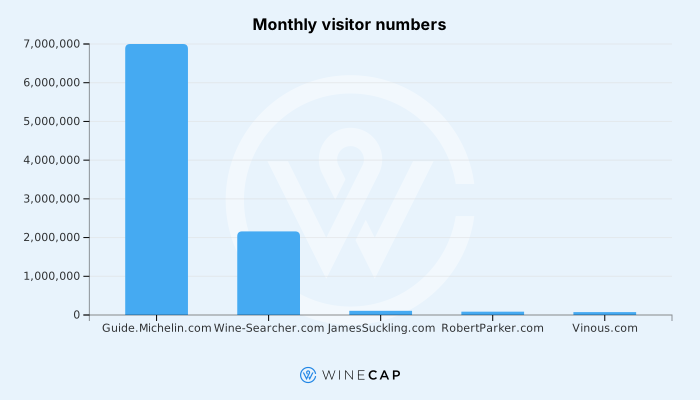
The scale of Michelin’s platform is what sets this apart from any previous shift in wine criticism. Michelin’s guide draws nearly 7 million monthly visitors, versus around 100,000 each for James Suckling, Robert Parker, Vinous. This means Michelin’s reach is more than 20 times larger than that of the three largest wine review platforms and three times larger than Wine-Searchers’ reach (full analysis).
In Burgundy, Domaine Leroy, Domaine de la Romanee-Conti and Domaine d’Auvenay, three of the most sought after producers in the region, took the top three-bunch tier. The most striking divergence from market pricing was Armand Rousseau, rated just one bunch despite bottles commanding up to £8,000.
In Bordeaux, Lafite Rothschild, d’Yquem, Cheval Blanc, Lafleur, Petrus, Montrose and Leoville Las Cases took the top tier, with three First Growths (the top tier of Bordeaux’s historic classification), Mouton Rothschild, Margaux and Haut-Brion placed a tier lower. Chateau Latour was omitted entirely, with a Michelin spokesperson later telling Decanter magazine: “For a small number of estates, including Chateau Latour, our evaluation process had not been fully completed by the time this inaugural selection was finalised, and our inspectors had therefore not yet reached a collegiate conclusion.”
Our analysis found no evidence yet that Michelin’s ratings have moved the market: Burgundy prices actually fell in July, immediately after Michelin’s rankings were published, before recovering in August. Due to the long-term nature of fine wine investment, it remains too early to draw conclusions from the Bordeaux selection, published on the 7th of September.
Given the unprecedented size of Michelin’s audience, we believe the wines worth watching closest for impact are those it left out entirely, such as Latour, and those ranked substantially lower than their market standing might suggest, such as Armand Rousseau.
The Autumn release campaign
Some of the highest profile releases of the Autumn campaign included:
- Opus One 2023: released at £2,815 per 12x75cl, competitive against older back vintages including 2013 (£3,320), 2016 (£3,090) and 2014 (£3,100)
- Masseto 2023: released at £5,760 per 12x75cl, a number of recent vintages with similar or superior scores were available for better prices
- Penfolds Grange 2022: released at £3,900 per 12x75cl, among the more affordable vintages were 2013 and 2008, both with 100 points from Robert Parker
- Sena 2024: one of Chile’s few investable wines released at £960 per 12x75cl to become the most costly vintage on the market
The autumn release campaign largely of New World and non-Bordeaux estates proved broadly disappointing on price and found little interest. With the exception of Opus One, most releases arrived priced above their own available back vintages, in some cases by wide margins. This repeats the pattern our Q2 report identified during the Bordeaux 2025 En Primeur campaign (En Primeur is the system of buying newly released Bordeaux wine before it’s bottled). Buyers are consistently rejecting new releases priced above proven, comparable vintages.
Opus One’s 2023 stood out as the campaign’s one clearly attractive release. At £2,815 per case of 12, it was priced below nearly every back vintage on record including the 2013 (£3,320), 2016 (£3,090) and 2014 (£3,100), while carrying critic scores from Wine Advocate and Vinous (98 points) that matched the best of those back vintages.
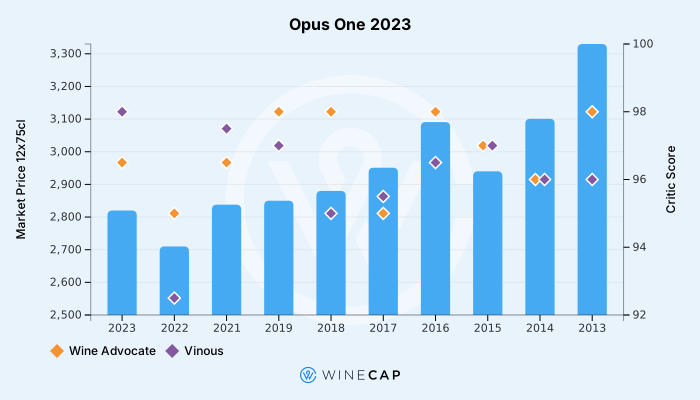
This quarter’s campaign reinforces the theme running through 2026: buyers are pricing new releases against the available back catalogue, not against critic scores or brand prestige alone, and estates that ignore that discipline are meeting resistance. Opus One’s pricing suggests the lesson from Bordeaux’s 2025 En Primeur – that value relative to back vintages, not vintage reputation, wins demand – is starting to inform how at least some global wines producers approach release pricing, even if most have yet to adjust.
The best-performing wines of Q3 2026
The message for the first half of 2026 was clearly about the market finding value in back vintages of Bordeaux. Q3 2026’s top performers show far more regional breadth, but still retain their focus on older vintages.
Bordeaux supplied 90% of Q2’s top 10 performing wines, and 80% of Q1’s. In Q3, Bordeaux’s share of the top 10 fell to just 20%, with Chateau d’Yquem 2018 and Chateau Haut-Bailly 2015 the only representatives. In their place, the list split evenly across five regions: two wines each from Bordeaux, Burgundy, Champagne, the Rhone and Italy, a spread not seen at any point earlier in the year.
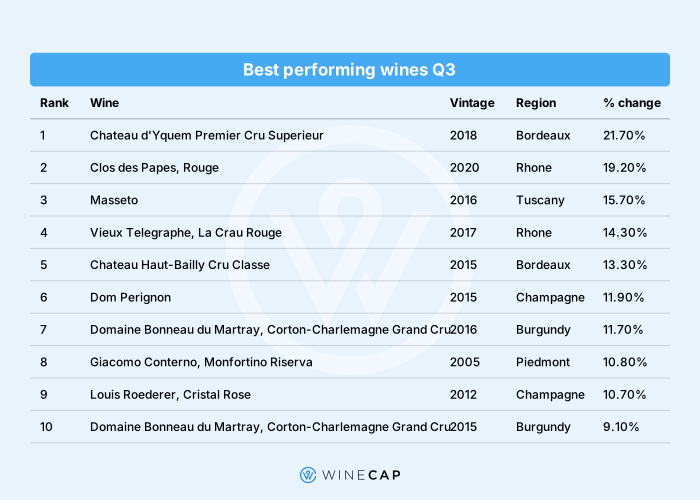
Widening the lens to the 25 best-performing wines of the quarter reinforces the same story, albeit with a little more concentration in the most prominent regions. Fourteen of the 25, came from Bordeaux, Burgundy, and Champagne, the classic French regions that have anchored the secondary market’s recovery through 2026.
The age profile of these wines is equally instructive, and points firmly toward established, back-catalogue vintages rather than recent releases. Nine of the top 10 date from 2018 or earlier, with one notable exception: Clos des Papes 2020, the quarter’s second single best performer. One other wine, Dom Perignon 2015 requires context its relatively young vintage label belying a release that only reached the market in the summer of 2024.
Across the wider top 25, 2015 and 2016 vintages together account for 40% of the list.
Dom Perignon 2015 is a particularly instructive case for what has happened to the market over the past two years. Released in the summer of 2024, close to what looks in hindsight like the point of peak pessimism, the wine fell by more than 20% in the months that followed. Its Q3 rise of close to 12% now leaves it at a modest 5% to 6% premium to that release price, evidence that buyers are finding value precisely where the preceding falls were steepest.
What do the best-performing wines in Q3 tell investors?
Q3’s best performers show that the market is starting to recognise a broader range of opportunities across the secondary market, and price rises are being felt more widely than in the first half of the year, although this is the early stages of that shift. Growth remains concentrated in the wine world’s largest and most recognised brands, and the broadest recovery so far is still concentrated in Bordeaux, specifically the late 1990s and early 2000s vintages that combine well-recognised, well-established quality with diminishing availability, rapidly approaching drinking windows, and price falls from the downturn. Examples of this dynamic include
- Margaux 1996 has risen by nearly 20% since a low point in trading in November 2025
- Chateau Cheval Blanc 2000 is up around 8% since April 2026
- La Mission Haut-Brion, 2005 is up 18% over a similar window, having troughed in September last year
Unlike Q1 and Q2, however, this quarter also shows significant movement outside Bordeaux. Burgundy’s share of trade on the leading trade platform Liv-ex, which hovered around 20% for most of 2023, 2024 and 2025, is rising back towards 30%. That renewed interest is concentrated less by appellation tier than by producer, as in Bordeaux it is focused on Burgundy’s highest-cost and highest profile names.
Read alongside the wider spread of regions across this quarter’s top performers, we see a market where price rises are starting to be felt more broadly than earlier in 2026, even if that breadth remains, for now, concentrated at the top of the market.
News round-up
A prominent investor’s case for fine wine
In a widely circulated Substack post, investor Michael Burry – best known for his early bet against the 2008 housing market – set out a case for bonded fine wine as a hedge against dollar devaluation and the disruptive risks he associates with advancing AI and quantum computing. Burry frames physical, storable assets such as First Growth Bordeaux and top Italian labels, singling out Sassicaia, as a form of “short position on the US dollar,” arguing that fine wine’s liquidity and analysability make it an overlooked asset class. Nonetheless, his suggested allocation is modest, up to 10% of a portfolio with a five-figure minimum. The endorsement, from a mainstream investor with a large public following, adds a further voice to a quarter already defined by capital looking beyond conventional equities and bonds.
Europe’s earliest harvest on record
Harvest began exceptionally early across Europe this quarter, with Champagne recording its earliest start on record and Bordeaux, Burgundy and Italy all picking one to two weeks ahead of historical norms, the result of successive heatwaves through the growing season (see our full harvest report). Separately, regulators raised the permitted ceiling on Champagne’s alcohol content in response to riper grapes from the early harvest although realistic alcohol levels for the 2026 vintage are not expected to be dramatically higher than historical precedent.
Outlook for Q4 2026
Q4 opens against a heavier political calendar, with US midterm elections in November likely to shape geopolitical and macroeconomic conditions over the following two years. Outside of these macro crosscurrents, we expect the stability now established in the fine wine market to continue, with buyers keeping their focus on established vintages that still offer value relative to the newest releases, rather than shifting back toward chasing recent vintages or reputation alone.
The quarter’s standout event will likely be Sotheby’s dedicated Chateau Haut-Brion sale in Paris on 1 October, marking the Dillon family’s 90th year of stewardship of the estate. The 676-lot sale spans vintages from 1935 to 2025 with, in Sotheby’s words, unimpeachable chateau provenance throughout. The historic 1961 vintage is represented, while the 100 point 1989 vintage is headlined by 12-bottle cases, and unusually large formats which generally carry a price premium and are likely to be some of the sale’s standout lots. Six bespoke tasting and hospitality experiences created for the anniversary round out the sale. We expect it to set new benchmark prices for the estate and to be one of the defining wine-market stories of Q4.
2026 has been the year fine wine stopped falling. After difficult years following the market’s 2022 peak, prices found a floor showing a relative stability that had been largely absent in previous years. Where growth appeared, it was concentrated rather than broad based: Champagne continued to lead and demand elsewhere favoured established high profile back-vintage wines from Burgundy and Bordeaux over newer releases, a pattern that ran through both the Q2 En Primeur campaign and this quarter’s autumn releases.
That trend has hardened into a firmer signal as the year has progressed, at the end of Q3 the case for a market still in decline is no longer credible.
Heading into Q4 and on into 2027, our outlook is the most positive it has been since the end of 2023.
FAQs:
What does Michelin’s move into wine criticism mean for fine wine investors?
Our analysis found no evidence that Michelin’s ratings have moved prices so far, with Burgundy actually dipping before recovering after its rankings were published. Given the unprecedented size of Michelin’s audience, the wines worth watching are those it rated well below market expectations, such as Armand Rousseau.
What should investors watch for heading into Q4?
The US midterm elections in November for their macro and geopolitical impact, and Sotheby’s Chateau Haut-Brion sale on 1 October, which we expect to set benchmark prices for the estate.
Did the Autumn release campaign offer good buying opportunities?
Mostly not. Most releases arrived priced above their own back vintages and met buyer resistance.
WineCap’s independent market analysis showcases the value of portfolio diversification and the stability offered by investing in wine. Speak to one of our wine investment experts and start building your portfolio. Schedule your free consultation today.
Capital at risk. Past performance is not a guide to future returns. Returns are not guaranteed.